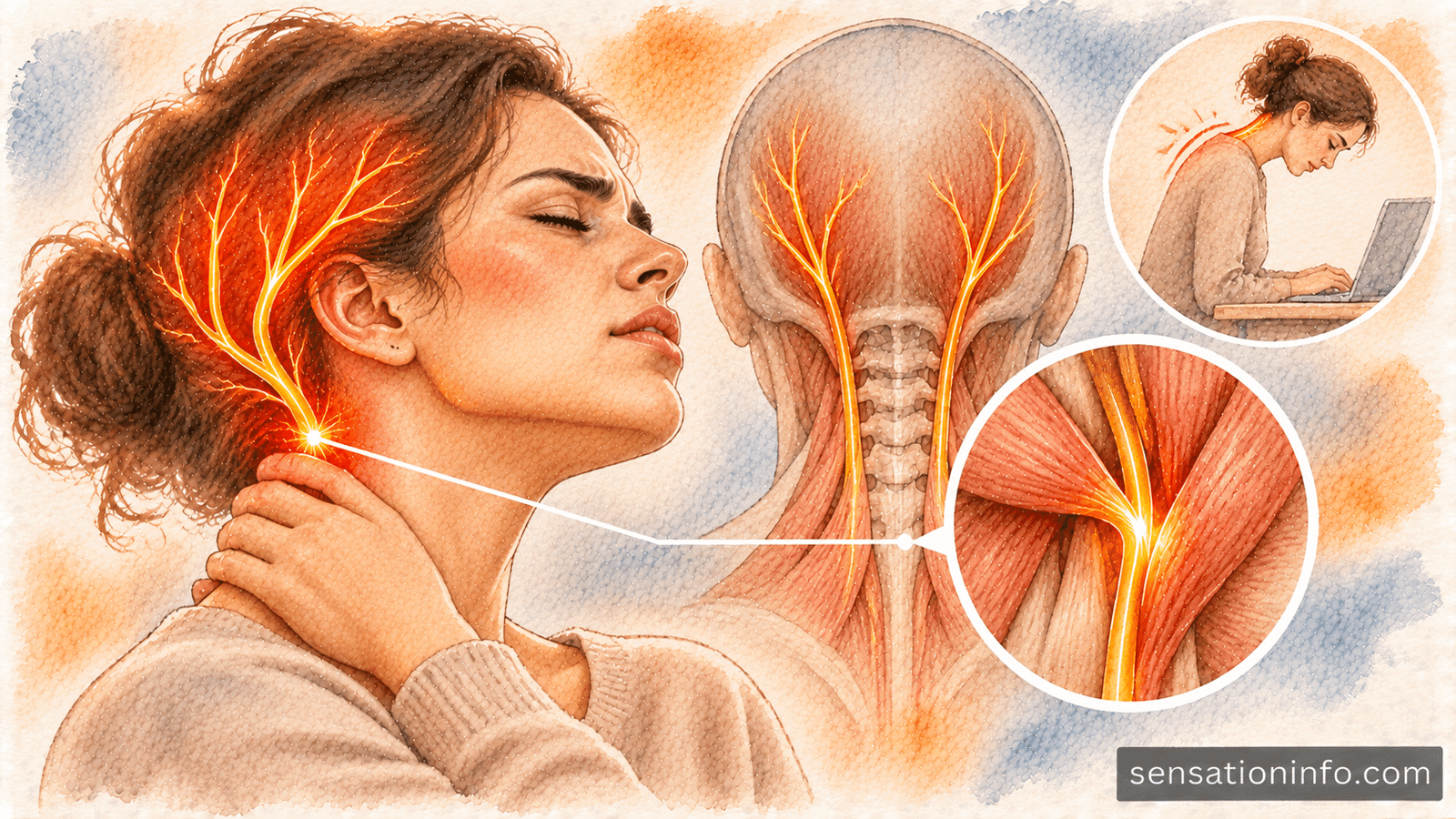

Occipital neuralgia is nerve pain that happens when the occipital nerves, which run from the top of your neck up through the back of your scalp, get squeezed or irritated. Tight neck muscles, a pinched nerve root, or an old injury can press on these nerves, and they answer with sudden electric shocks, stabbing jolts, or burning that shoots from the base of the skull over the head. It often starts on one side and may begin as tingling in the scalp before the shocks appear. It is painful but not dangerous, and most people improve with treatment.
What Is Happening Inside My Neck and Scalp?
Three pairs of sensory nerves carry feeling from the back of your head. When one is pinched, it misfires and sends bursts of pain instead of normal touch signals.
Which nerves are involved?
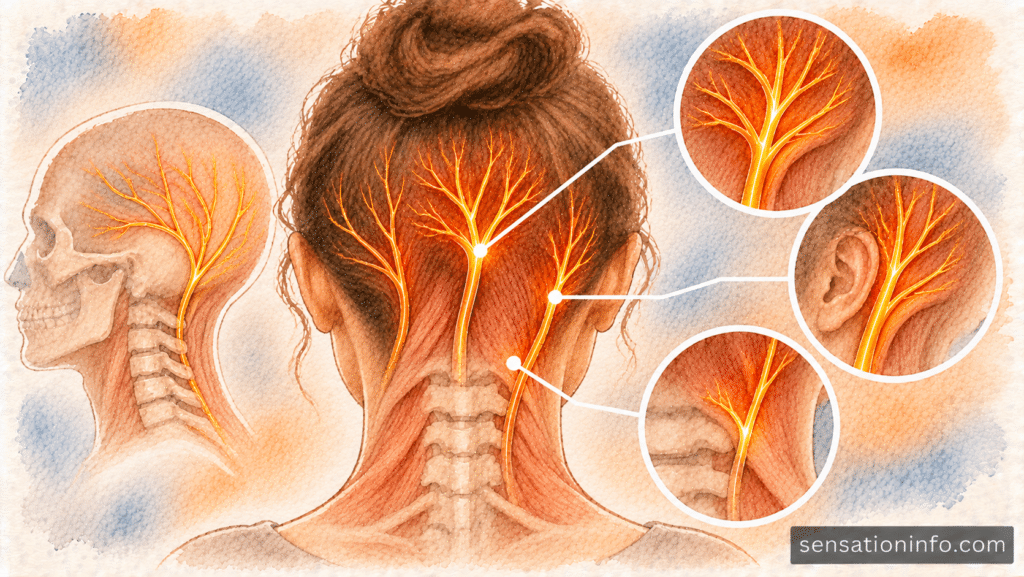
The greater occipital nerve causes about 90% of cases. It leaves the spine near the second neck bone (C2), threads through neck muscles, and fans out over the back and top of the scalp.
The lesser occipital nerve, which covers the area behind the ear, causes about 10%. The third occipital nerve is rarely the culprit.
How can neck tension pinch a nerve?
The greater occipital nerve does not travel in a protected tunnel. It pierces straight through the semispinalis capitis and trapezius muscles, the thick muscles you feel at the back of your neck.
When those muscles stay tight for hours from desk work, phone scrolling, stress, or an awkward sleeping position, they clamp down on the nerve. Patients often tell me the shocks began during a stressful month.
What Does Occipital Neuralgia Feel Like?
The hallmark is a sudden, sharp jolt that lasts seconds to a few minutes, often described as an electric shock, a stab, or a lightning bolt through the scalp. Between attacks, many people feel a dull ache or soreness at the base of the skull.
The scalp often becomes oversensitive. Doctors call this allodynia (pain from a touch that should not hurt), so brushing your hair or resting on a pillow can set off a shock. Pain can also spread behind the eye on the same side. It usually sits on one side, though about one in three people feel it on both.
What usually triggers the shocks?
Triggers are almost always mechanical. They involve pressure on the nerve or movement of the neck.
The list below covers the triggers I hear about most. Spotting yours helps you and your doctor confirm the nerve pattern.
- Turning or tilting the head quickly
- Lying back on a firm pillow or headrest
- Brushing, combing, or tying back hair
- Long periods of looking down at a phone or laptop
- Tight hats, helmets, or headphones
Could It Be a Different Kind of Headache?
Occipital neuralgia is easy to confuse with other headaches. The key difference is brief, shooting, electric pain along a nerve path rather than steady pressure or throbbing.
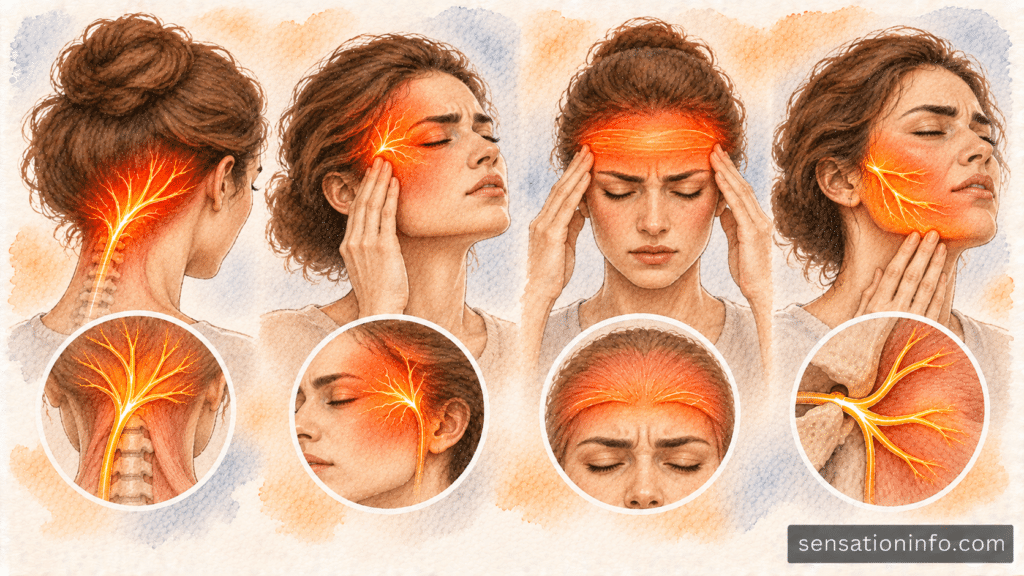
The symptom pattern table below shows how the location and feel of the pain point to different causes. Find the row closest to your experience, then check the urgency column.
| Where it is | What it feels like | What comes with it | Likely cause | How urgent |
| Base of skull up over the back of the head, one side | Electric shocks or stabs lasting seconds | Tender spot at the base of the skull; hair brushing hurts | Greater occipital nerve compression (occipital neuralgia) | See a doctor within a few weeks |
| Whole head, band like | Steady squeezing pressure | Tight shoulders, stress | Tension headache | Routine visit if frequent |
| One side of the head, often temple or eye | Throbbing, builds over hours | Nausea, light and sound sensitivity | Migraine | Routine visit; urgent if new pattern |
| Neck into the back of the head | Deep ache that worsens with neck movement | Stiff neck, reduced range of motion | Cervicogenic headache from neck joints or arthritis | Routine visit |
| Face, cheek, or jaw | Electric shocks set off by touch or wind | Pain with chewing or talking | Trigeminal neuralgia | See a doctor within a few weeks |
| Temple, one side, age over 50 | Constant ache, scalp tender to touch | Jaw pain when chewing, vision changes | Giant cell arteritis (inflamed arteries) | Same day care |
| Back of head, sudden and severe | Worst headache of your life within a minute | Stiff neck, vomiting, confusion | Bleeding in or around the brain | Call 911 |
How is it different from trigeminal neuralgia and Lhermitte’s sign?
All three cause electric shocks, but the location tells them apart. Trigeminal neuralgia shocks the face, cheek, or jaw, while occipital neuralgia stays at the back and top of the head.
Lhermitte’s sign is a shock that runs down the spine or into the arms when you bend your neck forward. That points to the spinal cord, not a scalp nerve, and needs a medical review.
What Causes the Nerve to Get Pinched?
Pinched nerves and tight neck muscles are the most common causes. In many people, no single cause is ever found.
Doctors consider a broad set of causes, from the everyday to the rare. The list below covers the ones I check for, so you can mention anything that applies to you.
- Muscle tension and posture: tight neck muscles squeezing the nerve
- Head or neck injury: whiplash or a fall onto the back of the head
- Upper neck arthritis and disc wear: osteoarthritis or degenerative disc disease near the C2 and C3 nerve roots
- Medical conditions: diabetes, gout, and vasculitis (inflamed blood vessels)
- Previous surgery: scar tissue at the back of the head or upper neck
- Rare structural causes: Chiari malformation (the lower brain sitting too low in the skull opening), blood vessel malformations, or tumors
If you also feel pins and needles in the neck or into one arm, mention it. That pattern can point to a pinched nerve root in the cervical spine rather than the scalp nerve alone.
When Should I Get Help Right Away?
Occipital neuralgia itself is not an emergency, but some headache patterns are.
The thresholds below tell you exactly what to do. If any line matches you, act on it now.
- Sudden, severe headache that peaks within a minute: call 911.
- Head pain with weakness, numbness, slurred speech, double vision, vision loss, or sudden confusion: call 911.
- Head pain with fever and a stiff neck: go to the emergency room.
- New head pain after a fall or blow to the head: go to the emergency room.
- Age over 50 with new temple pain, scalp tenderness, jaw pain when chewing, or blurred vision: get same day care.
- Shocks running down your spine or into your arms when you bend your neck: book a doctor visit within a few days.
- Shocks that keep coming after 2 weeks of home care, or wake you at night: book a doctor visit.
How Will My Doctor Confirm It?
There is no single scan that proves occipital neuralgia. Diagnosis rests on your story, the exam, and how you respond to a numbing injection.
The first thing I ask is to point to where the shock starts. Then I press along the base of the skull; if tapping the nerve sends a zap up the scalp (a Tinel sign), that supports the diagnosis.
The confirming step is an occipital nerve block, a small injection of local anesthetic near the nerve. If your pain clearly eases while the medicine lasts, the nerve is the source. A single block can be falsely positive, so some doctors repeat it. MRI or CT is ordered when there are red flags or the pattern is unusual.
What should I tell my doctor at the first visit?
Keep a simple log of when shocks happen and what set them off. Bring it along with the questions below, which cover what most patients wish they had asked.
- Does my pain follow the greater or lesser occipital nerve?
- Would a nerve block help confirm the diagnosis?
- Could my neck joints or discs be part of this?
- Which treatment should I try first, and how long before I judge it?
If you want to check which nerve best matches your pattern before the visit, our nerve symptom checker walks you through the common nerve maps of the head and neck.
Which Treatments Actually Help?
Treatment moves step by step from gentle to more involved. Mild to moderate pain often settles within one to two weeks; more intense pain can take four to six weeks.
What can I do at home?
Heat on the back of the neck, gentle massage, and rest from the trigger posture are the starting point. A physical therapist can teach chin tucks, upper back strengthening, and stretches that take pressure off the nerve.
Short courses of NSAIDs (nonsteroidal pain relievers) such as ibuprofen (Advil) or naproxen (Aleve) help some people; ask before using them regularly.
What medicines and procedures help?
For nerve pain that keeps coming back, doctors may prescribe gabapentin (Neurontin), pregabalin (Lyrica), nortriptyline (Pamelor), duloxetine (Cymbalta), or a muscle relaxant such as tizanidine (Zanaflex). Each can cause drowsiness or dizziness, so ask how it fits with your other medicines.
Nerve blocks with a numbing medicine and a steroid can bring relief, though the steroid effect often wears off after three to six months. Injections of onabotulinumtoxinA (Botox) are another option.
When is surgery considered?
Surgery is reserved for pain that persists despite medicines, blocks, and therapy. Options include occipital nerve stimulation, where a small implanted device blocks pain signals, and nerve decompression, where a surgeon frees the nerve from the muscle, fascia, or artery pressing on it. Decompression works best in people whose pain responds to a nerve block, and it does not guarantee full relief.
How Can I Live With It Day to Day?
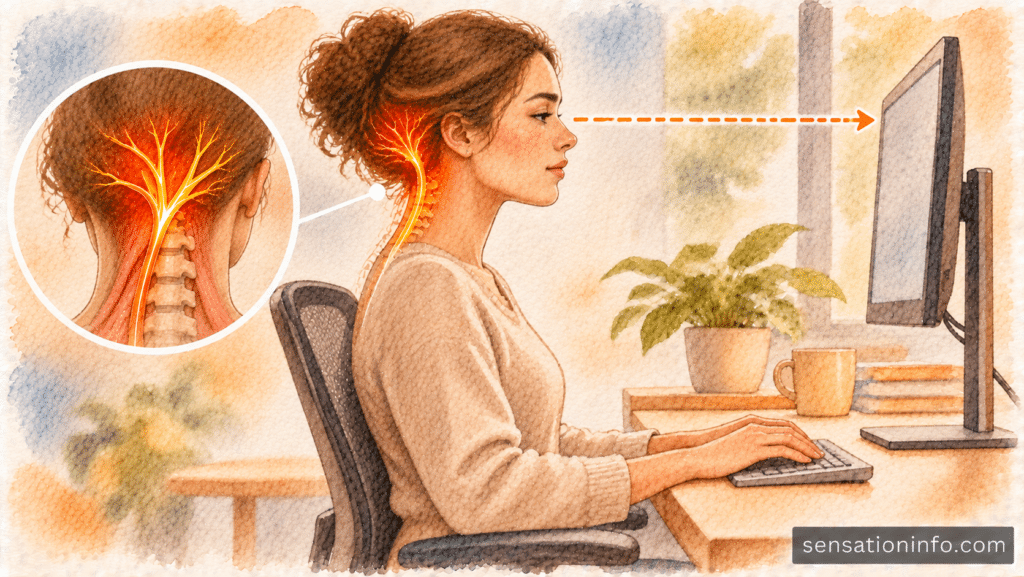
Small changes in posture and habits reduce how often the nerve gets squeezed.
The habits below are the ones I recommend most. Pick the two that match your triggers and start there.
- Raise your screen to eye level so your chin is not dropping for hours.
- Take a short break every 30 to 45 minutes to roll your shoulders and tuck your chin.
- Use a softer pillow that supports the neck without pressing on the base of the skull.
- Loosen tight ponytails, hats, and headphone bands.
- Build in stress relief, since stress tightens the very muscles the nerve passes through.
Fear of the next shock can be as draining as the pain itself. That worry usually eases once the trigger and the plan are clear.
Key Takeaways
These points sum up what matters most. Each one stands on its own as a quick reminder.
- Occipital neuralgia is pain from irritated occipital nerves that run from the upper neck through the scalp.
- The greater occipital nerve causes about 90% of cases, often where it passes through tight neck muscles.
- The pain feels like electric shocks or stabs lasting seconds to minutes, usually on one side of the back of the head.
- A numbing nerve block that eases the pain is the key step in confirming the diagnosis.
- Sudden severe headache, weakness, vision loss, fever with a stiff neck, or confusion needs emergency care.
Frequently Asked Questions
Occipital neuralgia is painful but not life threatening, and most people improve with treatment. Head pain that comes with fever, a stiff neck, weakness, numbness, vision loss, slurred speech, or sudden confusion is not typical of occipital neuralgia and needs emergency care.
Stress can contribute to occipital neuralgia because it tightens the neck muscles that the greater occipital nerve passes through. Tight muscles can squeeze the nerve and trigger the electric shock pain, so stress relief and posture breaks are part of managing the condition.
Each shock of occipital neuralgia usually lasts seconds to a few minutes, though a dull ache can linger between attacks. With treatment, mild to moderate flares often settle within one to two weeks, while more intense flares can take four to six weeks.
Doctor’s Recommendation
If the shocks keep returning after a few weeks of home care, a neurologist or headache specialist is the right next step, and a pain management doctor who treats nerve pain can offer occipital nerve blocks and other procedures when medicines are not enough. Our list of verified pain management doctors for nerve pain helps you find a specialist who performs these treatments and know what to ask at your first visit.
References
- Cleveland Clinic. Occipital Neuralgia. Cleveland Clinic Health Library. 2022.
- National Library of Medicine. Occipital Neuralgia. StatPearls (NCBI Bookshelf). 2023.
- American Association of Neurological Surgeons. Occipital Neuralgia. AANS Patient Information. 2026.
- Mayo Clinic. Nerve decompression surgery for trigger point headaches. Mayo Clinic for Medical Professionals. 2026.