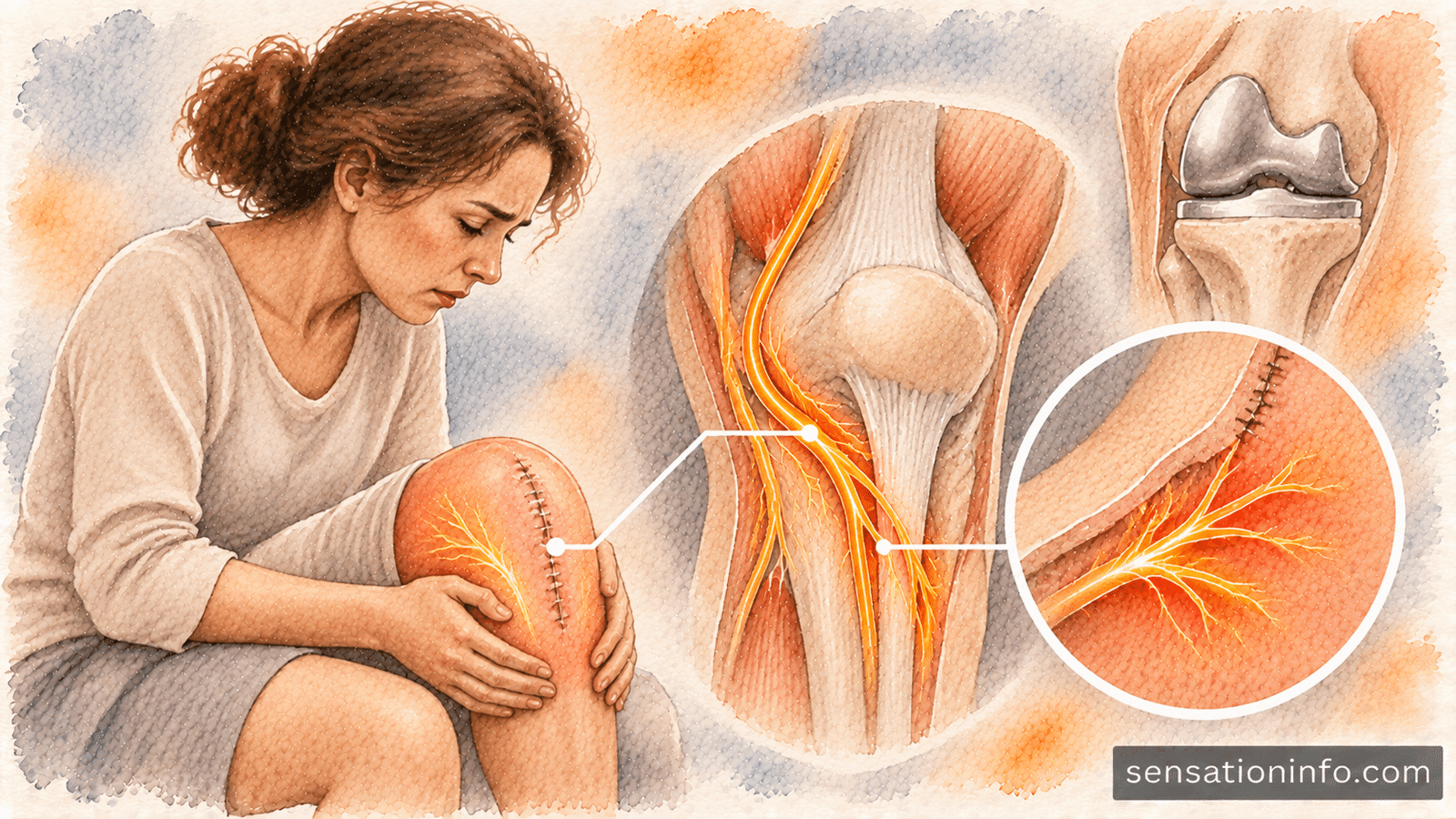

Numbness after knee replacement is very common, and in most people it is harmless. The skin incision almost always cuts small sensory nerves, most often the infrapatellar branch of the saphenous nerve, so a patch of skin on the outer side of the knee loses feeling. It does not damage your new joint. The patch often shrinks over the first year, though a small area may stay numb for good. Like most numbness after surgery, it follows the map of the nerve that was cut.
Why Is the Skin Around My New Knee Numb?
The incision that lets your surgeon reach the joint also cuts tiny skin nerves crossing the front of the knee. They carry feeling, not muscle power, so losing them changes sensation but not movement.
Which nerve gets cut during total knee arthroplasty?
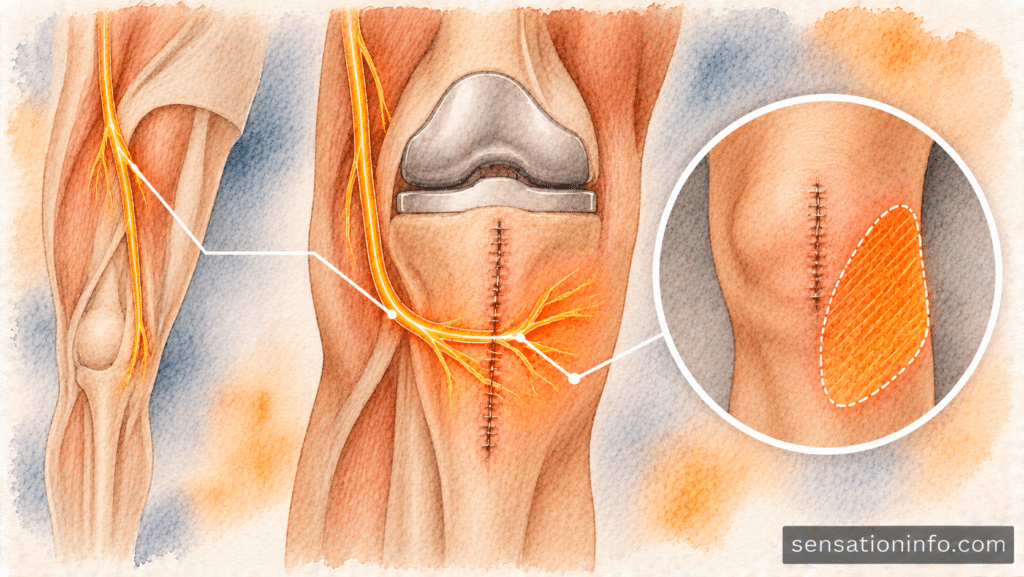
The main one is the infrapatellar branch of the saphenous nerve. The saphenous nerve runs down the inner thigh, and this branch curves across the front of the knee just below the kneecap.
A standard front incision for total knee arthroplasty (the medical name for knee replacement) crosses its path almost every time. Patients often ask me if this was a mistake. It was not; the branch sits right where the joint must be opened.
Why is the numb patch on the outer side when the scar is in the middle?
The branch travels from the inner knee outward, so when it is cut in the middle, all the skin beyond the cut goes quiet. That leaves a numb, slightly rubbery patch on the outer side of the scar and below the kneecap, sometimes larger if smaller nerves above the kneecap are cut too.
What Does It Feel Like, and Why Does It Keep Changing?
Most people describe a dead or “wooden” patch of skin, like touching through a thick glove. Over the following months, many also notice tingling, pins and needles, light burning, or brief electric zaps, which usually mean the nerve is trying to regrow.
Some patients tell me the patch feels numb and oversensitive at the same time. Doctors call that dysesthesia (an unpleasant, abnormal sensation), and it often shows up as bedsheets feeling scratchy over the scar.
Is it a simple numb patch or a painful neuroma?
A neuroma is a small knot of tangled nerve fibers that forms where a cut nerve heals into scar tissue. It is far less common than simple numbness and feels quite different.
The table below shows how I tell the two apart in clinic. Use it to guide what you describe to your surgeon, not to diagnose yourself.
| Feature | Simple numb patch | Painful neuroma |
| Main feeling | Reduced or absent touch | Sharp, burning, or electric pain |
| Location | Outer side of scar, below kneecap | Inner side of the knee near the scar |
| Tapping the spot | Feels dull | Sends a zap along the nerve (Tinel sign) |
| Effect on daily life | Odd but tolerable | Pain with kneeling, stairs, or clothing contact |
Is Numbness After Knee Replacement Normal or a Sign of Something Else?
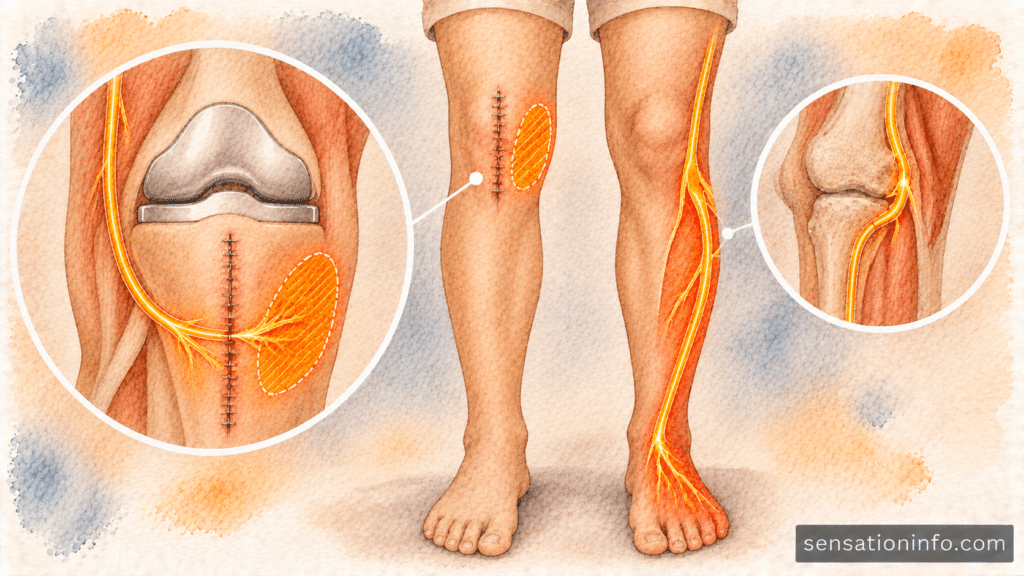
A numb patch beside the incision is expected. Numbness that spreads down the leg, reaches the foot, or comes with weakness, swelling, or fever points to a different cause.
The symptom pattern table below covers what I check at follow up visits. Find the row closest to your symptoms, then read the urgency column.
| Where it is | What it feels like | What comes with it | Likely cause | How urgent |
| Outer side of the scar and below the kneecap | Dull, rubbery, glove like | Nothing else | Cut infrapatellar branch of the saphenous nerve | Expected; mention at next visit |
| Inner knee near the scar | Sharp, burning, zaps when touched | Pain kneeling or on stairs | Infrapatellar saphenous neuroma | Book a visit within a few weeks |
| Whole thigh and inner leg, first day or two | Heavy, numb, hard to lift | Recent anesthesia | Femoral or adductor canal nerve block wearing off | Usually fades within days |
| Top of the foot and outer shin | Numb or tingling | Toes or ankle will not lift (foot drop) | Common peroneal nerve palsy | Call your surgeon the same day |
| Calf, ankle, or foot | Tight, aching, sometimes tingling | Calf swelling, warmth, redness | Deep vein thrombosis (blood clot) | Same day care |
| Around the incision | Spreading numbness or new pain | Fever, drainage, growing redness | Wound or joint infection | Same day care |
| Both feet, or leg and back | Burning, tingling | Back pain or pain down the leg | Diabetic neuropathy or a pinched nerve in the back (sciatica) | Routine visit |
What is usually harmless, and what needs a doctor?
Usually harmless: the numb patch beside the scar, tingling or zaps that come and go, and short lived numbness from a nerve block, a tight dressing, or swelling.
See a doctor: numbness that keeps spreading, numbness in the foot, a burning spot that makes kneeling unbearable, or numbness that starts after the first few days. Broader numbness in the legs from diabetes or the spine can also sit on top of surgical numbness and confuse the picture.
Which other symptoms change the urgency?
Weakness matters most. Numbness and weakness together suggest a nerve that controls muscle, such as the peroneal nerve, has been stretched or pressed. Calf swelling raises concern for a clot, red or draining skin for infection, and bladder or bowel changes for the spine.
When Should I Get Help Right Away?
Most numbness can wait for your next appointment. These specific signs cannot.
The list below gives clear thresholds. If any line matches you, take the action beside it.
- You cannot lift your foot or toes, or your foot slaps when you walk: call your surgeon the same day.
- Your calf is swollen, warm, or tender, or the pain is away from your incision: call your surgeon the same day; a warm sensation in the lower leg with swelling can signal a clot.
- Sudden shortness of breath, chest pain, or chest pain when you cough: call 911.
- Fever above 100°F, shaking chills, drainage from the wound, or spreading redness: call your surgeon the same day.
- Severe pain with a tense, swollen leg that keeps worsening despite pain medicine: go to the emergency room.
- Numbness that keeps spreading or still grows after 2 weeks: book a visit within the week.
- New bladder or bowel control problems with leg numbness: call 911.
Will the Feeling in My Knee Ever Come Back?
Often it improves, but not always completely. Cut skin nerves regrow slowly and the brain learns to ignore the gap, so the patch usually shrinks and matters less over time.
In my practice, most of the change happens within the first year, and tingling along the edge of the patch is a common sign of regrowth. Numbness still present after a year or two is more likely to stay, though most people stop noticing it.
Foot drop from peroneal nerve palsy is different and rare, affecting roughly 0.12% to 0.53% of knee replacements. Partial palsies usually recover fully, while complete palsies recover more slowly and less often.
What Should I Tell My Surgeon at the Follow Up Visit?
Bring a specific description, because “my knee feels weird” is hard to act on. The first thing I ask is exactly where the numbness is, so trace the numb area with a washable marker and photograph it every few weeks.
Your surgeon may tap along the nerve, test light touch and pinprick, and check foot and ankle strength. If weakness or foot symptoms are present, expect an ultrasound, a nerve conduction study, or an EMG (a test of the electrical signals in nerves and muscles).
The questions below are worth writing down before your visit. They cover what most patients wish they had asked.
- Is this numb area what you expected from my incision?
- Does my exam suggest any nerve besides the skin nerve is involved?
- Could a neuroma explain my burning or zapping pain?
- Which nerve pain medicines are safe with my other prescriptions?
If you want help working out which nerve might match your pattern before the visit, our nerve symptom checker walks you through the common nerve maps of the leg.
How Is Numbness or Nerve Pain After Knee Replacement Treated?
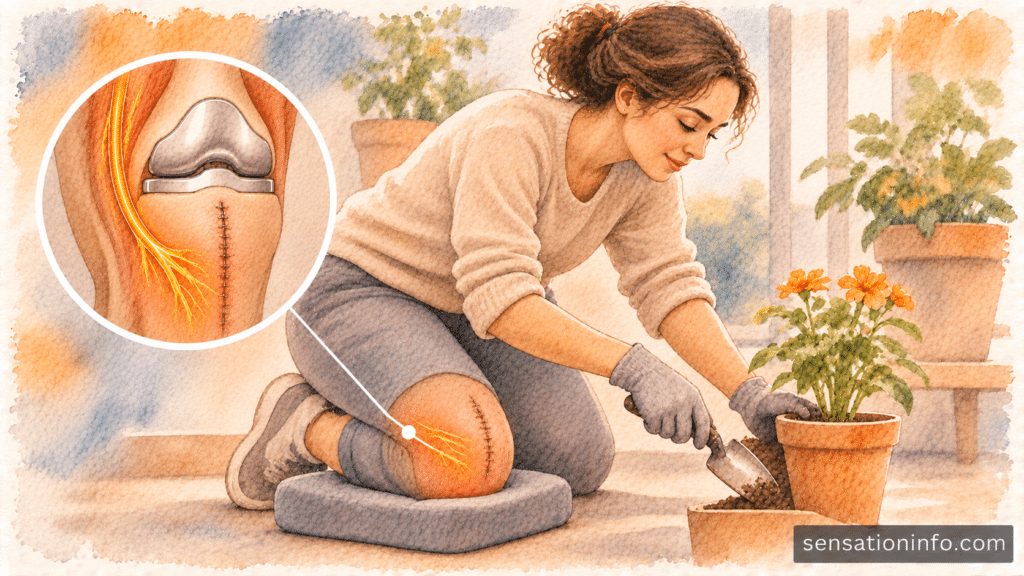
Plain numbness rarely needs more than time and skin protection. Treatment targets the painful problems: burning, zapping, hypersensitivity, or a neuroma.
Desensitization is the first step I recommend. Rubbing the area with soft cloth, then rougher textures, several times a day retrains how the brain reads that skin, and scar massage helps once the wound has fully healed.
For nerve pain, doctors may prescribe gabapentin (Neurontin), pregabalin (Lyrica), or duloxetine (Cymbalta), or suggest a lidocaine patch (Lidoderm). Each can cause drowsiness or dizziness, so ask how it fits with your other medicines.
When a neuroma is suspected, an injection of numbing medicine near the nerve can confirm it: if the pain vanishes, the nerve is the source. Options then include ultrasound guided hydrodissection (freeing the nerve from scar with fluid) with a steroid injection, radiofrequency ablation, peripheral nerve stimulation, or minor surgery. In one small series, this injection approach brought pain near zero in 9 of 16 patients.
Peroneal nerve palsy is managed with an ankle foot orthosis (a brace that holds the foot up), physical therapy, and close follow up.
How Can I Live With a Numb Knee Day to Day?
Numb skin cannot warn you about heat, cold, or pressure, and that fact shapes most of my practical advice.
The habits below protect the skin while it recovers. They are simple, but they prevent the most common setbacks.
- Wrap ice packs in a towel and check the skin often, because a numb area can frostbite without warning.
- Skip heating pads directly on the numb patch.
- Kneel on a padded cushion; it may feel strange but does not harm the implant. Report any burning sensation in the knee when kneeling, since it can point to a trapped nerve branch.
- Shave carefully around the scar, since small cuts may go unnoticed.
- Return to driving only when your surgeon clears you and you are off opioid pain medicine.
Feeling frustrated by skin that suddenly feels foreign is normal. For most people, it fades into background noise with time.
Key Takeaways
These points sum up what matters most. Each one stands on its own as a quick reminder.
- Numbness after knee replacement is common and usually caused by the incision cutting the infrapatellar branch of the saphenous nerve.
- The numb patch typically sits on the outer side of the scar and below the kneecap, and it does not affect how the new joint works.
- Burning pain on the inner knee that zaps when tapped may be a neuroma, which is treatable.
- Foot numbness with weakness lifting the foot needs a same day call to your surgeon.
- Calf swelling, fever, wound drainage, or chest symptoms need urgent care, not watchful waiting.
Frequently Asked Questions
No. The standard knee replacement incision almost always cuts a small skin nerve called the infrapatellar branch of the saphenous nerve, so a numb patch beside the scar is an expected result of the surgery, not a sign of a mistake or a problem with the implant.
Numbness of the thigh and inner leg from a femoral or adductor canal nerve block usually wears off within hours to a few days. Numbness that lasts beyond that, or that sits only beside the scar, has a different cause and should be mentioned to the surgeon.
Numbness in the shin or foot is not explained by the knee incision alone. It can come from a nerve block wearing off, pressure from swelling or a dressing, irritation of the common peroneal nerve, or an existing nerve problem such as diabetic neuropathy. Foot numbness with difficulty lifting the foot needs a same day call to the surgeon.
Doctor’s Recommendation
Your orthopedic surgeon is the right first stop, because they know exactly how your incision was made. If you have burning pain, zaps when the area is tapped, or foot numbness with weakness, ask for a referral to a peripheral nerve specialist, a neurologist for nerve testing, or a pain medicine specialist, and expect a sensory exam, strength testing, and possibly a diagnostic nerve block. To understand how lost sensation is classified and what helps it return, our guide on loss of sensation: causes, types and recovery is a useful next read.
References
- American Academy of Orthopaedic Surgeons. Total Knee Replacement. OrthoInfo. 2026.
- American Academy of Orthopaedic Surgeons. Activities After Total Knee Replacement. OrthoInfo. 2026.
- Mayo Clinic. Saphenous nerve neuroma after total knee arthroplasty. Mayo Clinic for Medical Professionals. 2020.
- National Library of Medicine. Infrapatellar Saphenous Neuralgia After TKA Can Be Improved With Ultrasound-guided Local Treatments. Clinical Orthopaedics and Related Research (PubMed Central). 2015.