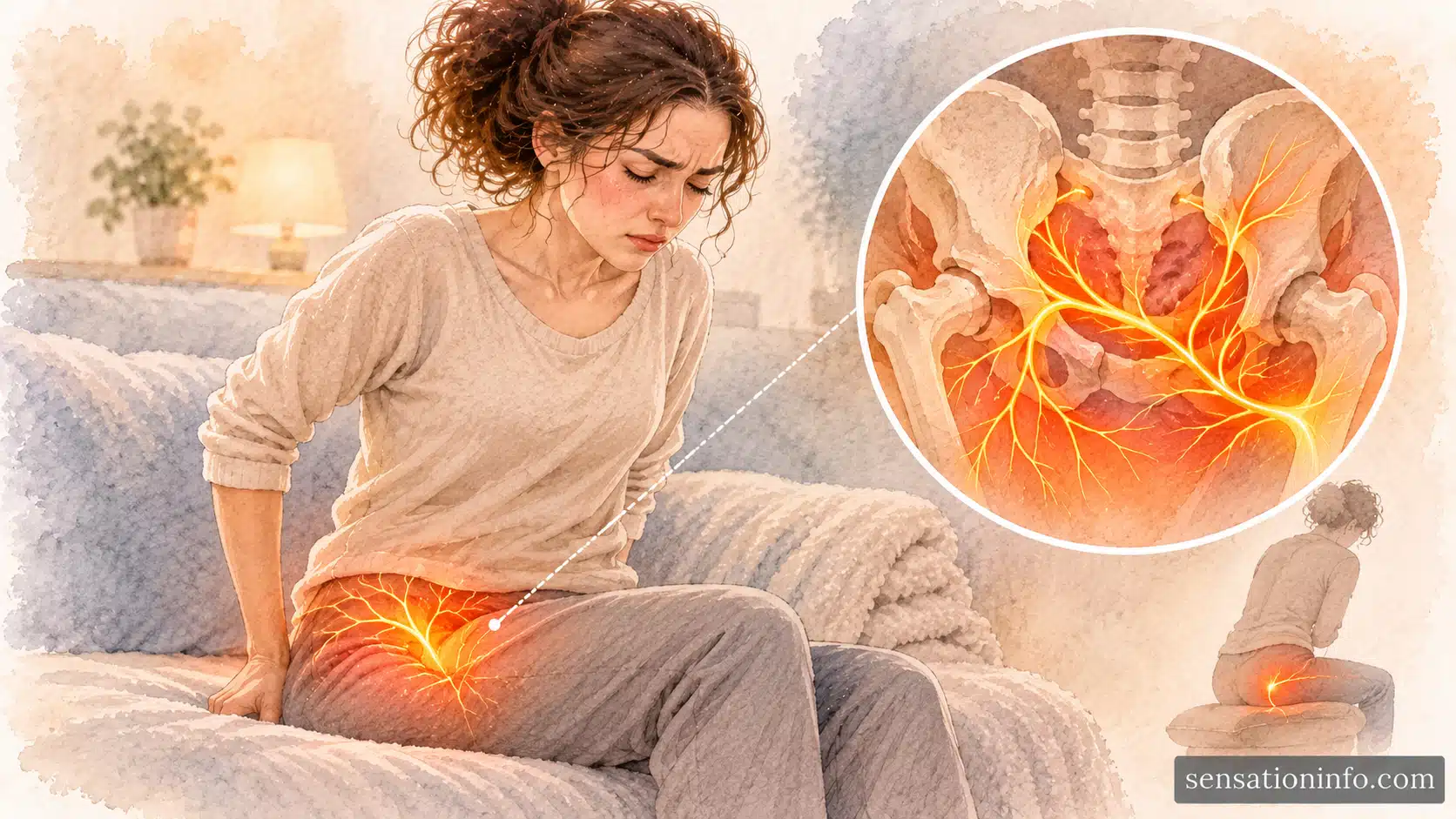

Pudendal neuralgia is long lasting nerve pain from an irritated or trapped pudendal nerve, the nerve that carries feeling from your genitals, perineum and anus. The hallmark is a burning, stabbing or aching pain between your sit bones that gets worse when you sit and eases when you stand or lie down. Long hours of sitting, cycling and the pressure behind numbness from cycling are common triggers, along with childbirth, pelvic surgery and chronic constipation.
When the nerve is squeezed, doctors also call it pudendal nerve entrapment. It is treatable but often missed for months or years, so if your pain matches this pattern, you are not imagining it.
Why Does It Hurt So Much to Sit Down?
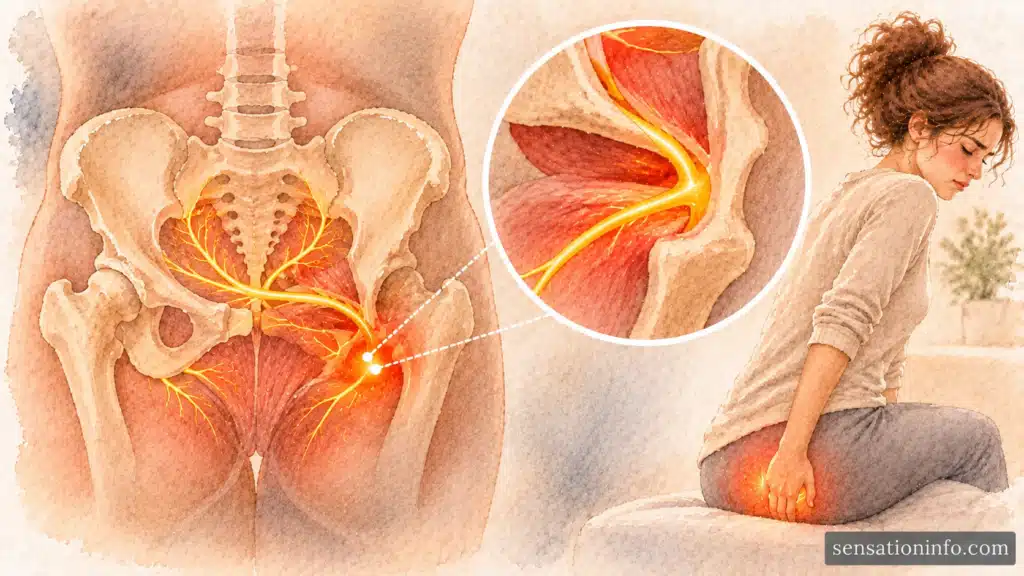
It hurts to sit because sitting presses directly on the path of the pudendal nerve. When the nerve is already irritated, that pressure makes it fire pain signals.
The pudendal nerve starts near the base of your spine. From there it runs deep in the pelvis, past the bony points you sit on, through a narrow tunnel called the Alcock canal. Along the way it can get squeezed between two tough pelvic ligaments.
So when you sit, your body weight lands right on that route. Standing takes the pressure off, which is why many patients tell me they eat dinner standing up or work at the kitchen counter.
What Does Pudendal Nerve Pain Feel Like?
Most patients describe burning pelvic pain, often deep, stabbing or shooting, in the area a bike saddle would touch. The pain can sit on one side or both, and it often builds through the day the longer you sit.
Patients describe it in remarkably similar words. Naming these sensations helps your doctor recognize the pattern:
- Burning or a raw, “sunburned” feeling in the genitals or perineum.
- Stabbing or electric shocks that shoot toward the rectum, vagina, penis or scrotum.
- A deep ache between the sit bones, worse by evening.
- A feeling that something is stuck in the rectum or vagina, called a foreign body sensation.
- Numbness or pins and needles in the same area.
Many people also notice changes in daily function. Urinary urgency and frequency, constipation, pain with sex and painful ejaculation in men can all come from the same nerve.
What Causes This Nerve Pain?
Pressure, stretching or injury to the pudendal nerve causes most cases. Compression is the most common mechanism, and it usually builds slowly from repeated strain.
These are the causes I look for when I take a history. Knowing your likely trigger shapes both treatment and what you need to avoid:
| Cause | How it affects the nerve |
|---|---|
| Prolonged sitting | Steady pressure on the nerve, common in desk jobs and long drives |
| Cycling and horseback riding | Saddle pressure on the perineum over many hours |
| Heavy squatting exercises | Repeated strain on the pelvic floor |
| Chronic constipation | Straining stretches the nerve over time |
| Vaginal childbirth | Stretching of the nerve during delivery |
| Pelvic surgery | Prolapse repair with mesh, sling procedures and hysterectomy can irritate the nerve |
| Falls or trauma to the buttocks | Direct injury to the nerve or nearby ligaments |
| Nerve diseases | Shingles, diabetes, multiple sclerosis, HIV and pelvic radiation therapy |
Women are affected more than twice as often as men, but men get it too.
Why Did It Take So Long to Get Diagnosed?
It often takes a long time because the pain overlaps with many common pelvic problems. Patients are frequently treated first for infections, prostatitis, hemorrhoids or bladder pain that is not there.
Patients often tell me they saw several doctors, had normal scans and were told it was stress. That experience is exhausting, and it can make you doubt yourself.
The condition is thought to be rare, with one estimate of about 1 in 100,000 people. However, because it is so often missed, the true number may be much higher.
Could It Be Something Else?
Several conditions cause pain in the same area, and some need different care. This table maps the patterns I sort through:
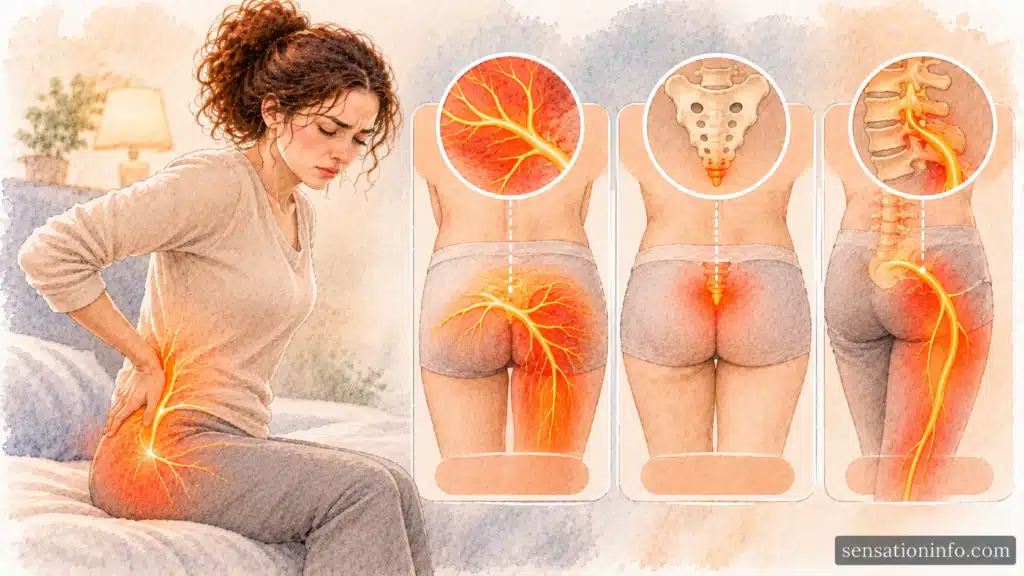
| Where it is | What it feels like | What comes with it | Likely cause | How urgent |
|---|---|---|---|---|
| Genitals, perineum, rectum | Burning, stabbing, worse sitting | Eases standing, rarely wakes you at night | Pudendal neuralgia | See a doctor within weeks |
| Tip of the tailbone | Sharp, aching pain when sitting or rising | Pain after a fall or childbirth | Coccydynia | See a doctor if it lasts weeks |
| Vulva | Burning, rawness, pain with touch | No visible rash or infection | Vulvodynia | See a doctor within weeks |
| Perineum and lower abdomen in men | Aching pressure, pain with urination | Urgency, painful ejaculation | Chronic prostatitis or chronic pelvic pain syndrome | See a doctor within weeks |
| Buttock into back of leg | Shooting pain, tingling down the leg | Back pain, worse bending | Sciatica or piriformis syndrome | See a doctor if it lasts weeks |
| Buttocks, inner thighs, genitals | Numbness that spreads | New bladder or bowel problems, leg weakness | Cauda equina syndrome | Emergency room now |
If the pain centers on the tailbone itself, tingling in the tailbone area and coccydynia follow a different pattern. Likewise, a burning sensation in the vulva can come from skin, infection or vulvodynia rather than the pudendal nerve.
When Should I See a Doctor or Get Help Right Away?
Most pelvic aches after a long drive or ride settle quickly, but pain that keeps returning deserves a proper workup. This comparison shows where your symptoms sit:
| Usually harmless | Book a doctor visit |
|---|---|
| A brief ache after a long drive or ride that settles within a day | Burning pain between the sit bones lasting more than 2 weeks |
| Soreness that eases fully once you stop sitting | Pain with new urinary urgency, constipation or pain with sex |
| Mild discomfort that a cushion fixes | Pain that stops you sitting through work or meals |
This nerve pain is not dangerous to your life. However, a few signs point to something more urgent, so act on these the same day:
- Numbness across the buttocks, inner thighs and genitals with new trouble urinating or loss of bowel control: go to the emergency room immediately.
- Sudden leg weakness or foot drop with pelvic pain: get same day care.
- Pelvic pain with fever, chills or pus: get same day care for possible infection.
- Thoughts of harming yourself because the pain feels unbearable: call or text 988, the Suicide and Crisis Lifeline.
Sudden loss of feeling across the whole seat area is different from nerve pain. That pattern of numbness in the saddle area can mean pressure on the nerves at the base of the spine, which needs emergency surgery.
What Should I Tell My Doctor?
The single most useful thing you can bring is a clear description of how sitting changes your pain. That one detail often points straight to the nerve.
Before your appointment, a nerve symptom checker can help you sort where the pain is and what makes it better or worse. Then be ready to cover these points:
- Exactly where the pain is, and whether it is on one side or both.
- How it changes when you sit, stand, lie down or sit on a toilet seat.
- Any bladder, bowel or sexual changes.
- Possible triggers such as cycling, childbirth, pelvic surgery, a fall or constipation.
- Treatments you have already tried, and what helped or failed.
Good questions to ask include “Could this be a nerve problem?”, “Can I see a pelvic floor physical therapist?” and “Would a diagnostic nerve block make sense for me?”
What Will the Exam and Tests Involve?
There is no single test that proves it. Instead, doctors combine your story, an exam and tests that rule out other causes.
In my exam, I check sensation and press gently along the nerve’s path, often through the vaginal or rectal wall, to see if it reproduces your pain. An MRI is used mainly to rule out other problems such as a disc, tumor or cyst.
The most useful test is an image guided pudendal nerve block, a numbing injection placed next to the nerve using ultrasound or CT scan guidance. If your pain eases after the injection, that strongly supports the diagnosis. A block that does not help does not fully rule it out.
Many doctors also use a checklist called the Nantes criteria. It looks for pain in the nerve’s territory that worsens with sitting, rarely wakes you at night, shows no true loss of feeling on exam and eases after the block.
How Is Pudendal Neuralgia Treated?
Treatment usually moves in steps, starting with the gentlest options. Most people need a combination rather than a single fix.
What Can I Do at Home?
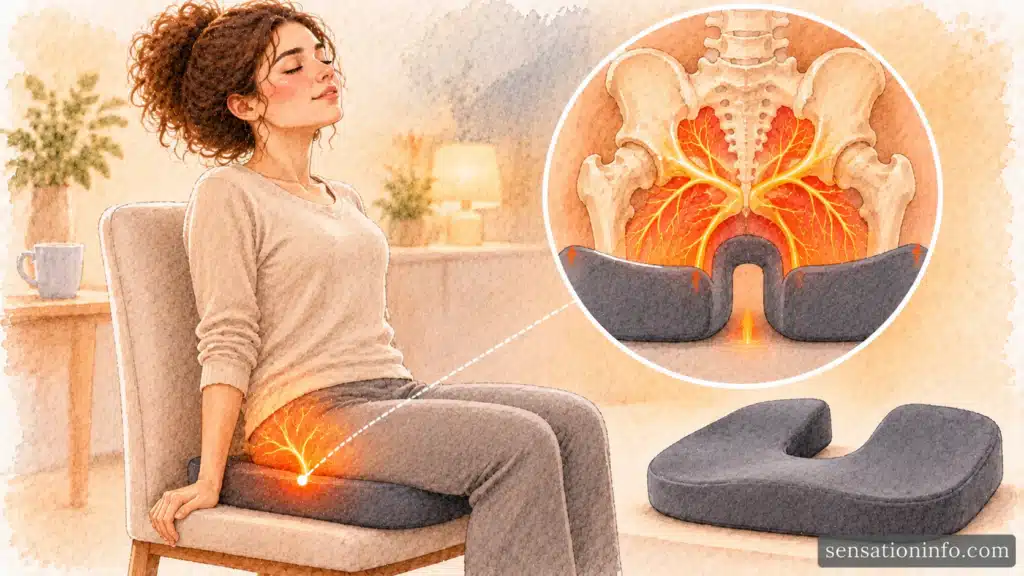
Home changes are the foundation of treatment, and they help every other step work better.
Start by cutting back on whatever squeezes the nerve. These are the changes I suggest first:
- Use a U shaped or cutout cushion that leaves the center of your seat empty.
- Switch to a standing desk, and break up long periods of sitting.
- Pause cycling, squats and horseback riding until the pain settles.
- Treat constipation so you do not strain on the toilet.
- Use warm baths or heat to relax tight pelvic muscles.
What Medical Treatments Help?
After that, pelvic floor physical therapy is usually the next step. A therapist trained in pelvic health works on tight, guarded muscles around the nerve, often using biofeedback, a method that shows your muscle activity on a screen so you learn to relax it. Some therapists add TENS, a small device that sends gentle electrical pulses through the skin.
Meanwhile, medicines that calm nerve pain are often added. These include amitriptyline, duloxetine (Cymbalta), gabapentin (Neurontin) and pregabalin (Lyrica), sometimes in combination. Your doctor will choose the medicine and dose, and side effects such as drowsiness are worth discussing openly.
Nerve block injections help many patients, but the relief often lasts only weeks. When pain persists, options include pulsed radiofrequency, which uses mild energy to calm the nerve, sacral neuromodulation and surgery to free the trapped nerve. Decompression surgery helps roughly 60 to 80 percent of carefully selected patients.
Will This Pain Ever Go Away?
Many people improve substantially with the right combination of care, although recovery is usually gradual. The condition can affect quality of life a great deal, but it does not shorten life expectancy.
I tell patients to measure progress in months, not days. Tracking how long you can sit comfortably each week is often the clearest sign that treatment is working.
Over time, ongoing pain often affects mood, sleep, work and relationships. Depression is common in chronic pain, so treating your mood is part of treating the pain, not a sign that it is “all in your head.”
Key Takeaways
This condition is real, treatable and too often missed. Keep these points in mind as you decide your next step:
- Pudendal neuralgia causes burning or stabbing pain between the sit bones that worsens with sitting and eases when standing or lying down.
- Common triggers include prolonged sitting, cycling, chronic constipation, childbirth and pelvic surgery.
- Diagnosis relies on your symptom pattern, an exam and an image guided nerve block, with MRI to rule out other causes.
- Treatment moves in steps, from cushions and pelvic floor physical therapy to nerve pain medicines, injections and surgery.
- Numbness across the seat area with new bladder or bowel problems is an emergency.
Frequently Asked Questions
A toilet seat supports the body on the outer edges and leaves the center open, so there is little pressure on the pudendal nerve. Many people with pudendal neuralgia notice this relief, and cutout cushions copy the same idea for everyday chairs.
Mild pudendal nerve irritation can settle when the trigger, such as cycling or long sitting, is reduced. Longer standing pudendal neuralgia usually needs active treatment, such as pelvic floor physical therapy, nerve pain medicines or nerve blocks, and improvement tends to come gradually over months.
Yes. The pudendal nerve carries feeling from the genitals, so irritation can cause pain with sex, reduced sensation, painful ejaculation in men and sexual dysfunction. These symptoms are worth raising with a doctor, because treating the nerve can improve them.
Doctor’s Recommendation
A pain medicine specialist or a urogynecologist or urologist with an interest in pelvic pain is the right specialist for suspected pudendal nerve pain, and your primary care doctor can rule out infections and refer you. Expect questions about sitting, a pelvic exam, MRI and possibly a guided nerve block. Look for a board certified pain medicine physician or a multidisciplinary pelvic pain center, and a list of pain management doctors for nerve pain can help you find one.
References
- Cleveland Clinic. Pudendal Neuralgia. Cleveland Clinic. 2022.
- StatPearls Publishing. Pudendal Nerve Entrapment Syndrome. StatPearls. National Center for Biotechnology Information, National Library of Medicine. 2026.
- Cleveland Clinic. Pelvic Floor Dysfunction: What It Is, Symptoms and Treatment. Cleveland Clinic. 2024.
- Cleveland Clinic. Cauda Equina Syndrome. Cleveland Clinic. 2024.