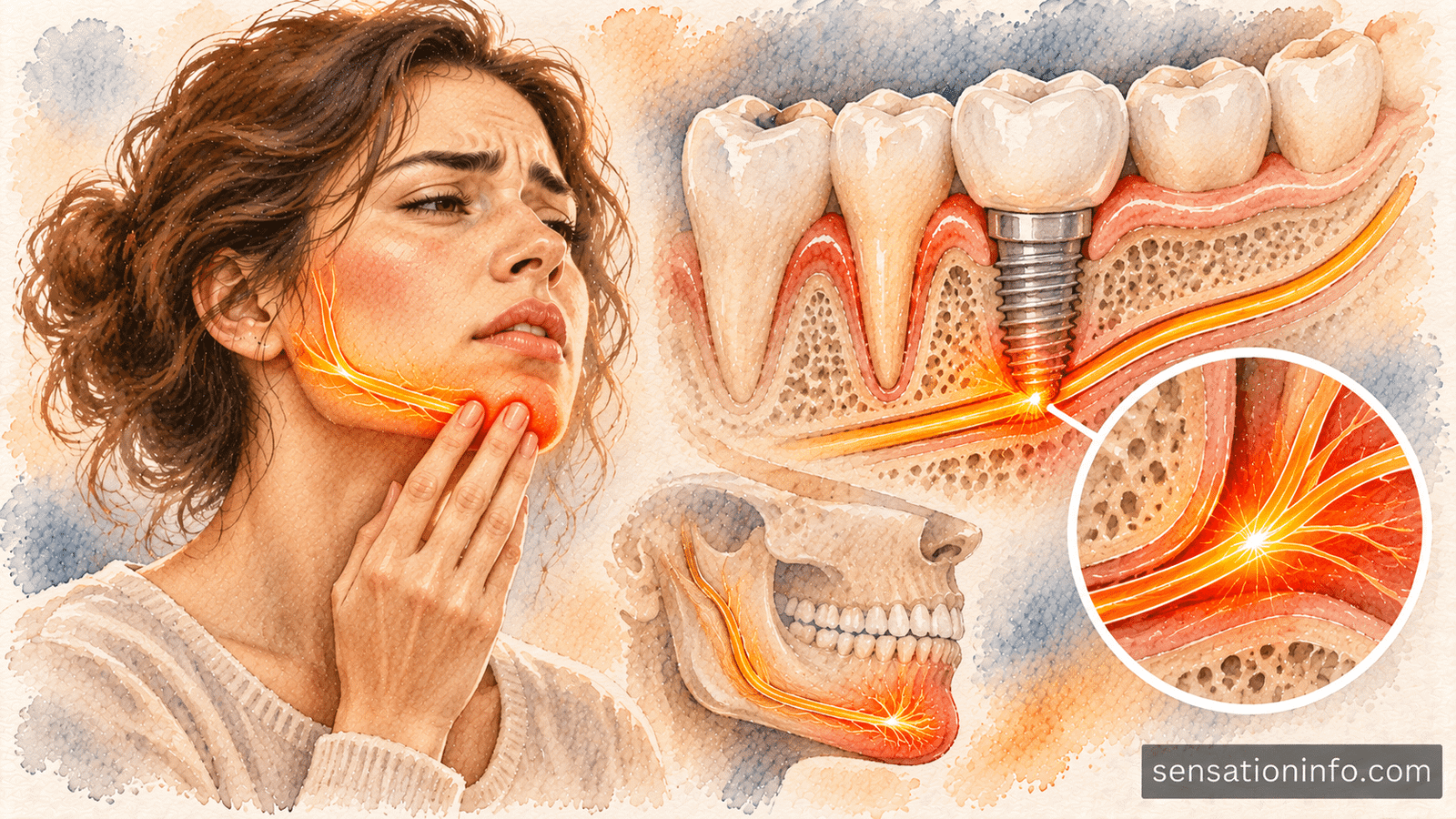

Numb chin syndrome is numbness, tingling or burning in the chin and lower lip on one side, caused by irritation of the nerve that runs through your lower jaw. After a dental implant, it usually means the drill, the implant or the swelling around it has pressed on that nerve. Most of this kind of numbness after surgery eases over weeks to months, but numbness that lasts past the day of surgery needs a call to your implant surgeon within 24 hours.
If your chin went numb with no recent dental work, treat it differently. That pattern needs a full medical checkup, because it can be the first sign of a problem elsewhere in the body.
Why Is My Chin Still Numb After My Implant?
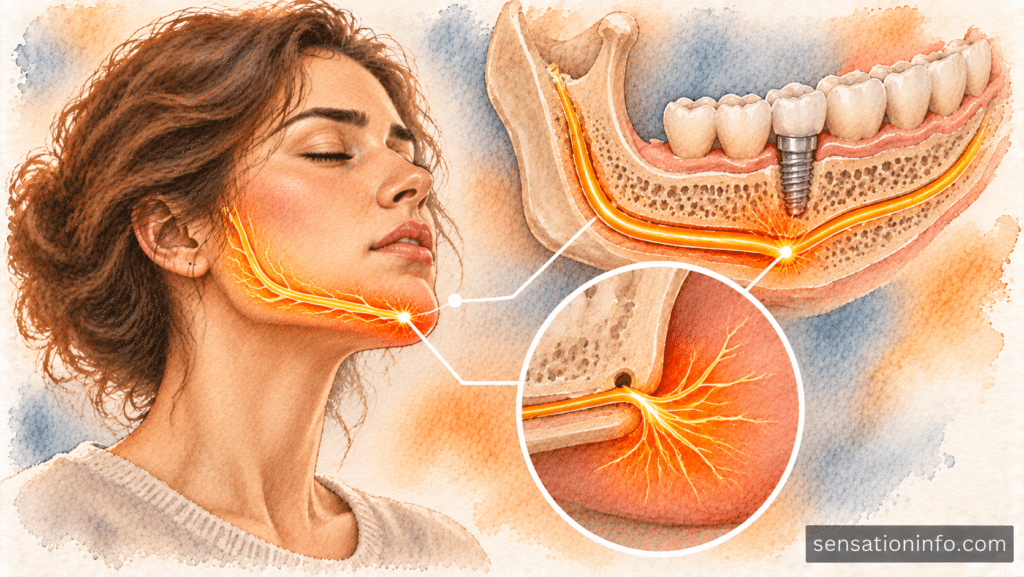
Your chin is still numb because a nerve inside your jawbone has been bruised, squeezed or stretched. The anesthetic wears off within hours, so numbness that lingers into the next day is a nerve signal, not leftover medicine.
A nerve called the inferior alveolar nerve runs through a tunnel in your lower jaw, called the mandibular canal. It carries feeling from your lower teeth. Near your premolars, it exits a small hole in the jaw and becomes the mental nerve, which supplies the skin of your chin, your lower lip and the gums in front.
Both nerves are branches of the trigeminal nerve, the main nerve of feeling in your face. That is why the numbness stops neatly at the middle of your chin and lip. Nerves on the left and right do not cross over.
How Can a Dental Implant Reach the Nerve?
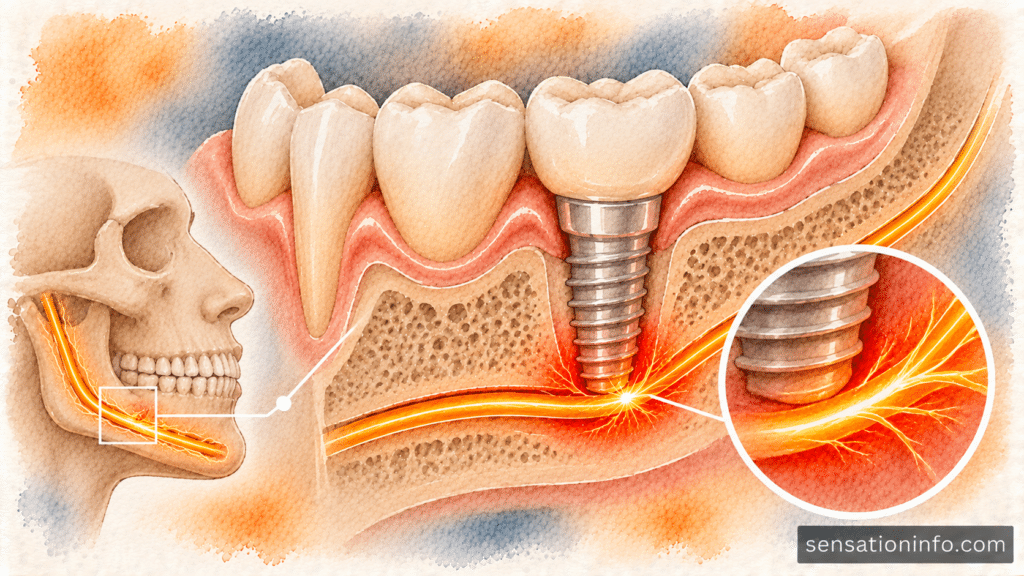
An implant reaches the nerve when it is placed too close to the canal, or when the drilling or swelling presses on it. Most implants never come near the nerve, and the risk sits mainly with implants in the lower back jaw.
Distance matters most. When an implant sits a millimeter or more from the nerve canal, sensation changes are rare. When it sits closer than that or breaks into the canal, they become common.
These are the ways I see the nerve get hurt during implant work. Knowing which one applies to you helps predict how you will recover:
- The drill passes too deep and touches or cuts the nerve.
- The implant itself presses into the canal roof.
- Bleeding or swelling around the site squeezes the nerve for days.
- The numbing injection needle bruises the nerve before surgery starts.
- An implant near the front premolars irritates the mental nerve as it exits the bone.
Less often, a nearby nerve that supplies the tongue is affected. Patients with numbness on the side of the tongue after jaw surgery may notice changes in taste and biting their tongue more.
What Does It Feel Like Day to Day?
Most patients describe it as the dental numbing that never wore off. Some feel nothing at all over the chin, while others feel tingling, crawling or a burning sore lip.
The daily problems are what bother people most. Patients tell me they dribble coffee without noticing, bite their lip while chewing, and feel embarrassed eating in public. Kissing, shaving and putting on lipstick feel strange, and some worry their smile or speech looks different.
Your lip still moves normally, because these nerves carry feeling, not muscle power. If your lip droops or you cannot purse it, tell your surgeon, since that points to swelling or a different nerve.
Is It Numbness, Tingling or Nerve Pain?
The words you use help your surgeon judge how badly the nerve is hurt. This table explains the three main sensations and what each one usually means.
| Sensation | What it feels like | What it usually means |
| Anesthesia (complete numbness) | No feeling at all, like a rubber lip | The nerve signal is blocked; needs prompt review |
| Paresthesia (tingling) | Pins and needles, crawling, buzzing | The nerve is irritated; often a sign of healing |
| Dysesthesia (painful sensation) | Burning, electric shocks, pain from light touch | The nerve is hurt and misfiring; needs active treatment |
Shooting electric pain from a damaged nerve can resemble trigeminal neuralgia, but the cause and treatment differ. Implant pain is usually constant and starts right after surgery, while trigeminal neuralgia comes in brief attacks set off by touch or a breeze.
Is This Normal Healing or Nerve Damage?
Numbness from the anesthetic should fade within a few hours. Any numbness still there the next morning is a sign of nerve irritation, and early action gives the nerve its best chance.
This comparison is what I walk patients through after implant surgery. Use it to judge whether you can wait or should call today.
| Usually harmless | See your surgeon |
| Numb lip that fades within a few hours of surgery | Numbness still present the morning after surgery |
| Mild gum soreness and swelling for a few days | Numbness that spreads or gets worse after day 2 |
| A brief tingle as swelling settles in the first week | Burning or electric pain in the lip or chin |
| Tenderness only at the implant site | Numbness lasting more than 2 weeks with no improvement |
Swelling, fever and pus with numbness raise the urgency. Those signs suggest infection in the bone, which can also press on the nerve.
What If My Chin Went Numb Without Any Dental Work?
Chin numbness with no clear dental cause needs a medical workup, not just a dental one. In this setting, chin numbness can be the first sign of a cancer that has spread to the jaw or skull base.
This table maps the patterns I sort through when someone has a numb chin. Find the row closest to your story, then talk to your doctor about it.
| Where it is | What it feels like | What comes with it | Likely cause | How urgent |
| Chin and lower lip, one side, after an implant | Numbness, tingling | Started right after surgery | Inferior alveolar or mental nerve injury | Call surgeon within 24 hours |
| Chin and lip, near a sore tooth | Numbness with throbbing | Swelling, fever, bad taste | Dental abscess or jaw bone infection (osteomyelitis) | See dentist the same day |
| Chin and lip, no dental cause | Numbness that slowly spreads | Weight loss, night sweats, bone pain | Lymphoma or breast cancer spread to the jaw | See a doctor within days |
| Chin plus other areas | Numbness, tingling | Vision changes, weakness, balance trouble | Multiple sclerosis | See a doctor soon |
| Chin with a known health condition | Numbness | Diabetes, sarcoidosis or sickle cell disease | Nerve involvement from that condition | See a doctor soon |
If the tingling also spreads across your cheek, ear or upper jaw, the cause is less likely to be your implant. Patterns of tingling in the face and jaw beyond the chin often point to a jaw joint, nerve or circulation problem instead.
When Should I Get Help Right Away?
A few signs mean you should not wait for a routine appointment. Act on these the same day:
- Sudden numbness of the face with drooping, slurred speech or arm weakness: call 911, because these are stroke signs.
- Numbness with fever, spreading swelling or trouble swallowing: go to urgent care or the emergency room.
- Complete numbness of the lip and chin the morning after implant surgery: call your surgeon that day.
- New chin numbness with no dental cause and a history of cancer: see your doctor within days.
What Should I Tell My Surgeon or Doctor?
The clearer your description, the faster your surgeon can tell how hurt the nerve is. Bring notes, because these visits often feel rushed.
Before your appointment, a nerve symptom checker can help you sort where the numbness is and what it feels like. Then be ready to cover these points:
- When the numbness started, and whether it was there as soon as the anesthetic wore off.
- Exactly which areas feel different: chin, lip, gums, teeth or tongue.
- Whether it feels numb, tingly, burning or painful, and whether that is changing.
- Any fever, swelling or discharge from the implant site.
- Your health history, including cancer, diabetes or multiple sclerosis.
What Will the Exam and Tests Involve?
In my exam, I map the numb area with light touch, a pinprick and a cold test, then draw its outline on your chin. Repeating this at each visit shows whether the area is shrinking.
Your surgeon will look at a 3D scan called a cone beam CT, which shows exactly how close the implant sits to the nerve canal. If there is no dental cause, I order an MRI of the jaw and skull base and blood tests.
Good questions to ask include “How close is the implant to the nerve?”, “Should it be backed out or removed?” and “When should I see a nerve specialist?”
How Is Numb Chin Syndrome Treated After an Implant?

Treatment depends on whether the implant is still pressing on the nerve. If the scan shows it is, backing it out or removing it early gives the nerve the best chance to recover.
The first few days matter most. Pressure that is relieved quickly is far more likely to heal than pressure left for weeks.
If the implant sits away from the nerve, your surgeon may treat the swelling with medicine and watch the numb area closely. Burning or electric nerve pain can be eased with prescription medicines that calm misfiring nerves, chosen by your doctor.
When numbness or pain does not improve within a few months, ask about a referral to an oral and maxillofacial surgeon who treats nerve injuries. Some cases need microsurgery to repair the nerve, and outcomes are better when it is done earlier.
At home, protect the numb lip from burns and bites. Test hot drinks with your fingers, chew on the other side, and use lip balm with sunscreen.
Will the Feeling in My Chin Come Back?
Many patients regain much or all of their feeling, especially when the nerve was bruised rather than cut. Recovery is slow, because nerves heal over weeks to months, and some patients improve within a week while others take a year.
The return of tingling is often a good sign. It usually means the nerve is waking up, even though it feels odd.
Some patients are left with a small numb patch or ongoing discomfort, most often when the implant entered the nerve canal. Patients tell me the patch matters less over time as they adapt, but nerve pain deserves active treatment rather than waiting.
Key Takeaways
Numb chin after an implant is uncommon, but timing shapes the outcome. Keep these points in mind as you decide your next step:
- Numb chin syndrome is numbness or tingling of the chin and lower lip from irritation of the nerve in the lower jaw.
- Numbness that lasts beyond the day of implant surgery needs a call to your surgeon within 24 hours.
- A cone beam CT shows how close the implant is to the nerve and guides whether it should be moved.
- Many people regain feeling over weeks to months, and tingling is often a sign of healing.
- Chin numbness with no dental cause needs a medical workup, because it can signal a serious illness.
Frequently Asked Questions
Numbness from the dental anesthetic usually fades within a few hours of implant surgery. Numbness that is still present the next day suggests irritation of the nerve in the lower jaw, which can take weeks to months to improve and should be reported to the implant surgeon promptly.
Numb chin syndrome after a dental implant is often temporary, especially when the nerve was bruised or squeezed rather than cut. Some people keep a small numb patch, most often when the implant entered the nerve canal, which is why early review and early removal of a misplaced implant matter.
A dental implant may need to be backed out or removed if a 3D scan shows it pressing on or entering the nerve canal. Relieving that pressure within the first few days gives the nerve the best chance to recover, so the decision should be made with the surgeon quickly.
Doctor’s Recommendation
If the numbness has spread beyond your chin and lip, the next clinical question is which part of the face is affected and whether a different nerve is involved. A guide to numbness in the face explains how doctors sort facial numbness by pattern and when it needs prompt care.
References
- Mayo Clinic. Dental implant surgery. Mayo Clinic. 2024.
- Cleveland Clinic. Trigeminal Nerve: What It Is, Anatomy, Function and Conditions. Cleveland Clinic. 2024.
- Peña-Cardelles JF, et al. Inferior alveolar nerve damage related to dental implant placement: A systematic review and meta-analysis. Medicina Oral, Patología Oral y Cirugía Bucal. PubMed Central, National Library of Medicine. 2025.
- Baskaran RK, et al. Numb Chin Syndrome: A reflection of systemic malignancy. World Journal of Surgical Oncology. PubMed Central, National Library of Medicine. 2006.