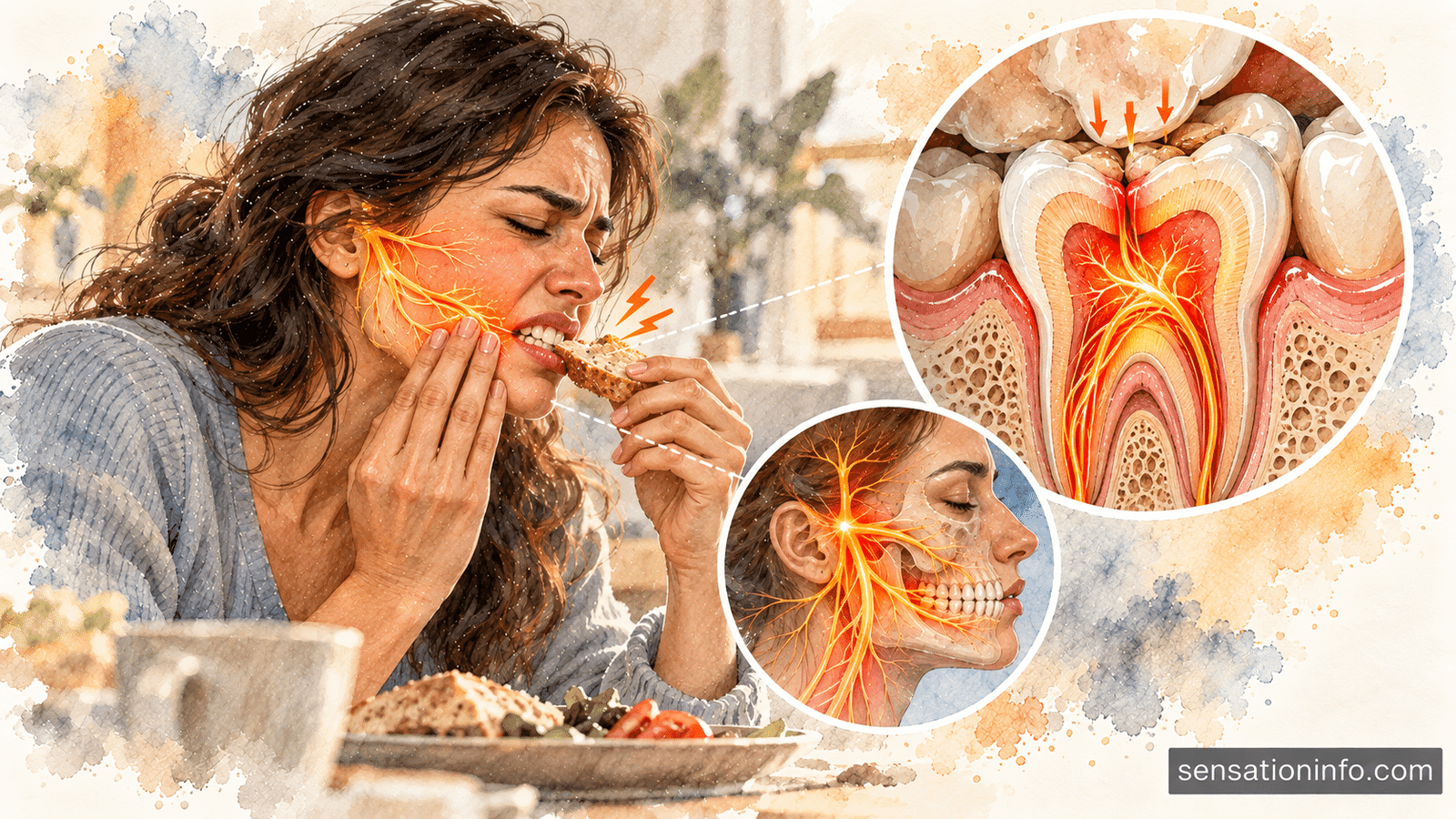

Feeling a sudden electrical shock or tingling in the teeth when biting down happens when mechanical pressure irritates either the internal tooth pulp or the surrounding nerve pathways. This unusual sensation often stems from structural dental issues like a hidden crack, an inflamed root, or a localized infection pressing against the microscopic nerve endings inside your mouth.
In other cases, this prickling feeling actually originates outside the tooth itself. If you are also experiencing uncomfortable pins and needles around your jaw alongside this tooth sensitivity, it frequently points to a broader mechanical problem like temporomandibular joint dysfunction or irritation of the major cranial nerves.
Red Flag Symptoms That Require Immediate Medical or Dental Care
While mild tooth tingling can sometimes relate to temporary enamel sensitivity, certain signs indicate severe spreading infections or acute neurological compromise.
Seek urgent emergency care if you notice any of the following warning signs:
- Rapidly spreading swelling across your cheek, jaw, under your tongue, or down into your neck, which can quickly compromise your airway
- High fever accompanied by chills, confusion, or difficulty swallowing and breathing
- Sudden numbness affecting one entire side of your face, slurred speech, or facial drooping
- Unbearable, throbbing facial pain that spreads into your eye socket or temple and does not respond to standard pain relievers
- Continuous bleeding or visible pus draining from the gum line near the affected tooth
If your tooth tingling is strictly limited to biting down on hard foods without swelling or fever, you should still schedule a comprehensive evaluation with your dentist promptly to prevent tooth fracture or irreversible nerve death.
What Does Tooth Tingling Feel Like?
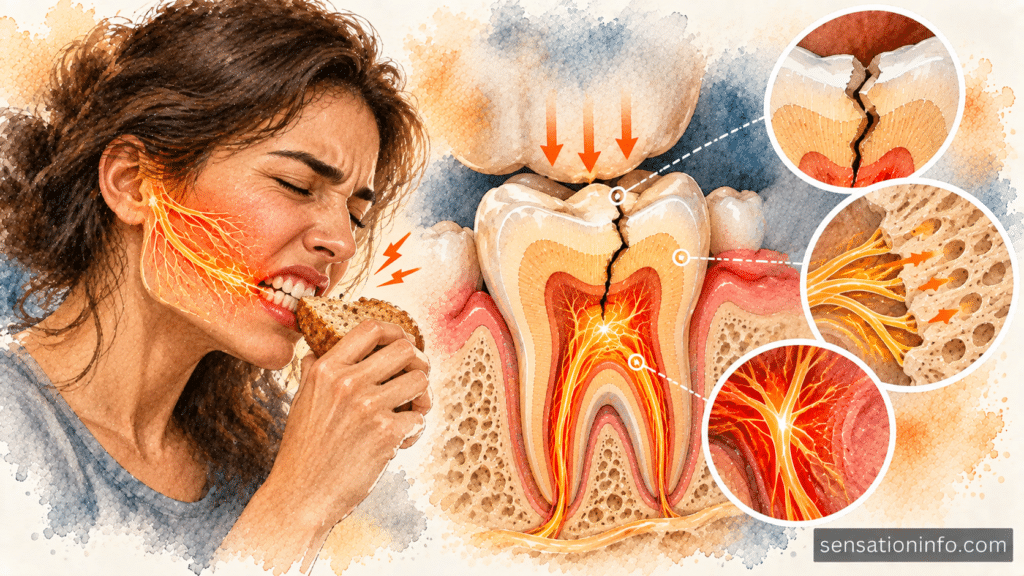
People describe tooth tingling in various ways depending on whether the source is physical tooth damage or neurological irritation.
When the cause is physical damage to the tooth structure, biting pressure typically produces a sharp, brief prickling sensation or a tiny electrical zap that disappears the moment you release your bite. You might also notice a lingering ache after consuming hot coffee or ice water.
When the sensation is nerve-related, the tingling often feels like a constant low-level vibration, buzzing, or pins and needles humming deep inside the jawbone. In severe neurological conditions, the simple act of chewing or lightly touching your cheek can trigger an intense, lightning bolt sensation that radiates across your jaw, teeth, and cheek. If the irritation spreads to neighboring nerve branches, you may also experience pins and needles around the jaw from temporomandibular joint tension or notice strange prickling sensations along your cheekbone.
Common Dental Causes of Tingling When Biting
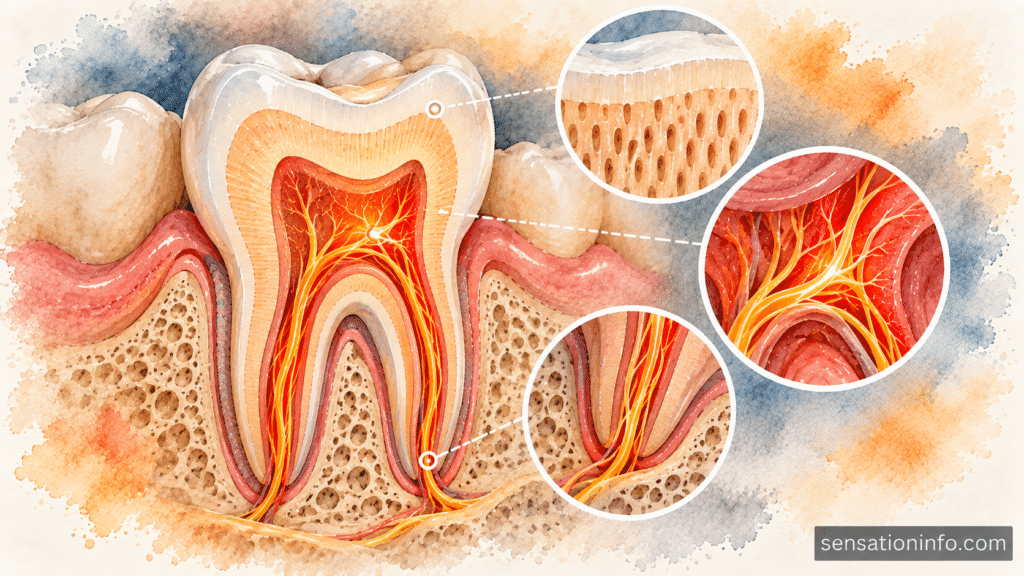
The inner chamber of every healthy tooth contains dental pulp, a soft bundle composed of blood vessels and sensitive sensory nerve fibers. When external barriers like enamel and dentin break down, biting pressure directly agitates these delicate internal nerves.
Cracked Tooth Syndrome
A microscopic fracture in a tooth crown can flex slightly under the force of chewing. This microscopic movement stimulates the fluid within the tiny dentinal tubules, creating a sudden tingling or sharp sting on the release of your bite. According to the American Association of Endodontists, cracked teeth represent one of the leading causes of unexplained dental pain and can be challenging to detect on standard two-dimensional dental x-rays.
Reversible and Irreversible Pulpitis
Pulpitis occurs when bacteria from deep tooth decay or repeated dental procedures cause inflammation inside the pulp chamber. In early or reversible pulpitis, biting down or sipping cold beverages produces a brief prickling sensitivity. If the inflammation advances to irreversible pulpitis, the dental pulp begins to break down, resulting in continuous throbbing, heat sensitivity, and spontaneous tingling sensations.
Periapical Abscess and Periodontal Ligament Inflammation
Each tooth is suspended inside the jawbone by a microscopic shock absorber known as the periodontal ligament. When a bacterial infection escapes the root tip or when intense teeth grinding bruises this ligament, biting down drives the tooth root into the inflamed socket tissue. This mechanical impact triggers localized tingling, throbbing, and severe pressure pain.
Exposed Dentin and Enamel Erosion
Aggressive tooth brushing, acidic food consumption, or receding gums can expose the microscopic pores of your dentin layer. When you bite down on crunchy or acidic foods, the physical contact and fluid movement inside these pores create a brief, tingling nerve response known as dentin hypersensitivity.
Nerve-Related and Facial Causes of Tooth Tingling
When a dentist examines your mouth and finds perfectly intact teeth, healthy gums, and clear x-rays, the underlying cause of your tooth tingling often lies within your cranial nervous system.
Trigeminal Neuralgia
The trigeminal nerve is the primary sensory highway for your entire face, dividing into ophthalmic, maxillary, and mandibular branches that supply sensation to your upper and lower teeth. Trigeminal neuralgia occurs when a normal blood vessel presses against this nerve root near the brainstem, stripping away its protective myelin sheath. This compression causes the nerve to misfire. Chewing, light biting, brushing your teeth, or even a cool breeze can trigger sudden bursts of tingling, burning, or excruciating electric shocks in teeth that are completely cavity-free. When this cranial pathway becomes irritated, you may also notice tingling in the face and jaw from cranial nerve compression that mimics dental disease.
Atypical Odontalgia (Phantom Tooth Pain)
Also known as persistent idiopathic dentoalveolar pain, this neuropathic condition causes a continuous, dull, tingling, or burning ache localized to a tooth site where dental treatments have already been completed. The pain persists despite root canals, crowns, or even complete tooth extraction, because the misfiring sensory nerves reside within the central nervous system rather than the tooth itself.
Temporomandibular Joint (TMJ) Dysfunction
Clenching or grinding your teeth during sleep places immense strain on your temporomandibular joints and chewing muscles. This sustained mechanical load inflames the surrounding nerve networks, producing referred sensations of tingling, tightness, and soreness throughout your rear molars and jaw.
Maxillary Sinusitis
The roots of your upper molars and premolars sit directly beneath the maxillary sinus cavities. When a viral or bacterial sinus infection fills these cavities with fluid and inflammatory pressure, it compresses the superior alveolar nerves supplying your upper teeth. Biting down or walking heavily can cause your upper teeth to tingle and ache simultaneously. In widespread neurological or sinus irritation, patients sometimes notice tingling spreading into the lips and tongue as surrounding oral tissues react.
| Feature | Cracked Tooth Syndrome | Dental Pulpitis | Trigeminal Neuralgia | Maxillary Sinusitis |
|---|---|---|---|---|
| Primary Sensation | Sharp sting on bite release | Lingering throb or cold prickle | Electric shock or buzzing | Dull ache and pressure tingle |
| Trigger Mechanism | Direct biting on specific cusp | Hot, cold, sweet foods | Light touch, chewing, breeze | Biting down, bending head forward |
| Number of Teeth Affected | Exactly one single tooth | One isolated tooth | Entire side of upper or lower jaw | Multiple upper back molars |
| X-Ray Findings | Often normal on standard film | Deep decay or root shadow | Completely normal teeth | Cloudy or fluid-filled sinus |
| Response to Dental Numbing | Pain temporarily disappears | Pain temporarily disappears | Pain may persist or partly fade | Pain persists |
How Healthcare Providers Diagnose the Cause
Pinpointing the exact origin of tooth tingling requires a systematic diagnostic workup, combining specialized dental tests with neurological assessments when necessary.
Your clinician will typically perform:
- Visual examination and magnification: Dentists use surgical loupes, transillumination lights, and special organic dyes to illuminate hidden crack lines across the enamel and restorations.
- Tooth Slooth bite test: You bite down on a specialized plastic instrument placed over individual tooth cusps. Sharp tingling or pain upon releasing your bite strongly points to cracked tooth syndrome.
- Thermal and electric pulp testing: The dentist applies cold stimuli or mild electric currents to verify whether the inner nerve inside your tooth is healthy, inflamed, or dead.
- High-resolution imaging: While standard periapical x-rays reveal bone loss and large cavities, a 3D cone-beam computed tomography scan provides cross-sectional views of root fractures and sinus congestion.
- Diagnostic local anesthetic blocks: Numbing a specific tooth with local anesthetic helps determine the source. If the tingling vanishes completely, the problem resides inside that tooth. If tingling and electric shocks continue, the condition is likely neurological.
- Brain MRI with contrast: If trigeminal neuralgia or central nerve lesions are suspected, a neurologist will order a specialized high-resolution magnetic resonance imaging scan to check for blood vessel compression along the trigeminal nerve root.
If sensory changes extend beyond the mouth, doctors may check for progressive numbness in the face or jaw area to rule out systemic neurological conditions.
Treatment Options for Dental and Nerve-Related Tooth Tingling
Treating tooth tingling requires addressing the precise biological cause rather than simply masking the sensation.
Dental Restorations and Root Canal Therapy
If a tooth crack is superficial, your dentist can place a composite bonding or a full-coverage dental crown to bind the tooth cusps together and stop painful flexure. If bacterial infection has penetrated the pulp chamber, root canal therapy removes the inflamed nerve tissue, cleans the interior canals, and seals the tooth to preserve its chewing function.
Periodontal and Occlusal Adjustments
When teeth grinding or an uneven dental filling causes excessive biting force, your dentist can perform an occlusal adjustment to smooth high contact points. Wearing a custom-fitted nightguard relieves mechanical pressure on the periodontal ligaments and temporomandibular joints.
Neurological Medications
For trigeminal neuralgia or atypical odontalgia, standard dental procedures will not provide relief. Instead, neurologists prescribe nerve-stabilizing anticonvulsant medications such as carbamazepine (Tegretol) or oxcarbazepine (Trileptal) to quiet overactive nerve signaling. Other nerve pain medications such as gabapentin (Neurontin) or pregabalin (Lyrica) are frequently used for chronic neuropathic facial pain.
Surgical and Interventional Procedures
If medication fails to control severe trigeminal nerve compression, neurosurgical procedures such as microvascular decompression can gently reposition the offending blood vessel away from the cranial nerve root, offering long-term pain relief.
Practical Home Care and Temporary Relief
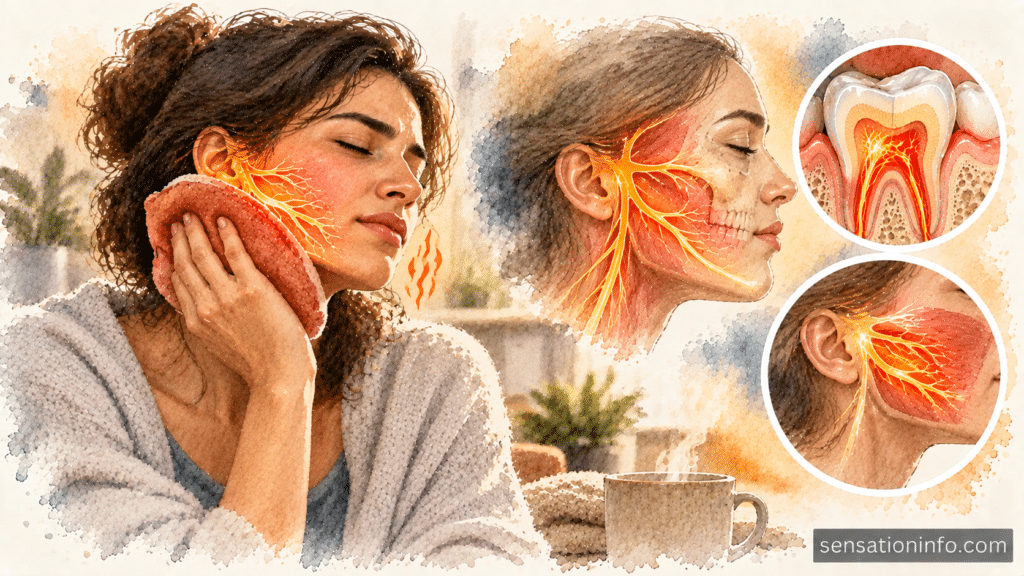
While waiting for your dental or medical appointment, these safe self-care habits can protect your teeth and minimize uncomfortable sensations:
- Chew on the opposite side: Avoid biting hard, crunchy, or sticky foods with the sensitive tooth to prevent propagating an existing fracture.
- Use desensitizing toothpaste: Toothpastes containing potassium nitrate or stannous fluoride help block microscopic dentinal tubules and calm agitated nerve endings over two to three weeks of consistent use.
- Rinse with warm salt water: Swishing with half a teaspoon of salt dissolved in warm water helps soothe inflamed gum tissue around a bruised periodontal ligament.
- Avoid extreme temperatures: Stick to lukewarm meals and room-temperature beverages to avoid provoking sensitive pulp tissue.
- Apply gentle heat or cold to the jaw: If clenching or sinus pressure is the primary trigger, applying a warm compress to your jaw muscles can reduce muscle tension and soothe surrounding nerves.
Common Myths About Tooth Tingling
- Myth: If a tingling tooth stops hurting on its own, the problem is resolved. Fact: When an inflamed tooth nerve suddenly stops sending pain signals, it frequently means the internal nerve tissue has died. Without treatment, the dead tissue can harbor bacteria that lead to a severe jawbone abscess.
- Myth: Tooth tingling is always fixed by getting a filling. Fact: If the tingling originates from a cranial nerve condition like trigeminal neuralgia, placing dental fillings or performing extractions will fail to resolve the pain and can permanently worsen neuropathic nerve firing.
- Myth: All tooth cracks can be seen on standard dental x-rays. Fact: Vertical crack lines run parallel to standard x-ray beams and are frequently invisible on standard dental films, requiring specialized bite testing and transillumination to diagnose.
Prevention Guidelines for Healthy Teeth and Facial Nerves
Protecting your teeth and surrounding nerve pathways involves proactive daily care and protective dental habits:
- Wear a custom sports mouthguard during contact sports and an occlusal nightguard if you clench or grind your teeth while sleeping.
- Avoid chewing on non-food items such as ice cubes, hard candy, popcorn kernels, pens, or opening packaging with your teeth.
- Maintain excellent daily oral hygiene with a soft-bristled toothbrush and fluoride toothpaste to prevent enamel demineralization and root decay.
- Schedule routine dental examinations and professional cleanings twice yearly so minor enamel defects and failing fillings can be restored before cracks reach the pulp.
- Manage chronic sinus allergies and congestion promptly with medical guidance to avoid secondary pressure on upper dental nerve roots.
Recovery Outlook and Long-Term Prognosis
The long-term outlook for tooth tingling depends entirely on early and accurate diagnosis.
When caused by dental factors such as reversible pulpitis, a mild crack, or an elevated filling, appropriate dental intervention typically resolves the tingling within several days to weeks, fully restoring pain-free chewing. If extensive pulp inflammation requires root canal therapy, modern endodontic procedures boast success rates exceeding ninety percent, according to the American Association of Endodontists.
For neurological conditions like trigeminal neuralgia or atypical odontalgia, recovery requires ongoing medical management. With appropriate neurological medication adjustments, physical therapy, and targeted nerve therapies, the majority of patients achieve significant reduction in tingling episodes and substantial improvement in daily comfort.
Key Takeaways
- Tingling in the teeth when biting down can indicate mechanical tooth damage like a crack or pulpitis, or an external neurological issue like trigeminal neuralgia.
- Cracked tooth syndrome typically produces a sharp sting or tingle on the release of your bite, while nerve-related pain often feels like electric buzzing or burning.
- Sudden facial swelling, high fever, or spreading numbness requires immediate emergency medical evaluation to prevent serious complications.
- Performing invasive dental procedures on healthy teeth when the real issue is trigeminal nerve compression will not relieve the pain and can worsen symptoms.
- Accurate diagnosis relies on a combination of visual magnification, tooth bite tests, thermal pulp checks, 3D cone-beam imaging, and diagnostic nerve blocks.
Frequently Asked Questions
A tingling sensation or sharp sting that happens specifically upon releasing your bite is a classic indicator of cracked tooth syndrome, which occurs when microscopic fractures in the tooth flex and agitate the fluid within the internal nerve tubules.
Dentists use diagnostic tools including specialized bite sticks, thermal cold testing, high-resolution cone-beam 3D imaging, and targeted local anesthetic numbing blocks to determine whether the sensation originates from tooth structure or cranial nerve pathways.
If persistent tingling or burning continues after a technically sound root canal, the underlying condition may be neuropathic, such as atypical odontalgia or trigeminal nerve irritation, which requires medical management by an orofacial pain specialist or neurologist rather than further dental surgery.
Doctor’s Recommendation
When you experience persistent tooth tingling that does not resolve after routine dental evaluation, consulting a pain specialist or neurologist is a crucial next step. Specialized physicians can perform advanced cranial nerve assessments, order dedicated brain imaging, and prescribe targeted neuromodulatory therapies to alleviate complex facial and dental nerve pain.
To find experienced clinical specialists who evaluate nerve-related facial pain and complex sensory conditions, explore the pain management doctors directory for nerve pain specialists for detailed provider listings across the United States.
References
- American Association of Endodontists. Cracked Tooth Diagnosis and Treatment Guidelines. Endodontics: Colleagues for Excellence. 2021.
- National Institute of Dental and Craniofacial Research. Trigeminal Neuralgia and Facial Pain: Causes, Symptoms, and Clinical Overview. National Institutes of Health. 2023.
- American Dental Association. Dental Pulp Diseases and Tooth Pain Management. ADA Center for Evidence-Based Dentistry. 2022.
- Mayo Clinic. Trigeminal Neuralgia: Symptoms, Diagnosis, and Treatment Approaches. Mayo Foundation for Medical Education and Research. 2024.
- Cleveland Clinic. Pulpitis: Symptoms, Causes, Types, and Dental Treatments. Cleveland Clinic Health Library. 2023.