
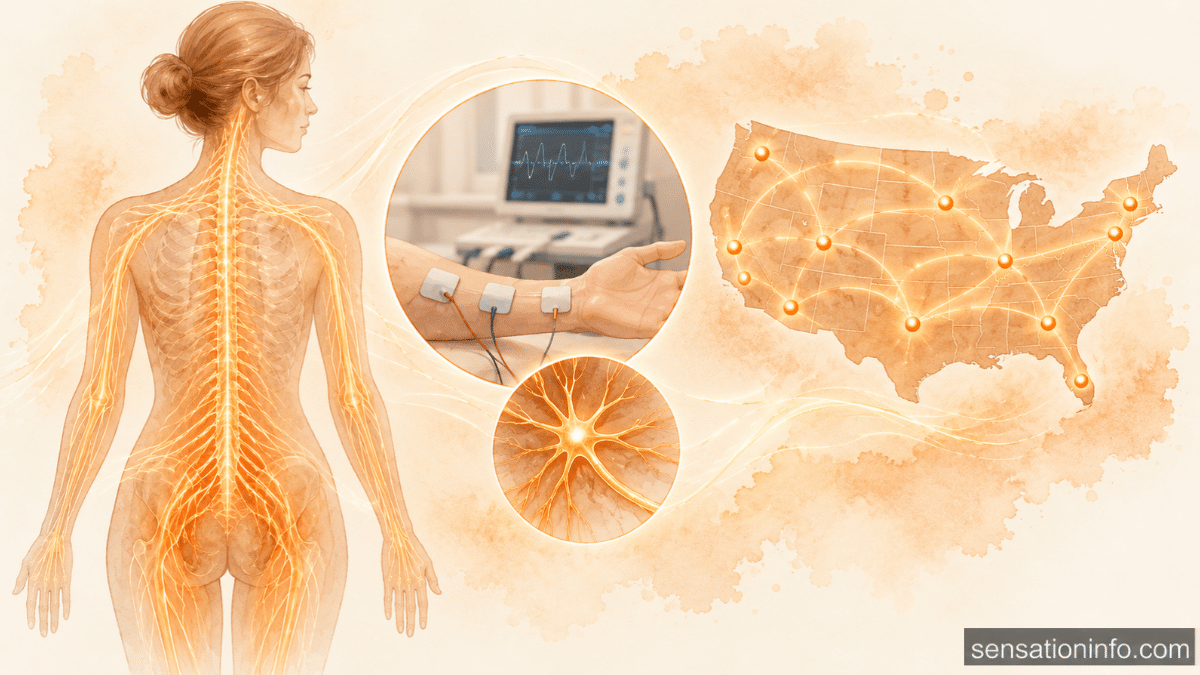

If you are searching for an EMG test near me, ten verified places to get an EMG or nerve conduction study in the USA are Mayo Clinic, Cleveland Clinic, the University of Rochester Medical Center, Weill Cornell Medicine, Johns Hopkins, Emory Healthcare, UTHealth Houston, Children’s Mercy Kansas City, UC Davis Health, and Stanford Health Care. Six of these electrodiagnostic labs hold accreditation from the American Association of Neuromuscular & Electrodiagnostic Medicine (AANEM), and four hold its highest level, Exemplary Status. If you want to understand the test before you book, our guide to the nerve conduction study walks through each step in plain language.
How This List Was Compiled
Every center in this EMG test near me guide was checked against its own official hospital or university page. Each one had to show a currently operating EMG or electrodiagnostic laboratory, a confirmed address or contact route, and at least one verifiable mark of quality. Quality marks included AANEM lab accreditation, named lab directors with board certification in clinical neurophysiology or electrodiagnostic medicine, published annual testing volume, or an accredited EMG fellowship. We also chose labs across the Northeast, Midwest, South, and West so more readers can find one within reach. No center paid to be included.
Specialists are listed for reference and are not ranked by preference.
10 Accredited and Academic EMG Labs Across the USA
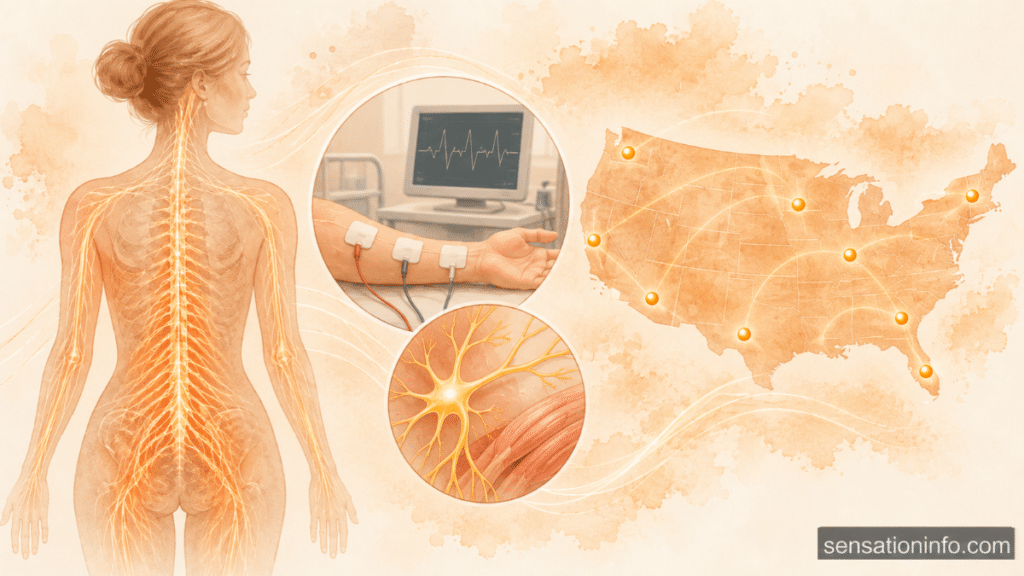
These ten labs perform both needle EMG and nerve conduction studies, and most offer advanced testing as well. Each listing below shows the same details in the same order so you can compare them quickly.
1. Mayo Clinic EMG Practice, Rochester, Minnesota
Hospital/Clinic: Mayo Clinic, Rochester campus
Specialty Focus: Electromyography and nerve conduction studies for neuromuscular disease, peripheral neuropathy, ALS, myasthenia gravis, and brachial plexus disorders
Why Listed: Mayo Clinic lists 33 physicians who perform EMG across its campuses. It also runs an ACGME accredited Clinical Neurophysiology EMG Fellowship that began in 1960 and meets American Board of Electrodiagnostic Medicine training requirements.
Address: 200 First Street SW, Rochester, MN 55905
Contact: Central Appointment Office, 507.538.3270 (7 a.m. to 6 p.m. Central, Monday through Friday)
Profile: Mayo Clinic EMG doctors and departments
What Sets Them Apart: Mayo lists EMG expertise across 10 departments, including the Peripheral Nerve Clinic, Hand Surgery Program, and Spine Care, so testing connects to the team most likely to treat you.
2. Cleveland Clinic EMG Laboratory, Cleveland, Ohio
Hospital/Clinic: Cleveland Clinic Neuromuscular Center
Specialty Focus: Routine EMG and nerve conduction testing plus single-fiber EMG, macro EMG, motor unit estimation, channelopathy assessment, and neuromuscular ultrasound
Why Listed: Cleveland Clinic states its EMG Laboratory holds AANEM Accreditation with Exemplary Status and describes it as one of the largest EMG labs in Ohio.
Address: Main Campus, 9500 Euclid Avenue, Cleveland, OH 44195 (additional EMG sites in Mayfield Heights, Avon, Sheffield Village, Solon, Strongsville, Wadsworth, and Willoughby Hills)
Contact: 216.636.5860 or toll free 866.588.2264
Profile: Cleveland Clinic Neuromuscular Center
What Sets Them Apart: Cleveland Clinic says patients are contacted within one business day after a referral arrives, and reports reach the referring doctor within one business day of testing.
3. University of Rochester Medical Center EMG Lab, Rochester, New York
Hospital/Clinic: URMC Department of Neurology, Strong Memorial Hospital
Specialty Focus: Adult and pediatric nerve conduction studies, EMG, single-fiber EMG, and neuromuscular ultrasound for entrapment neuropathies, polyneuropathy, and muscle disease
Why Listed: URMC states its EMG Lab is an AANEM Accredited Exemplary Status facility and is accredited to train Clinical Neurophysiology and Neuromuscular Medicine fellows.
Address: 601 Elmwood Avenue, Neurology Clinic/EMG Lab, 1st Floor, Rochester, NY 14642 (second site at 919 Westfall Road, Building C, Rochester, NY 14618)
Contact: 585.275.4568
Profile: URMC EMG Laboratory
What Sets Them Apart: Each visit starts with a directed history and neurologic exam, so the test is tailored to your symptoms rather than run as a fixed protocol.
4. Weill Cornell Peripheral Neuropathy Center EMG Lab, New York, New York
Hospital/Clinic: Weill Cornell Medicine Peripheral Neuropathy Center
Specialty Focus: EMG, nerve conduction studies, repetitive stimulation studies, and punch skin biopsy for small fiber neuropathy
Why Listed: The lab holds AANEM Laboratory Accreditation with Exemplary Status. Jennifer Langsdorf, MD, is the EMG laboratory’s medical director.
Address: 1305 York Avenue, Suite 217, New York, NY 10021
Contact: 646.690.2074
Profile: Weill Cornell Electrodiagnostic Testing
What Sets Them Apart: Large fiber and small fiber testing happen in one neuropathy center, which helps when a standard nerve conduction study comes back normal despite real symptoms.
5. Johns Hopkins EMG Laboratory, Baltimore, Maryland
Hospital/Clinic: Johns Hopkins Medicine, Department of Neurology
Specialty Focus: EMG and nerve conduction studies for CIDP, Guillain-Barré syndrome, chemotherapy-induced peripheral neuropathy, carpal tunnel syndrome, ulnar neuropathy, radiculopathy, and muscle disease
Why Listed: The lab evaluates 21 listed nerve, muscle, and neuromuscular junction conditions on an outpatient or inpatient basis, and Johns Hopkins lists it among the diagnostic labs of its Peripheral Nerve Center.
Address: Verify via Johns Hopkins Medicine website
Contact: Physician scheduling line 410.955.6270
Profile: Johns Hopkins EMG Lab
What Sets Them Apart: The lab sits within the Hopkins neuromuscular division alongside its ALS center and Charcot-Marie-Tooth clinic, which helps when a test result points to a specialized condition.
6. Emory Electrodiagnostic Laboratory, Atlanta, Georgia
Hospital/Clinic: Emory Healthcare Neuromuscular Program, Emory Brain Health Center
Specialty Focus: Nerve conduction studies, EMG, and neuromuscular ultrasound for peripheral nerve disease, myasthenia gravis, ALS, and Guillain-Barré syndrome
Why Listed: Emory performs more than 1,500 electrodiagnostic tests each year. Vita Kesner, MD, PhD, who directs the Electrodiagnostic Laboratory at Emory Clinic, is board certified in Neurology and Clinical Neurophysiology by the American Board of Psychiatry and Neurology.
Address: 12 Executive Park Drive NE, Atlanta, GA 30329 (Dr. Kesner’s practice location)
Contact: 404.778.3444 (Neuromuscular Program appointments: 404.778.7777)
Profile: Vita G. Kesner, MD, Emory Healthcare
What Sets Them Apart: Emory’s Neuromuscular Program houses both the electrodiagnostic lab and a regional nerve and muscle pathology lab, so EMG and biopsy findings come from the same program.
7. UTHealth Houston Electromyography Laboratory, Houston, Texas
Hospital/Clinic: McGovern Medical School at UTHealth Houston, UT Neuromuscular Clinic
Specialty Focus: Nerve conduction studies, EMG, repetitive nerve stimulation, blink reflexes, cranial nerve studies, and single-fiber EMG for neuropathy, radiculopathy, thoracic outlet syndrome, and traumatic nerve injury
Why Listed: The lab is AANEM accredited. Its director, Thy Nguyen, MD, is certified by the ABPN in Neurology and Clinical Neurophysiology and by the American Board of Electrodiagnostic Medicine.
Address: UT Professional Building, 6410 Fannin, Suite 1014, Houston, TX 77030
Contact: 832.325.7573
Profile: UTHealth Houston EMG Laboratory
What Sets Them Apart: The lab states that expedited referrals can be arranged, which helps when symptoms are progressing quickly.
8. Children’s Mercy EMG Laboratory, Kansas City, Missouri
Hospital/Clinic: Children’s Mercy Kansas City, Division of Rehabilitation Medicine
Specialty Focus: Pediatric EMG and nerve conduction studies for congenital, traumatic, and acquired nerve and muscle conditions, including muscular dystrophy and nerve injuries
Why Listed: Children’s Mercy states its EMG lab was the first AANEM accredited electromyography lab in the country dedicated to pediatric patients. Both testing physicians hold board certification from the American Board of Physical Medicine and Rehabilitation and the American Board of Electrodiagnostic Medicine.
Address: 2401 Gillham Road, Kansas City, MO 64108
Contact: 816.234.3000 (toll free 866.512.2168)
Profile: Children’s Mercy EMG Testing
What Sets Them Apart: A spray to ease discomfort can be offered before the needle portion, and reports generally reach the ordering doctor the same day.
9. UC Davis EMG Laboratory, Sacramento, California
Hospital/Clinic: UC Davis Health, Department of Neurology
Specialty Focus: EMG, nerve conduction studies, repetitive nerve stimulation, single-fiber EMG, neuromuscular ultrasound, and Sudoscan sweat gland testing for suspected small fiber or autonomic neuropathy
Why Listed: The UC Davis EMG Laboratory holds AANEM Laboratory Accreditation with Exemplary Status and evaluates both adult and pediatric patients.
Address: Midtown Ambulatory Care Center, 3160 Folsom Blvd., Suite 3100, Sacramento, CA 95816
Contact: Through the UC Davis Health website
Profile: UC Davis EMG Laboratory
What Sets Them Apart: UC Davis says the standard EMG and nerve conduction visit takes about one hour, and parking is validated free at the lab’s front desk.
10. Stanford Neurodiagnostic Labs, Palo Alto, California
Hospital/Clinic: Stanford Health Care, Stanford Neuroscience Health Center
Specialty Focus: EMG and nerve conduction velocity (NCV) testing alongside evoked potentials and autonomic testing
Why Listed: Stanford runs a Clinical Neurophysiology/EMG fellowship listed with AANEM and offers EMG/NCV testing at its Palo Alto neurodiagnostic labs, with EMG clinics also in Emeryville and Pleasanton.
Address: 213 Quarry Road, Palo Alto, CA 94305
Contact: EMG/NCV scheduling 650.723.6888
Profile: Stanford Neurodiagnostic Labs
What Sets Them Apart: East Bay and Tri Valley patients can test at Emeryville or Pleasanton instead of driving to the main Palo Alto campus.
EMG Testing Center Comparison
| Center | Location | Specialty Focus | Key Recognition |
|---|---|---|---|
| Mayo Clinic | Rochester, MN | Neuromuscular disease, neuropathy, ALS, brachial plexus | 33 EMG physicians listed; EMG fellowship since 1960 |
| Cleveland Clinic EMG Laboratory | Cleveland, OH | Routine and advanced EMG, neuromuscular ultrasound | AANEM Exemplary Status |
| URMC EMG Lab | Rochester, NY | Adult and pediatric EMG, single-fiber EMG, ultrasound | AANEM Exemplary Status |
| Weill Cornell Peripheral Neuropathy Center | New York, NY | EMG, NCS, small fiber skin biopsy | AANEM Exemplary Status |
| Johns Hopkins EMG Laboratory | Baltimore, MD | CIDP, Guillain-Barré, neuropathy, radiculopathy | Listed lab of Hopkins Peripheral Nerve Center |
| Emory Electrodiagnostic Laboratory | Atlanta, GA | Peripheral nerve disease, myasthenia gravis, ALS | 1,500+ tests per year |
| UTHealth Houston EMG Laboratory | Houston, TX | Neuropathy, radiculopathy, nerve injury, single-fiber EMG | AANEM accredited; ABEM certified director |
| Children’s Mercy EMG Laboratory | Kansas City, MO | Pediatric nerve and muscle conditions | First AANEM accredited pediatric EMG lab |
| UC Davis EMG Laboratory | Sacramento, CA | EMG, NCS, single-fiber EMG, Sudoscan | AANEM Exemplary Status |
| Stanford Neurodiagnostic Labs | Palo Alto, CA | EMG/NCV, evoked potentials, autonomic testing | AANEM listed EMG fellowship; three EMG sites |
How Much Does an EMG or Nerve Conduction Test Cost?
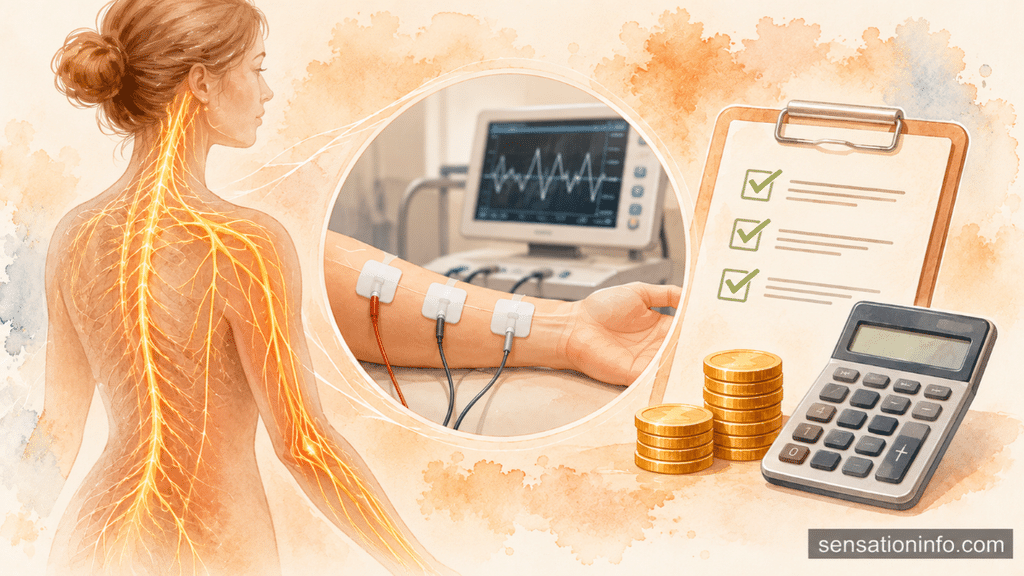
Without insurance, an EMG or nerve conduction study can cost about $150 to $500 per arm or leg, according to AANEM. Because many studies test two or more limbs, a full workup often costs more than a single limb price suggests.
Hospital based labs may bill in two parts. Weill Cornell’s Laboratory of Clinical Neurophysiology, for example, explains that one charge covers the technician’s services and a separate charge covers the physician’s interpretation. That split is common in academic centers, so ask about both before your visit.
Practical ways to keep costs predictable:
- Ask your doctor’s office which limbs and tests are ordered, since price rises with each limb studied.
- Call your insurer and confirm whether a referral or prior authorization is required.
- Ask the lab whether a hospital facility fee applies in addition to the physician fee.
- Use the hospital’s online price estimate tool if one is offered; URMC and Children’s Mercy both publish these.
- If you are paying out of pocket, ask about a self pay rate before the appointment, not after.
How to Choose the Right Specialist
Choose a lab where a board certified neurologist or physiatrist performs and reads the study, ideally in an AANEM accredited laboratory. AANEM recommends that electrodiagnostic testing be performed by an MD or DO board certified in neurology or physical medicine and rehabilitation, and you have the right to ask whether your EMG doctor holds that certification. AANEM also recommends choosing a doctor with extra electrodiagnostic training, such as certification from the American Board of Electrodiagnostic Medicine (ABEM).
AANEM accreditation is the clearest outside quality check available for EMG labs. Exemplary Status is the highest level an electrodiagnostic laboratory can earn under the AANEM program. AANEM keeps a public search tool to find accredited labs and ABEM certified doctors near you, which is the fastest way to turn an “EMG test near me” search into a verified local result.
Make sure the visit includes both parts of the study when your doctor suspects a pinched nerve. AANEM advises against a nerve conduction study without a needle EMG in that setting, because the nerve test alone can point toward the wrong diagnosis.
Match the lab to your question. If your main concern is a hand problem such as carpal tunnel syndrome, nearly any accredited lab can help. If you have burning feet with a normal nerve conduction result, a center that also offers skin biopsy or Sudoscan, such as Weill Cornell or UC Davis, may be the better choice, since small fiber neuropathy often does not show up on standard testing.
A second opinion makes sense when results do not match your symptoms, when surgery is being considered, or when the study was done in an office without board certified physician oversight.
Questions to Ask at Your First Appointment
Whether you book at one of these ten labs or find an EMG test near you through the AANEM locator, five to seven focused questions can make your visit more useful and avoid surprises later.
- Is the physician performing my needle EMG board certified in neurology or physical medicine and rehabilitation, and are they ABEM certified?
- Is this laboratory AANEM accredited, and at what level?
- Which nerves and muscles will you test, and why those?
- Will my study include both a nerve conduction study and a needle EMG?
- How long will the appointment take, and can I drive afterward?
- When will my referring doctor receive the report, and who will explain it to me?
- If the results are normal but my symptoms continue, what testing comes next?
What to Expect During Your First Visit
A typical visit includes a short history and exam, a nerve conduction study, and a needle EMG. AANEM says most studies take 30 to 60 minutes of testing time, and the full appointment, including check in and exam, often runs longer.
During the nerve conduction study, sticker electrodes go on your skin and brief electrical pulses test how fast and how strongly your nerves send signals. This part may be done by a technologist under the doctor’s supervision. During the needle EMG, the doctor uses a thin needle electrode to record electrical activity inside selected muscles. Depending on your symptoms, the lab may add repetitive nerve stimulation, single-fiber EMG, or neuromuscular ultrasound. If the test was ordered for numbness and tingling in your hands and feet, tell the doctor where your symptoms started and how they have spread, since that guides which nerves are tested.
Before the test:
- Shower and skip lotions, creams, and oils on your arms and legs.
- Wear loose clothing that exposes your arms and legs easily.
- Tell the lab if you take aspirin or blood thinners, or have a bleeding disorder.
- Tell the lab if you have a pacemaker or defibrillator.
- If you take pyridostigmine (Mestinon), ask your doctor whether to pause it before testing.
- Bring your insurance card, referral, and a list of your medications.
Most people return to normal activities right away, including driving and exercise. The EMG doctor may discuss results with you at the visit or send them to the doctor who ordered the test. If your study confirms neuropathy, our list of verified neuropathy specialists in the USA can help with the next step.
Frequently Asked Questions
The fastest way to find an EMG test near you is the AANEM “Find a Specialist” tool, which links to AANEM accredited laboratories, AANEM members, and ABEM certified doctors. You can also call a nearby academic medical center and ask whether its EMG lab holds AANEM accreditation or Exemplary Status.
Most hospital and academic EMG labs require a referral from a physician before scheduling an EMG test or nerve conduction study. Many insurance plans also require a referral or prior authorization, so call your insurer before booking.
An EMG and nerve conduction study usually takes 30 to 60 minutes of testing, according to AANEM. The full appointment, including check in, history, and exam, often runs about an hour or more. Studies that add single-fiber EMG can take longer; UC Davis allows about two hours for that test alone.
An EMG test causes mild, brief discomfort for most people, but it is usually well tolerated. The nerve conduction study feels like quick, mild tingling shocks, and the needle EMG feels like a small pinch in each muscle tested. No sedation is needed, and most people return to normal activities right after the test.
An EMG or nerve conduction study without insurance can cost about $150 to $500 per arm or leg, according to AANEM. Testing several limbs raises the total. Hospital based labs may send separate bills for the technician and the physician, so ask for both estimates before your appointment.
Key Takeaways
- Six of the ten EMG labs listed here hold AANEM accreditation, and four hold Exemplary Status, the highest level AANEM awards.
- Without insurance, an EMG or nerve conduction study can cost about $150 to $500 per arm or leg, according to AANEM.
- Most EMG labs require a physician referral, and many insurance plans require prior authorization before testing.
- The most reliable way to find an EMG test near me is the AANEM locator, which lists accredited labs and ABEM certified doctors.
- A typical EMG and nerve conduction visit includes a brief exam plus 30 to 60 minutes of testing.
- A normal nerve conduction study does not rule out small fiber neuropathy, which may need a skin biopsy or Sudoscan.
Doctor’s Recommendation
An EMG or nerve conduction study is one tool for understanding how your nerves and muscles are working, and it is most useful when you know what your doctor is looking for. If your testing relates to numbness, tingling, or burning in the hands or feet, our complete guide to neuropathy explains the condition in clear terms. Reading it before your appointment can help you ask focused questions and understand your results when they arrive.
References
- AANEM: Choosing Wisely, EMG and Nerve Conduction Studies
- AANEM Patient Brochure: What to Expect During an EMG
- Mayo Clinic: Clinical Neurophysiology Electromyography Fellowship
- Weill Cornell Medicine: Laboratory of Clinical Neurophysiology
- Emory Healthcare: Neuromuscular Program
- AANEM: Stanford Clinical Neurophysiology (EMG) Fellowship Listing


One Response