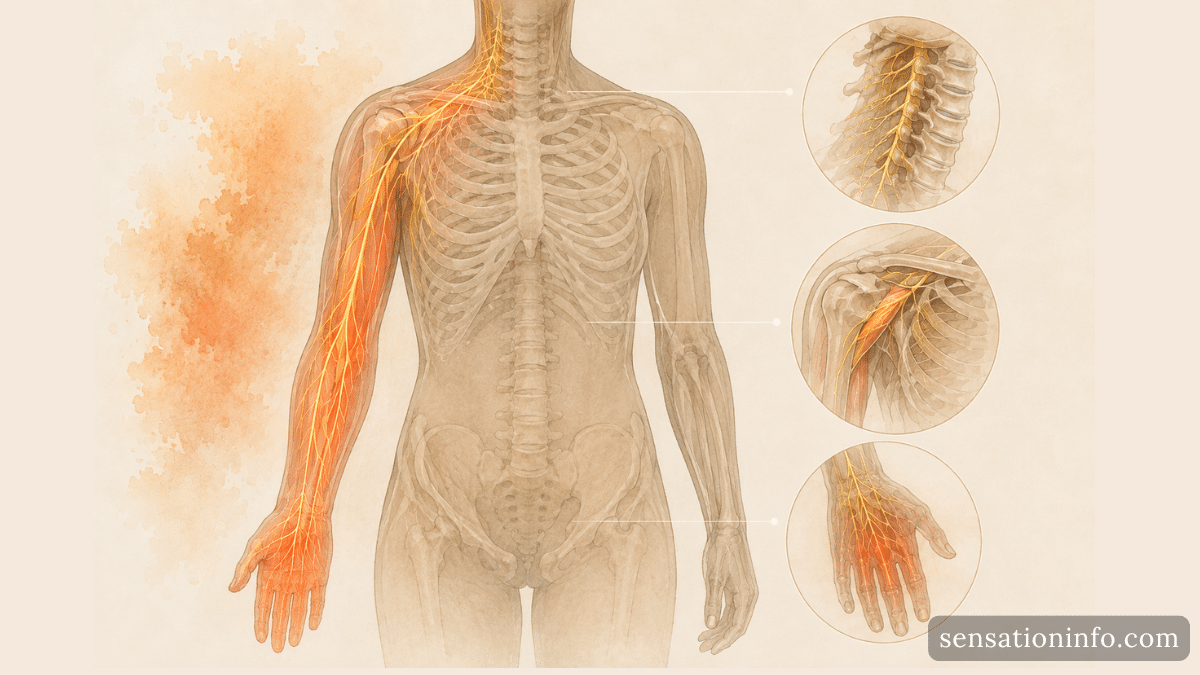

Burning pain in one arm can come from an irritated nerve, muscle or tendon strain, a skin problem, or reduced blood flow. It can also occur with a heart attack or stroke. Where the burning starts, what triggers it, how it travels, and whether you have weakness, numbness, chest symptoms, or skin changes can help determine how urgently you need care.
What does burning pain in one arm feel like?
Burning pain can feel hot, raw, prickly, stinging, electric, or similar to an intense sunburn. It may affect the shoulder, upper arm, elbow, forearm, wrist, hand, or fingers.
The pattern can offer clues. Burning that travels along a narrow path with tingling or an electric sensation often suggests nerve irritation. Pain that follows lifting or repetitive movement may involve muscles or tendons. Burning with redness, itching, or a rash may come from the skin.
The sensation alone cannot tell you the cause. Even pain that seems to be coming from the surface of the arm can sometimes occur with a serious heart or blood vessel problem.
Is burning pain in one arm an emergency?
Seek emergency medical help immediately if burning in one arm occurs with symptoms that could indicate a heart attack, stroke, or a serious circulation problem. In India, call 112 or your local emergency ambulance service.
- Chest pressure, squeezing, fullness, heaviness, or discomfort
- Shortness of breath
- Cold sweating, nausea, vomiting, severe weakness, or faintness
- Pain or discomfort spreading to the jaw, neck, back, shoulder, or other arm
- Sudden facial drooping, confusion, trouble speaking, vision changes, severe dizziness, or loss of balance
- Sudden weakness, inability to lift the arm, or loss of feeling
- An arm or hand that suddenly becomes pale, blue, cold, swollen, or unusually heavy
- Severe burning after a major fall, road accident, neck injury, or other serious trauma
A heart attack can cause discomfort in one or both arms or shoulders, with or without strong chest pain. Faster treatment can reduce heart muscle damage, so do not delay seeking emergency care.
A stroke can cause sudden numbness or weakness, particularly on one side of the body. Sudden trouble speaking, seeing, walking, or maintaining balance are also warning signs. Seek emergency medical help immediately if these symptoms occur.
Do not drive yourself to the hospital. Ask someone to accompany you or arrange an ambulance. If possible, note when the symptoms began and whether they started suddenly or gradually.
Could a burning sensation in one arm come from the neck?
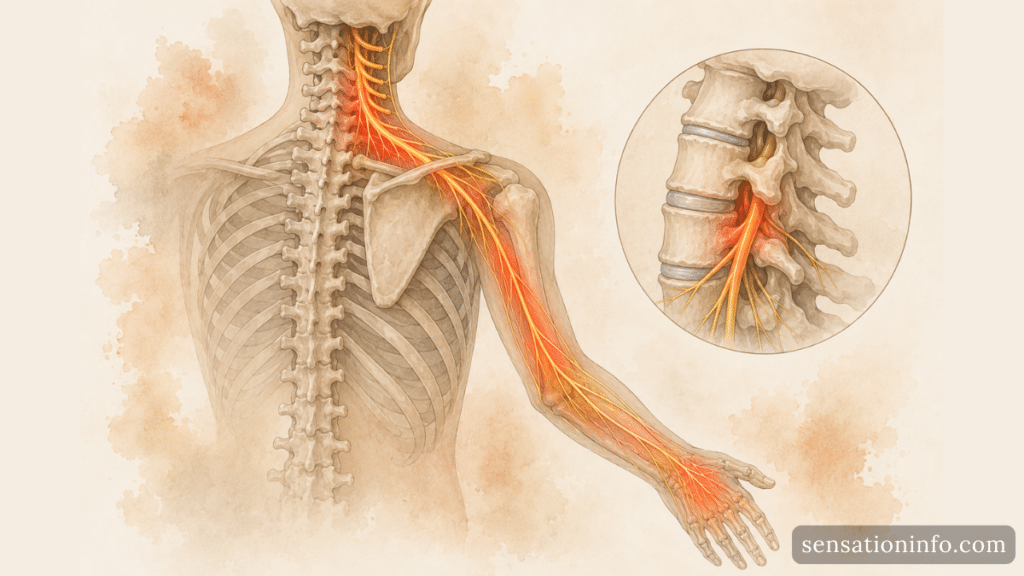
Yes. An irritated nerve root in the neck can cause burning pain that travels into one shoulder, arm, or hand.
This condition is called cervical radiculopathy. A nerve root is the part of a spinal nerve that leaves the spine. Pressure or inflammation around that nerve can cause burning, shooting pain, tingling, numbness, or weakness along the affected nerve pathway.
Neck movement may make the symptoms worse. You may also notice pain that travels from the neck through the shoulder and down the arm.
New weakness, severe symptoms after an accident, difficulty walking, or changes in bladder or bowel control require prompt medical assessment.
What causes burning pain in one arm?
Several conditions can cause burning in one arm. Some are temporary, while others need medical evaluation.
A pinched or irritated nerve
A pinched nerve is one of the more common explanations for burning arm pain. Nerve compression can occur in the neck, shoulder, elbow, wrist, or another narrow area.
You may also have tingling, numbness, reduced sensation, or weakness. Symptoms often follow the area supplied by the affected nerve rather than staying in one small spot.
For example, cervical radiculopathy can send burning pain from the neck into the arm. A compressed nerve near the elbow or wrist may produce symptoms farther down the arm or into specific fingers.
Brachial plexus injury
The brachial plexus is a network of nerves that carries signals between the spinal cord, shoulder, arm, and hand. Stretching or squeezing these nerves can cause burning or electric shock sensations, numbness, and weakness.
Minor injuries are sometimes called burners or stingers and can occur during contact sports. More serious injuries can follow falls, road accidents, or forceful movements of the shoulder and neck.
Symptoms that persist, repeatedly return, or cause weakness should be assessed by a clinician.
Thoracic outlet syndrome
Thoracic outlet syndrome occurs when nerves or blood vessels are compressed in the space between the lower neck and upper chest.
It can cause burning, tingling, numbness, weakness, heaviness, swelling, or pain in one arm. Symptoms may become worse when you raise the affected arm.
If blood vessels are involved, the hand or arm may become swollen, cool, pale, or blue. These vascular changes can require urgent medical attention.
Symptoms that worsen when you raise your arm can occur with thoracic outlet syndrome, especially when swelling, heaviness, or color changes are also present.
Muscle, tendon, or joint strain
Lifting, exercise, repetitive work, or an awkward movement can strain muscles and tendons in the shoulder, arm, or forearm.
A strain usually causes soreness, aching, tightness, tenderness, or pain with movement rather than a strong electric burning sensation. However, swelling or tight tissue can sometimes irritate a nearby nerve.
Resting from the activity that clearly worsens the pain may help. Severe pain, significant swelling, weakness, or persistent symptoms need medical assessment.
Skin irritation or a burn
A skin problem can cause burning that feels closer to the surface of the arm. Possible triggers include heat, chemicals, friction, sun exposure, allergic reactions, and other forms of skin inflammation.
Redness, itching, tenderness, peeling, blisters, or visible swelling may help distinguish a skin problem from nerve pain.
Chemical exposure should be rinsed with running water while following appropriate first aid instructions. A deep or extensive burn, severe swelling, breathing difficulty, or a burn involving the hand or a major joint needs urgent care.
Shingles
Shingles can begin with burning, tingling, itching, or pain before the characteristic rash appears. The symptoms usually affect one side of the body.
A rash may later develop as grouped blisters in a band like pattern. If burning on one side is followed by a rash, contact a clinician promptly.
Reduced blood flow
Reduced blood flow can cause pain, burning, numbness, tingling, weakness, coolness, swelling, or a change in skin colour.
A suddenly painful arm that becomes pale, blue, cold, swollen, or difficult to move can indicate a serious blood vessel problem and requires emergency evaluation.
Do not massage a suddenly painful, swollen, or discoloured arm while waiting for emergency help.
Peripheral neuropathy
Peripheral neuropathy means damage to nerves outside the brain and spinal cord. Diabetes is one possible cause, but other medical conditions, nutritional problems, medicines, infections, and alcohol exposure can also affect nerves.
Peripheral neuropathy more often affects the feet or both hands, but symptoms can be uneven. Persistent burning, especially with numbness, weakness, balance problems, or symptoms elsewhere in the body, deserves medical evaluation.
Persistent burning with numbness or symptoms affecting other areas may also point to peripheral neuropathy, which involves damage to nerves outside the brain and spinal cord.
How can the trigger help explain the burning?
The trigger does not prove the cause, but it can help a clinician decide what to examine.
| Pattern | What may be considered | What you should do |
| Burning with exercise and chest discomfort or breathlessness | Possible heart problem | Stop the activity and seek emergency medical help |
| Burning that travels from the neck into the arm | Cervical radiculopathy or another neck problem | Arrange medical assessment |
| Burning after lifting or repetitive movement | Muscle strain or nerve irritation | Rest from the trigger and seek care if symptoms persist |
| Burning after contact sports or trauma | Brachial plexus injury | Seek assessment if weakness or persistent symptoms occur |
| Burning that worsens when the arm is raised | Thoracic outlet syndrome or another nerve problem | Arrange medical assessment |
| Burning with a rash or grouped blisters | Shingles or skin inflammation | Contact a clinician |
| Burning with swelling or colour change | Possible blood vessel problem | Seek prompt or emergency care depending on severity |
| Burning that keeps returning without a clear trigger | Nerve, circulation, or another medical problem | Arrange a clinical evaluation |
If burning repeatedly starts during physical activity and improves with rest, do not automatically assume that you have a muscle strain. Tell a clinician exactly what activity brings on the symptom.
Could burning pain in one arm be a heart attack?
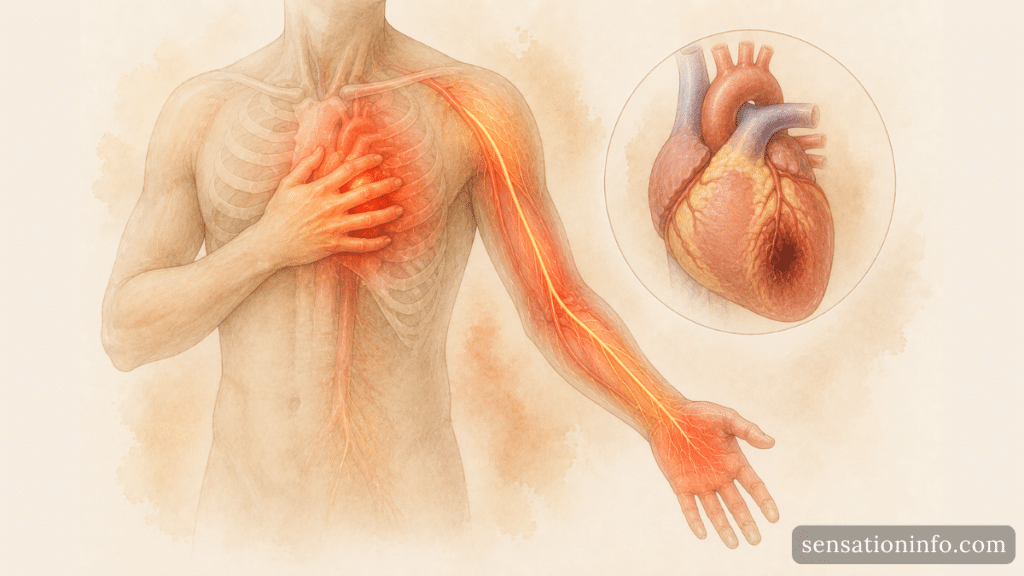
Yes. A heart attack can cause discomfort in one or both arms or shoulders, along with chest discomfort, shortness of breath, nausea, sweating, weakness, dizziness, or faintness.
Heart related discomfort does not always feel like severe pain. It may feel like pressure, tightness, heaviness, aching, or unusual discomfort.
Seek emergency medical help when arm burning occurs with possible heart attack symptoms. In India, call 112 or your local emergency ambulance service. Do not wait for the discomfort to become severe or try to reproduce it through exercise.
Could burning in one arm be a stroke?
A stroke more commonly causes sudden weakness or numbness than isolated burning pain.
However, sudden burning or another unusual arm sensation becomes more concerning when it occurs with weakness, facial drooping, trouble speaking, confusion, vision changes, severe dizziness, or loss of coordination.
Seek emergency medical help immediately if these symptoms begin suddenly. Note the time symptoms started because this information can help doctors determine treatment.
Even if the symptoms disappear after a short time, urgent medical evaluation is still needed because a transient ischemic attack can be a warning event.
How can you tell nerve pain from muscle or skin pain?
The quality and distribution of the symptom can provide clues, but they cannot establish a diagnosis.
| Feature | Nerve related burning | Muscle or tendon problem | Skin related burning |
| Sensation | Electric, shooting, prickling, or burning | Sore, tight, aching, or pulling | Hot, raw, itchy, tender, or stinging |
| Location | May follow a narrow path into the hand or fingers | Often near a used muscle or joint | Usually matches the affected skin |
| Common trigger | Neck position, pressure, repetitive movement, or injury | Lifting, exercise, or movement | Heat, friction, products, or sun exposure |
| Other clues | Numbness, tingling, weakness, or altered sensation | Tenderness, stiffness, or limited movement | Redness, rash, peeling, or blisters |
Heart and blood vessel problems can overlap with these patterns. Warning symptoms should always take priority over trying to classify the sensation yourself.
What should you do before seeing a clinician?
Keep a simple record of the symptom. Note when it started, how long it lasts, where it begins, whether it travels, and what makes it better or worse.
Also record recent lifting, exercise, repetitive work, neck pain, injury, illness, rash, new medicines, medicine changes, and symptoms that occur during physical activity.
If the arm feels numb, protect it from burns, cuts, and prolonged pressure. Avoid heavy lifting or the movement that clearly worsens the symptoms until you have been assessed.
Do not stop prescribed medicine or start high dose vitamins to treat unexplained burning without medical guidance.
How is burning pain in one arm diagnosed?
Diagnosis starts with the history and physical examination. A clinician may ask about the timing, location, quality, severity, duration, triggers, and related symptoms.
The examination may assess muscle strength, sensation, reflexes, neck and shoulder movement, pulses, skin temperature, skin colour, swelling, and range of motion.
Depending on the pattern, testing may include an electrocardiogram, blood tests, blood glucose testing, nerve conduction studies, electromyography, ultrasound, X ray, or magnetic resonance imaging.
The purpose is to determine whether the symptoms are coming from the heart, blood vessels, nerves, spine, muscles, joints, skin, or more than one source.
How is burning pain in one arm treated?
Treatment depends on the underlying cause.
A heart attack, stroke, serious blood flow problem, or major nerve injury requires urgent medical care. A compressed nerve may be treated with activity changes, physical therapy, prescribed medicines, or another targeted approach.
Muscle and tendon problems may improve with guided rest and rehabilitation. Skin problems are treated according to their cause. Shingles may require prescription antiviral treatment and pain management.
When an underlying condition such as diabetes is affecting nerve function, treating that condition can be part of managing the nerve symptoms.
The right treatment depends on the cause, so unexplained burning should not simply be masked with pain medicine while new weakness, swelling, colour change, or chest symptoms are ignored.
When should you make a medical appointment?
Arrange medical care when burning lasts beyond a brief episode, repeatedly returns, spreads, interrupts sleep, limits normal arm use, or has no clear explanation.
You should also seek assessment when burning follows an injury, new medicine, illness, or repeated activity and does not improve.
Prompt evaluation is appropriate for worsening pain, numbness, weakness, a weaker grip, neck pain, swelling, a rash, skin colour change, or a cool hand.
Seek emergency medical help for chest discomfort, severe breathing difficulty, faintness, sudden weakness, facial drooping, trouble speaking, or other sudden neurologic changes. In India, call 112 or your local emergency ambulance service.
Key Takeaways
- Burning pain in one arm can come from nerves, muscles, skin, blood vessels, or a condition affecting the heart.
- Seek emergency medical help when arm burning occurs with chest discomfort, shortness of breath, sweating, faintness, spreading discomfort, sudden weakness, or major colour and temperature changes. In India, call 112 or your local emergency ambulance service.
- Burning that travels from the neck or follows a narrow path can suggest nerve irritation, but the sensation alone cannot confirm the cause.
- Thoracic outlet syndrome and brachial plexus injury can cause burning with numbness, weakness, swelling, heaviness, or colour changes.
- New, persistent, recurrent, worsening, or unexplained burning pain should be evaluated by a qualified clinician.
Frequently Asked Questions
Burning pain in one arm can be a heart attack symptom, especially when it occurs with chest discomfort, shortness of breath, sweating, nausea, faintness, weakness, or discomfort spreading to the jaw, neck, back, shoulder, or other arm. Seek emergency medical help immediately. In India, call 112 or your local emergency ambulance service.
Anxiety can cause muscle tension and unusual sensations, particularly when breathing becomes rapid. Burning limited to one arm can also have nerve, circulation, heart, or injury related causes, so new or severe symptoms should not automatically be attributed to anxiety.
Burning that becomes worse when one arm is raised can occur with thoracic outlet syndrome, neck problems, shoulder problems, or nerve irritation. Swelling, heaviness, pale or blue skin, or a cool hand requires prompt medical assessment.
Medical evaluation is appropriate when burning lasts beyond a brief episode, repeatedly returns, spreads, limits arm use, follows an injury or medicine change, or occurs with numbness, weakness, neck pain, swelling, rash, or colour change. Seek emergency medical help for chest symptoms, severe breathing difficulty, faintness, or sudden neurologic symptoms. In India, call 112 or your local emergency ambulance service.
Doctor’s Recommendation
When burning repeatedly travels from the neck, shoulder, or upper chest into one arm, or occurs with swelling or colour change, a clinician may need to assess both nerves and blood vessels. The thoracic outlet syndrome article linked earlier in this document explains this specific compression pattern and may be useful background for readers with these symptoms.
For persistent or more widespread nerve related symptoms, the neuropathy article linked earlier in this document provides broader information about possible nerve involvement. Neither article can establish a diagnosis.
Conclusion
Burning pain in one arm can have a simple explanation, such as skin irritation or muscle strain, but it can also reflect nerve irritation, reduced blood flow, or a serious heart or neurologic problem. The most useful clues are where the burning starts, what triggers it, how it travels, and whether weakness, numbness, swelling, colour changes, chest symptoms, or breathing problems occur.
If you have emergency warning signs, seek immediate medical help rather than trying to identify the cause at home. In India, call 112 or your local emergency ambulance service. If the burning is new, recurrent, persistent, worsening, or unexplained, arrange a clinical evaluation.
References
- Centers for Disease Control and Prevention. Signs and Symptoms of Stroke. CDC. 2026.
- Mayo Clinic. Brachial Plexus Injury: Symptoms and Causes. Mayo Clinic. 2024.
- Cleveland Clinic. Cervical Radiculopathy: Pinched Nerve in Neck. Cleveland Clinic. 2022.
- Cleveland Clinic. Thoracic Outlet Syndrome: Symptoms and Treatment. Cleveland Clinic. 2023.