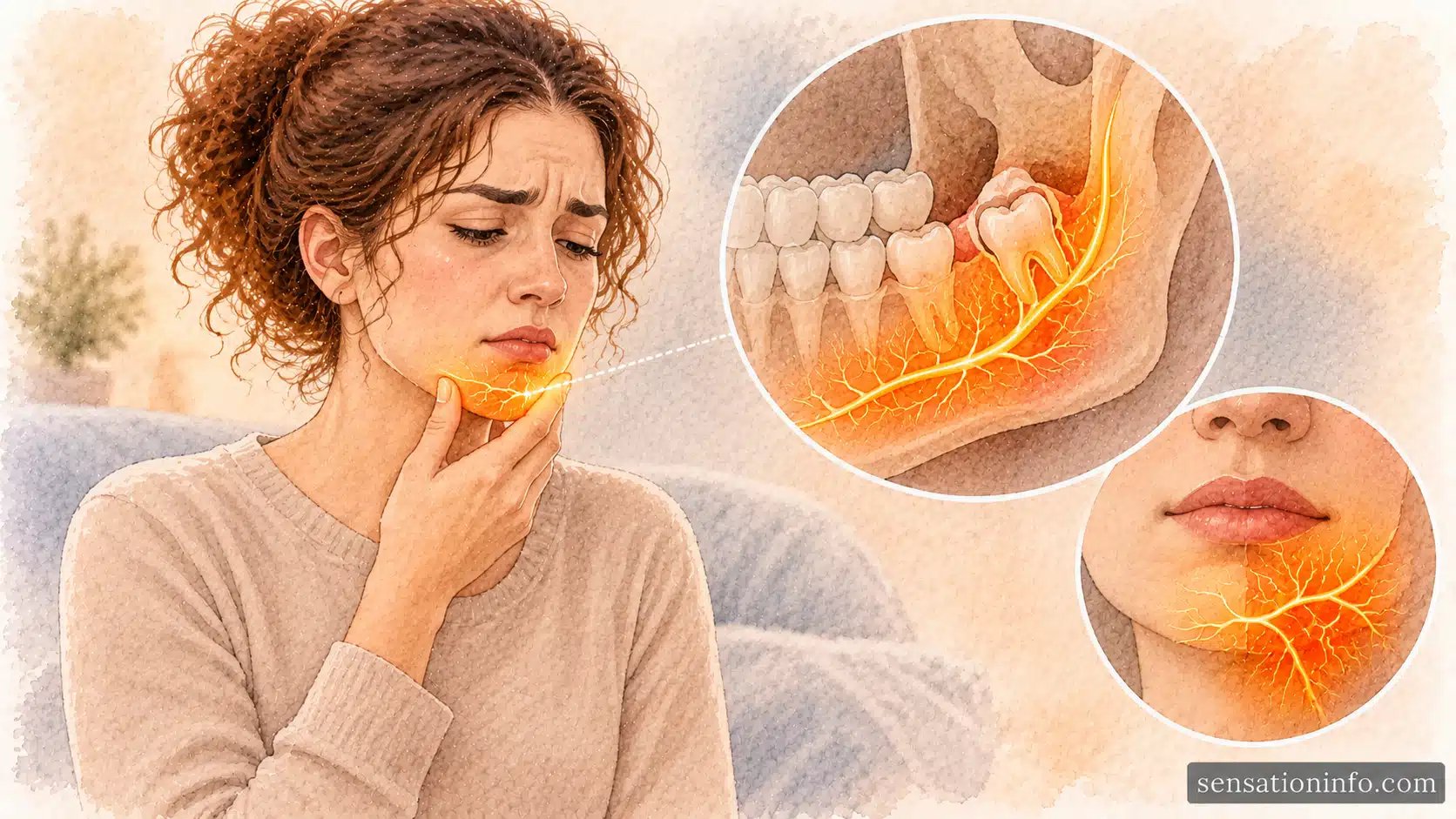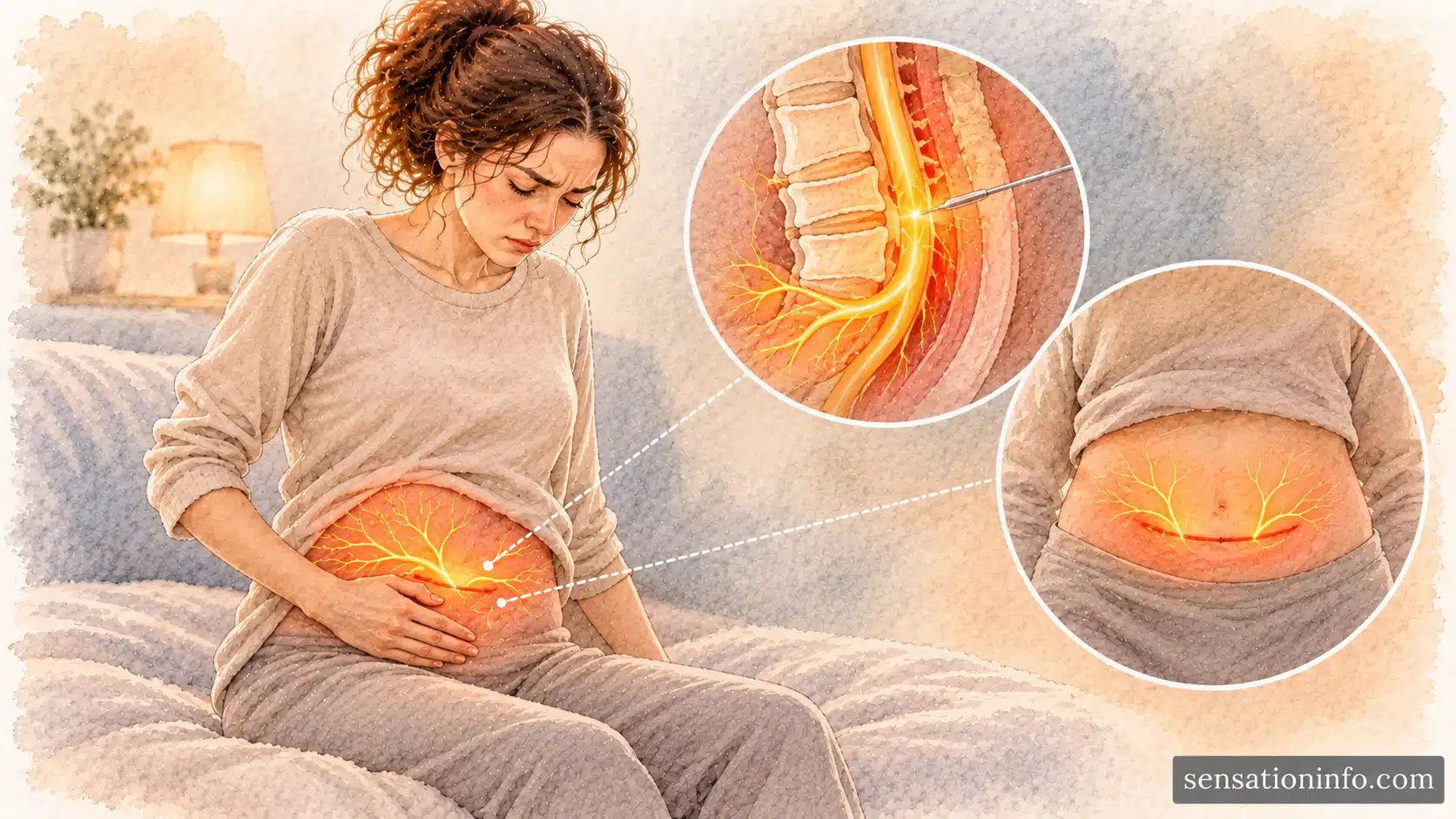

Lingering numbness after C-section is common and usually comes from the small skin nerves cut during surgery, not from the epidural. Epidural numbness wears off within a few hours of the last dose, while a numb patch around or above your scar can last months as those nerves slowly regrow. That said, new numbness or weakness in a leg, trouble walking, or loss of bladder control is not part of normal healing, and it needs prompt care. As with other kinds of numbness after surgery, the pattern tells you a lot about the cause.
Why Is My C-Section Scar Numb?
To reach your uterus, your surgeon cuts through skin and the layers beneath it. Tiny sensory nerves run through that skin, and some of them are cut or pulled back along the incision.
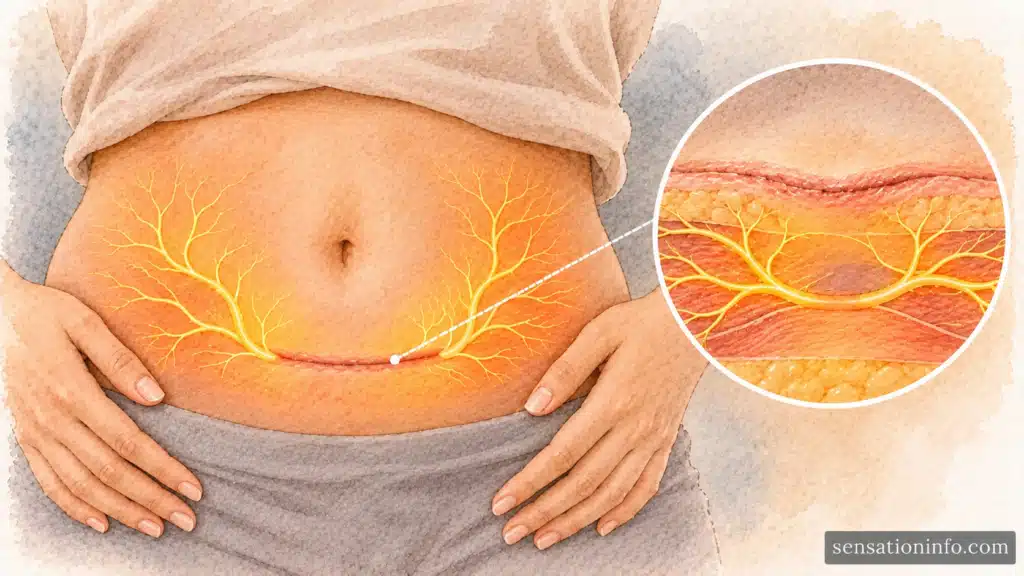
The result is hypoesthesia, a reduced sense of touch, in a band along and often just above the scar. In one group of women followed after cesarean birth, about one in four reported numbness in the scar region.
New moms often tell me the skin feels “like it belongs to someone else” or “like cardboard.” Some notice it only when their waistband or a seat belt rubs the area.
The good news is that nerves can regrow, so feeling often returns slowly from the edges inward. Many women notice tingling, itching, or zings as this happens, which is usually a sign of healing.
Is It the Epidural or the Surgery?
Most women had an epidural or spinal block and then surgery, so it is natural to wonder which one is responsible. The timing and location usually answer that question quickly.
The comparison below shows how I sort the three main causes of numbness after a C-section. Find the row that matches you.
| Feature | Epidural or spinal block | Surgical scar nerves | Nerve stretched during labor |
|---|---|---|---|
| Where | Belly, hips, and both legs | Strip along and above the scar | One thigh, shin, or foot |
| When it starts | Right after the dose | Noticed once the block wears off | Noticed in the first day or two |
| How long | A few hours after the last dose | Months, sometimes a small permanent patch | Usually weeks to a few months |
| What comes with it | Heavy legs, slight tingling as it wears off | Itching, tingling, tenderness | Possible weakness, foot drop, or trouble climbing stairs |
Can an Epidural Cause Long Lasting Numbness?
Rarely. Nerve damage from an epidural is listed as a rare risk, and back soreness at the injection site usually settles within a few days.
What I see far more often is leg numbness from labor itself. Nerves in the pelvis and legs can be squeezed or stretched by the baby’s head, by long pushing, or by holding your legs in one position for hours.
These injuries happen in roughly 0.3% to 2% of deliveries. Most are caused by birth, not anesthesia, although an epidural can play a small part because it keeps you still longer.
Which Nerves Are Usually Involved?
The most common one is the lateral femoral cutaneous nerve, which supplies the outer thigh. Numbness or burning there is called meralgia paresthetica, and it does not cause weakness.
Other nerves can be affected too. A femoral nerve injury weakens the front of the thigh and makes stairs hard, while a common peroneal nerve injury causes foot drop, where the front of the foot drags. An obturator nerve injury causes numbness on the inner thigh and weakness pulling the legs together.
Most of these recover within weeks, and in one study the typical recovery took about two months. A few women still have some change a year later.
What Does Normal Scar Healing Feel Like?
Most women feel soreness for several days to weeks, and full recovery takes about four to eight weeks. Numbness, though, often outlasts the soreness.
The timeline below shows what I expect at each stage. Knowing it helps you tell normal healing from a problem.
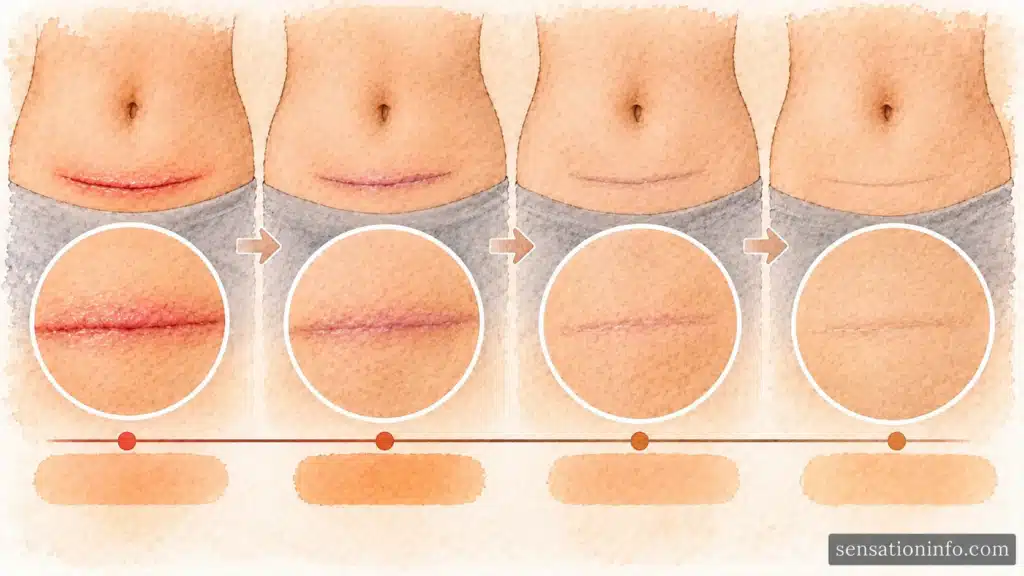
| Time after birth | What the scar usually looks and feels like |
|---|---|
| First days | Sore, swollen, and numb; epidural numbness gone within hours |
| 1 to 3 weeks | Raised, darker, a little puffy; numb band along the scar |
| 4 to 8 weeks | Most daily activities possible; numbness may still be present |
| Months after | Scar becomes thinner, flatter, and closer to skin color; feeling slowly returns |
| A year or more | A small numb patch may remain for some women |
Numbness vs Nerve Pain at the Scar
Numbness and nerve pain are different problems, and they are treated differently. Numbness is a loss of feeling, while nerve pain is burning, stabbing, or electric pain that does not settle.
The nerves most often involved in lasting scar pain are the ilioinguinal and iliohypogastric nerves. They run near the sides of a low transverse incision, and they can be caught in scar tissue or stitches. Pain from these nerves often spreads toward the groin or upper thigh on one side.
If your numbness spreads low across the belly and pubic bone rather than staying at the scar, other causes of numbness across the lower abdomen are worth ruling out. And if you are unsure which nerve fits your pattern, our nerve symptom checker can help before your appointment.
What Else Could Be Causing My Symptoms?
Not every feeling around a healing C-section is a nerve problem. I look at what comes with the numbness, because that changes the urgency.
The table below lists the patterns I check. Match your symptoms against it, then use the urgency column.
| Where it is | What it feels like | What comes with it | Likely cause | How urgent |
|---|---|---|---|---|
| Band along and above the scar | Numb, cardboard like | Mild itch or tingling | Cut skin nerves from the incision | Normal; mention at your checkup |
| One side of the scar toward the groin | Burning, stabbing | Worse when standing or moving | Ilioinguinal or iliohypogastric nerve entrapment | Book a visit |
| Outer thigh | Numb, burning | No weakness | Meralgia paresthetica | Book a visit |
| Front of thigh or foot | Numb | Knee buckling or foot drop | Femoral or common peroneal nerve injury | See a doctor within days |
| Incision | Sore, hot | Redness, swelling, pus, fever | Wound infection | Call your provider the same day |
| Lower back and both legs | Numb, weak | Severe back pain, fever, bladder or bowel loss | Epidural abscess | Go to the emergency room |
When Should I Call My Doctor or Get Emergency Care?
Most scar numbness is safe to watch. However, some symptoms need action, and each one below comes with exactly what to do.
- Severe back pain with fever, new leg weakness, or loss of bladder or bowel control: go to the emergency room now.
- Chest pain or shortness of breath: call 911.
- Swelling in one leg that is red, warm, or painful in the calf: call your provider right away, as this can be a blood clot.
- Severe headache when sitting or standing that eases when lying down: call the team that placed your epidural.
- Fever above 100°F that does not go away, or redness, drainage, or opening of the incision: call your provider the same day.
- Leg numbness or weakness that lasts longer than your care team said it should: call your provider.
- Burning scar pain that persists past your six week checkup: book a visit.
What Will My Doctor Ask at My Postpartum Visit?
The numbness itself is easy to describe, but the details are what help me most. Bring a few notes so nothing gets missed during a busy visit.
These are the points your doctor will want. Writing them down also shows you whether things are improving:
- Exactly where the numbness is, and whether the patch is shrinking
- Whether it burns, stabs, or zaps, or is simply numb
- Any leg weakness, tripping, or trouble on stairs
- How long you pushed, and whether forceps or vacuum were used
- Any bladder, bowel, or fever problems since birth
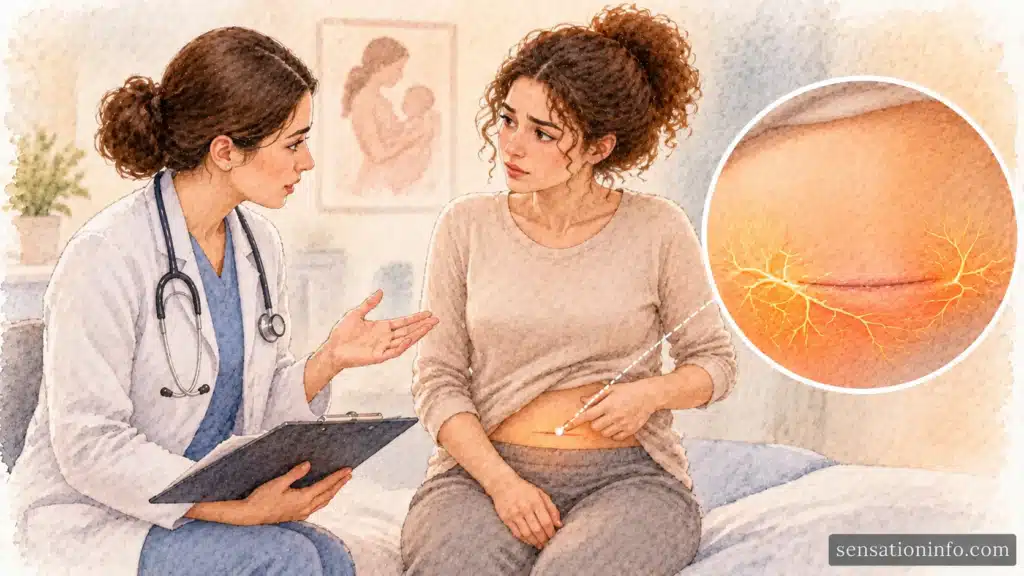
Your doctor will examine the scar, test feeling around it, and check your leg strength and reflexes. If the pattern is unclear, a referral to a neurologist and electromyography (EMG), a test of how well nerves and muscles carry signals, can pinpoint the nerve involved.
Good questions to ask include: “Is this the incision nerves or a labor injury?” and “When should I expect feeling to come back?”
Treatment and Daily Care
For plain scar numbness, there is no special treatment; time does most of the work. Meanwhile, careful scar care protects skin you cannot fully feel.
Keep the incision clean with mild soap and water, and avoid baths, hot tubs, and swimming until your provider clears you, usually around three weeks. Because you may not feel heat well, test any heating pad or warm compress on your hand first.
Protect the healing area in daily life too. Lift nothing heavier than your baby for the first six to eight weeks, and wait at least two weeks before driving, longer if you still take opioid pain medicine.
For leg nerve injuries from labor, physical therapy helps you walk safely, and assistive devices keep you steady while the nerve recovers. For nerve pain at the scar, options include injections, nerve pain medicines such as amitriptyline or gabapentin (Neurontin), and in rare stubborn cases, surgery to release or remove the trapped nerve. Many of these entrapments also settle on their own.
Key Takeaways
These points sum up what new moms should know about numbness after an epidural and C-section. Each one stands on its own as a quick reminder.
- Lingering numbness after a C-section usually comes from cut skin nerves around the scar, not from the epidural.
- Epidural numbness wears off within a few hours of the last dose.
- Leg numbness after birth is usually from nerves stretched during labor, and most recovers within weeks to months.
- Burning or stabbing pain near the scar that spreads to the groin may be a trapped nerve and can be treated.
- Severe back pain with fever, leg weakness, or loss of bladder control needs emergency care.
Frequently Asked Questions
Feeling around a C-section scar often returns slowly over months as the cut skin nerves regrow, usually starting from the edges of the numb area. Some women keep a small numb patch above the scar long term, which is harmless unless it comes with burning pain, redness, or swelling.
Itching, tingling, or brief zings around a C-section scar months after birth usually mean the small skin nerves are regrowing and sending signals again. Constant burning or stabbing pain, especially pain spreading toward the groin, is different and should be checked for a trapped nerve.
Some medicines used for nerve pain can be taken while breastfeeding and others need caution, so the choice depends on the specific drug and the baby’s age. A doctor or pharmacist should review every medicine before it is started during breastfeeding.
Doctor’s Recommendation
Your obstetrician (OB/GYN) is the right first stop for scar numbness, and your six week postpartum visit is a good time to raise it. A neurologist is the next step if you have leg weakness, foot drop, or numbness that is not improving, since nerve testing can show which nerve is involved. If burning scar pain lingers despite treatment, our list of pain management doctors for nerve pain can help you find a specialist experienced with trapped nerves.
References
- Cleveland Clinic. Epidural: What It Is, Procedure, Risks and Side Effects. Cleveland Clinic. Accessed 2026.
- Cleveland Clinic. C-Section (Cesarean Section): Procedure, Risks and Recovery. Cleveland Clinic. Accessed 2026.
- MedlinePlus. Going Home After a C-Section. MedlinePlus Medical Encyclopedia, National Library of Medicine. Accessed 2026.
- McCrory EH, Banayan JM, Toledo P. Postpartum Peripheral Nerve Injuries: What Is Anesthesia’s Role? Anesthesia Patient Safety Foundation Newsletter. 2021.
- Gizzo S, et al. Caesarean Section: Could Different Transverse Abdominal Incision Techniques Influence Postpartum Pain and Subsequent Quality of Life? A Systematic Review. PLoS ONE, PubMed Central. 2015.