

Numbness in thumb and index finger that wakes you at night, or that you shake away in the morning, is often the first sign of carpal tunnel syndrome. This happens when the median nerve gets squeezed at the wrist.
Early carpal tunnel is easy to dismiss, but it is also the easiest stage to treat. A night splint and a few changes to how you use your hands often help.
When Is Thumb and Index Finger Numbness an Emergency?
Almost never. Carpal tunnel builds slowly over weeks. These rare situations are different and need care right away:
- Numbness that comes on suddenly with face drooping, slurred speech, confusion, or trouble seeing, even if it fades within minutes: Call 911. The CDC lists these as stroke warning signs.
- Numbness after a fall, car crash, or neck injury: Go to the emergency room the same day.
- Numbness with new leg weakness, trouble walking, or loss of bladder or bowel control: Go to the emergency room. This can mean pressure on the spinal cord in your neck.
- A hand or finger that suddenly turns pale, blue, or cold and painful: Go to the emergency room. This can be a blocked artery.
The Overlooked Early Signs of Carpal Tunnel Syndrome
Early carpal tunnel rarely starts with pain. It shows up as small moments that are easy to explain away, and they come and go for weeks or months.
Why the Thumb and Index Finger Go Numb First
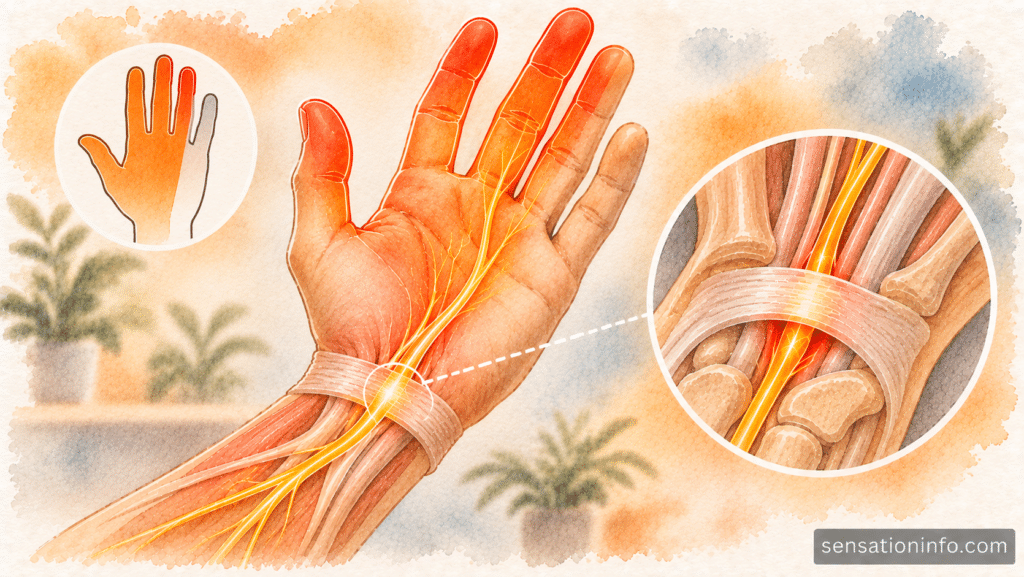
The median nerve gives feeling to the palm side of your thumb, index finger, middle finger, and the thumb side of your ring finger.
It passes through the carpal tunnel, a narrow passage in your wrist made of small bones and a tough band of tissue called the transverse carpal ligament. When the synovium (the thin lining around the finger tendons in that tunnel) swells, the tunnel cannot stretch. Pressure on the nerve rises, and these fingers go numb.
If your little finger is numb too, carpal tunnel is less likely, because the median nerve does not supply that finger. That pattern usually points to the ulnar nerve and numbness in the pinky and ring finger, which often starts at the elbow.
Early Signs to Watch For
- Waking up with numb or tingling fingers. Night symptoms are one of the most typical early features, and they often start in your dominant hand.
- Shaking your hand to bring the feeling back. Doctors call this the flick sign. If it has become a habit, take note.
- Tingling while you hold something. Mayo Clinic notes symptoms often appear while holding a phone, a book, or a steering wheel.
- Burning or itching numbness. NINDS describes early symptoms as burning, tingling, or itching numbness in the palm and fingers, especially the thumb, index, and middle fingers.
- Fingers that feel swollen when they are not. Your fingers may feel puffy or clumsy even though they look normal.
- Clumsiness with small tasks. Buttons, earrings, keys, or coins feel harder to handle.
- Dropping things. A loose grip on a mug or pen can come from numbness, weak pinch muscles, or both.
- Trouble telling hot from cold. NINDS notes some people cannot tell hot from cold by touch in the affected fingers.
- Feeling that travels up the arm. Mayo Clinic notes the feeling can travel from the wrist up the arm, so arm symptoms do not rule out carpal tunnel.
The need to shake your hand out at night is one of the most telling early signs of carpal tunnel syndrome.
Why It Is Worse at Night

Bending your wrist for long periods raises pressure in the carpal tunnel. Many people sleep with their wrists curled or tucked under a pillow, which keeps that pressure on for hours. That is why tingling in hands at night is so often the first clue.
How Carpal Tunnel Usually Progresses
Carpal tunnel syndrome usually develops slowly, through rough stages:
- Intermittent: Numbness at night or after a specific task, gone after shaking your hand.
- Daytime: Tingling during everyday activities like driving, reading, or holding a phone.
- Constant: Numbness that does not fully go away, with a weaker grip.
- Long standing: The thenar muscles (the muscle pad at the base of your thumb) slowly shrink.
Most people treated at stage 1 or 2 improve without surgery. That is why early signs matter.
Who Is More Likely to Get Carpal Tunnel Syndrome?
Carpal tunnel syndrome usually comes from several factors together rather than one cause.
Cleveland Clinic estimates that about 3 out of every 1,000 people in the U.S. experience it each year. NINDS reports that women are three times more likely than men to develop it.
Risk Factors Doctors Look For
- Pregnancy and menopause, which cause fluid retention
- Diabetes, hypothyroidism (an underactive thyroid), rheumatoid arthritis, or gout
- Obesity, kidney failure, or amyloidosis (a buildup of abnormal protein)
- A past wrist fracture, or a ganglion cyst in the wrist
- Regular use of vibrating tools
- A family history of carpal tunnel syndrome
- Anastrozole (Arimidex), a breast cancer medicine that some studies link to carpal tunnel syndrome
What About Phones and Typing?
Phones and typing get a lot of blame. Mayo Clinic reports there is not enough evidence to support computer use as a risk factor, although some evidence suggests mouse use may be related.
Still, gripping a phone for long periods can aggravate a nerve that is already irritated. If your thumb tingles every time you scroll, the connection between thumb tingling and smartphone use is worth understanding.
Pregnancy, Older Adults, and Children
- Pregnancy: Carpal tunnel is common during pregnancy and, as Mayo Clinic notes, generally gets better on its own after delivery. Tell your obstetrician. Call the same day if hand swelling comes on suddenly with a severe headache or vision changes.
- Older adults: Early signs are easier to miss, so muscle wasting is more likely by the time of diagnosis. Get checked sooner rather than later.
- Children: NINDS notes carpal tunnel usually occurs only in adults. A child with numb fingers should see a pediatrician.
What Else Can Numb Your Thumb and Index Finger?
Carpal tunnel is the most common cause, but a few other problems numb the same fingers. The pattern of your symptoms usually tells them apart.
A Pinched Nerve in the Neck
The C6 nerve root leaves your spine in the lower neck and carries feeling to the thumb and index finger.
Cleveland Clinic reports that cervical radiculopathy affects about 85 out of 100,000 people, and about a quarter of cases involve the C6 root. It is treated very differently from a wrist problem, so telling the two apart matters.
Carpal Tunnel vs Pinched C6 Nerve
| Feature | Carpal tunnel syndrome | Pinched C6 nerve in the neck |
| Neck pain | Usually none | Common |
| Where pain travels | Wrist and hand, sometimes up the forearm | Neck, shoulder, and down the arm to the thumb |
| Worse when | At night, gripping, holding a phone, driving | Tilting or turning your head, looking up |
| What eases it | Shaking the hand, a wrist splint | Resting your hand on top of your head |
| Weakness | Thumb pinch and grip | Biceps and wrist lifting |
| Most useful test | Nerve conduction study | MRI of the neck |
You can have both at once, so doctors sometimes check the neck and the wrist together.
Symptom Patterns and What They Point To
| Where it is | What it feels like | What comes with it | Likely cause | How urgent |
| Palm side of thumb, index, and middle fingers, worse at night | Tingling, fingers “asleep”; you shake your hand to wake it | Clumsy grip, symptoms while holding a phone or steering wheel | Carpal tunnel syndrome | Doctor visit within a few weeks; within 1 to 2 weeks if your hand is weak |
| Thumb and index finger, with pain from the neck into the forearm | Electric, burning, or shooting | Neck stiffness, pain worse when you tilt your head | Cervical radiculopathy (pinched C6 nerve root) | Doctor visit within 1 to 2 weeks; emergency room if legs feel weak or bladder control changes |
| Back of the thumb and index finger | Burning, tingling, or a numb patch | A tight watch, bracelet, handcuffs, cast, or wrist injury | Superficial radial neuropathy (Wartenberg syndrome) | Remove the pressure; doctor visit if not clearly better within a few weeks |
| Thumb, index, middle fingers, and palm, not at night | Tingling with a forearm ache | Pain in the front of the forearm when you twist or grip | Pronator teres syndrome (median nerve squeezed in the forearm) | Routine doctor visit |
| Fingertips of both hands, often after the feet | Numb, burning, like wearing gloves | Both sides affected, slowly spreading | Peripheral neuropathy from diabetes, vitamin B12 deficiency, or too much vitamin B6 | Routine doctor visit with blood tests |
| Several fingers turn white or blue in the cold | Numb, then throbbing as color returns | Triggered by cold or stress | Raynaud’s phenomenon | Routine doctor visit; sooner if a fingertip sore appears |
| Thumb and index finger after sleeping on your arm | Pins and needles that fades within minutes | Clear pressure trigger | Temporary nerve pressure | Usually harmless; doctor visit if it lasts more than a day or your wrist droops |
When Both Hands and Feet Are Involved
Numbness that spreads to both hands and into your feet rarely comes from one trapped nerve. It more often points to peripheral neuropathy, where diabetes or low vitamin B12 damages many nerves at once.
If you are unsure which pattern fits, our nerve symptom checker can help you see which nerve may be involved before your appointment.
How Doctors Confirm Early Carpal Tunnel
A careful history and a hands on exam often point to carpal tunnel syndrome. Your doctor will ask which fingers are numb, when it happens, and what eases it.
Exam Tests
- Tinel sign: The doctor taps over the nerve at your wrist. Tingling in your fingers suggests an irritated median nerve.
- Phalen test: You hold your wrists bent forward for about a minute. Numbness that appears points toward carpal tunnel syndrome.
- Strength and reflex checks: These help separate a wrist problem from a pinched nerve in the neck.
Nerve Tests and Imaging
- Nerve conduction study and electromyography (EMG): These measure how well signals travel along the nerve and how the muscles respond. They show where the nerve is squeezed and how badly.
- Ultrasound: Can show a swollen median nerve at the wrist.
- MRI of the neck: Used when a pinched nerve root is suspected.
- X-rays and blood tests: Rule out arthritis or a fracture, and check blood sugar, thyroid, and vitamin B12.
How to Treat Early Carpal Tunnel Syndrome
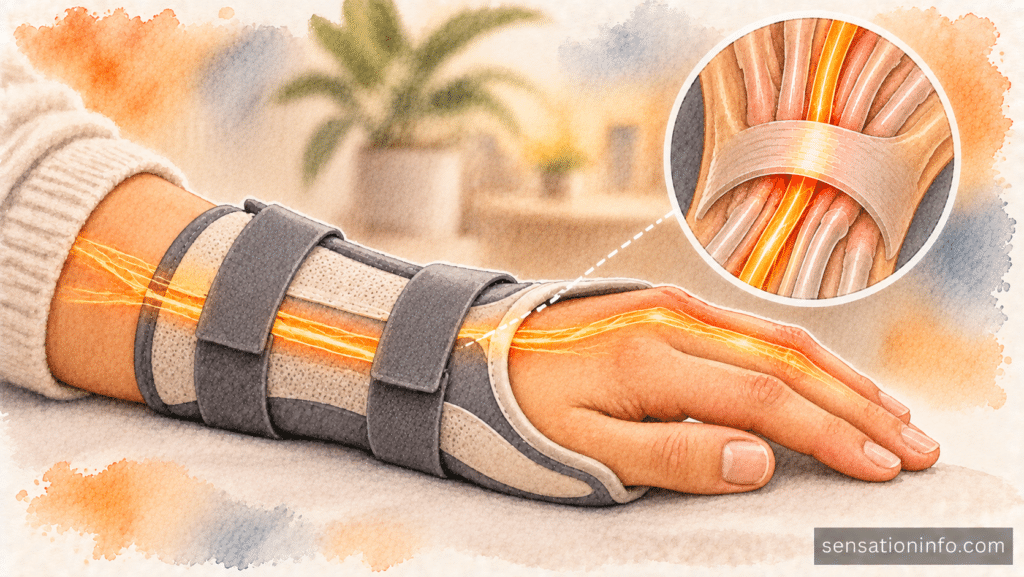
Early carpal tunnel often improves without surgery. The goal is to take pressure off the nerve, especially at night
First Steps You Can Take
- Wear a night splint. A wrist splint that holds your wrist straight is usually the first treatment. Make sure it does not press hard on the thumb side of your wrist.
- Keep your wrists straight at work. Set the keyboard at elbow height or slightly lower.
- Relax your grip. Type lightly and use a phone stand instead of gripping your phone.
- Take short breaks. Rest and gently move your hands every 30 to 60 minutes.
- Remove tight watches and bracelets on the numb hand.
Skip deep stretches that bend your wrist far forward or back and bring on tingling. A hand therapist can show you gentle nerve gliding exercises instead.
Medical Treatments
- Pain relievers: Nonsteroidal anti-inflammatory drugs (NSAIDs) such as ibuprofen (Advil, Motrin) or naproxen (Aleve) may ease pain for a short time. NINDS notes they have not been shown to treat the condition itself. Talk with your doctor before taking them for more than a few days.
- Corticosteroid injection: A steroid shot into the carpal tunnel can calm swelling. People with diabetes need extra care, because steroids can raise blood sugar.
- Treating the underlying condition: Managing diabetes, thyroid disease, or rheumatoid arthritis can help.
Surgery
Carpal tunnel release cuts the transverse carpal ligament to give the nerve more room. Doctors recommend it when other treatments do not work or when the condition is severe.
How Long Does Numbness in Thumb and Index Finger Last?
It depends on the cause and how early it is treated. Pressure numbness clears in minutes, while nerve compression can take weeks to months to settle.
| Situation | What to expect |
| Sleeping on your arm or leaning on your elbow | Clears within minutes to hours |
| Early carpal tunnel syndrome with a night splint | Often eases over several weeks of consistent use |
| Carpal tunnel syndrome during pregnancy | Usually improves after delivery |
| After carpal tunnel surgery | Cleveland Clinic reports recovery usually takes a month or two; grip strength can take several months |
| Pinched C6 nerve in the neck | Over 85% of cases resolve within 8 to 12 weeks, according to Cleveland Clinic |
Key Takeaways
- Numbness in thumb and index finger that wakes you at night is often the first sign of carpal tunnel syndrome.
- Shaking your hand to bring back feeling, clumsiness with buttons, and tingling while holding a phone or steering wheel are easy to miss early signs.
- Early carpal tunnel often improves with a night splint that keeps your wrist straight, plus changes to how you use your hands.
- A pinched C6 nerve in the neck can numb the same fingers, but it usually comes with neck pain that shoots down the arm.
- Weakness, dropping things, or a shrinking muscle at the base of the thumb needs a doctor visit within 1 to 2 weeks.
Frequently Asked Questions
Not necessarily. While constant daytime numbness indicates moderate to severe carpal tunnel syndrome, many patients still recover using corticosteroid injections and strict splinting. However, surgery is required if you begin losing muscle mass at the base of your thumb.
Carpal tunnel syndrome rarely goes away on its own if you continue the repetitive behaviors that caused it. However, if you catch the symptoms early and aggressively correct your ergonomics and sleep posture, the nerve irritation can fully resolve without medical intervention.
Numbness originating from the neck (cervical radiculopathy) usually involves neck stiffness and shooting pain that travels down your shoulder and arm. Carpal tunnel syndrome originating from the wrist rarely causes pain above the elbow.
Doctor’s Recommendation
When thumb and index finger numbness keeps returning despite a splint and hand changes, the next clinical question is how much pressure the median nerve is under and exactly where.
A nerve conduction study measures how well signals travel through the nerve. Knowing what the test involves can help you decide with your doctor whether it is time to confirm the diagnosis and plan treatment.
References
Mayo Clinic. Carpal tunnel syndrome: Symptoms and causes. Mayo Clinic. 2026.
Cleveland Clinic. Carpal Tunnel Syndrome. Cleveland Clinic. Accessed 2026.
Cleveland Clinic. Cervical Radiculopathy (Pinched Nerve). Cleveland Clinic. Accessed 2026.
Centers for Disease Control and Prevention. Signs and Symptoms of Stroke. CDC. Accessed 2026.