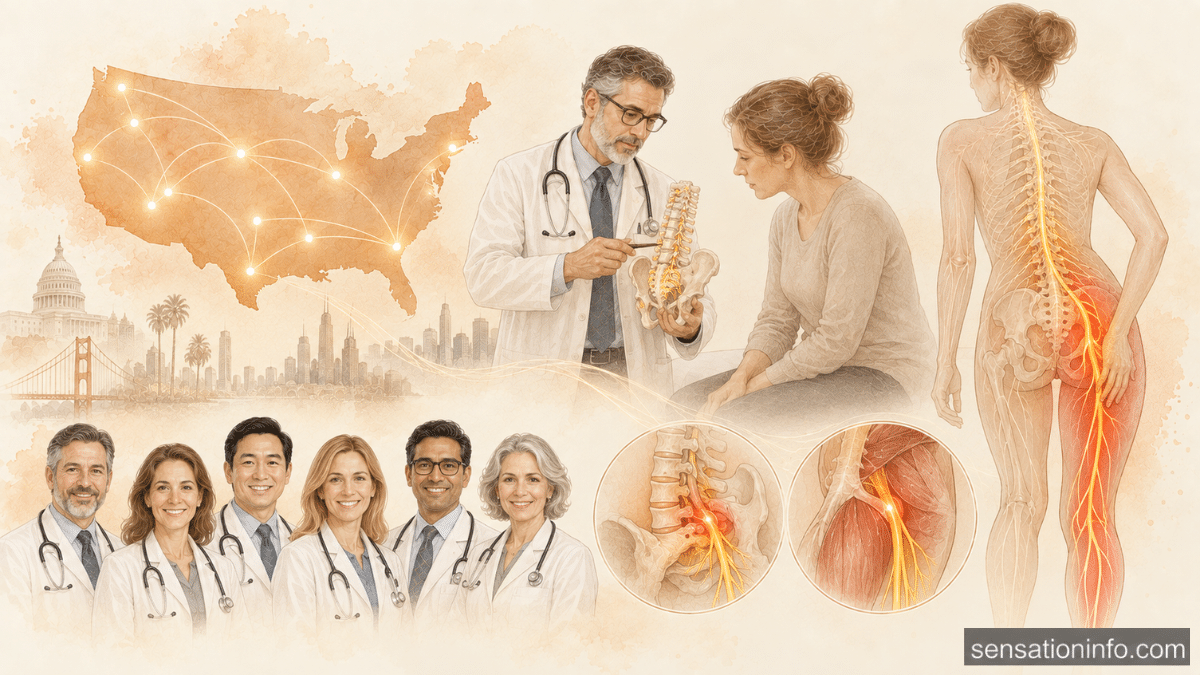

The best sciatica specialists in the USA are board certified spine surgeons and neurosurgeons at institutions like HSS, Johns Hopkins, Cleveland Clinic, Mount Sinai, and Stanford. The ten doctors listed here were verified for active practice, fellowship training in spine surgery, and peer reviewed recognition for treating sciatic nerve pain and lumbar radiculopathy. Sciatica affects up to 40 percent of adults at some point in their lives, and choosing the right specialist is the most important decision a patient can make. Specialists are listed for reference and are not ranked by preference.
How This List Was Compiled
Only about 7 percent of licensed physicians in the United States earn Castle Connolly Top Doctor recognition in any given year. Every specialist on this list was selected based on verified board certification, subspecialty training in spine surgery, documented recognition from peer reviewed organizations such as Castle Connolly and the North American Spine Society, and active appointment status at leading academic medical centers. Each doctor’s credentials, hospital profile, and contact information were confirmed through their institution’s official website.
Top Verified Sciatica Doctors Across the United States
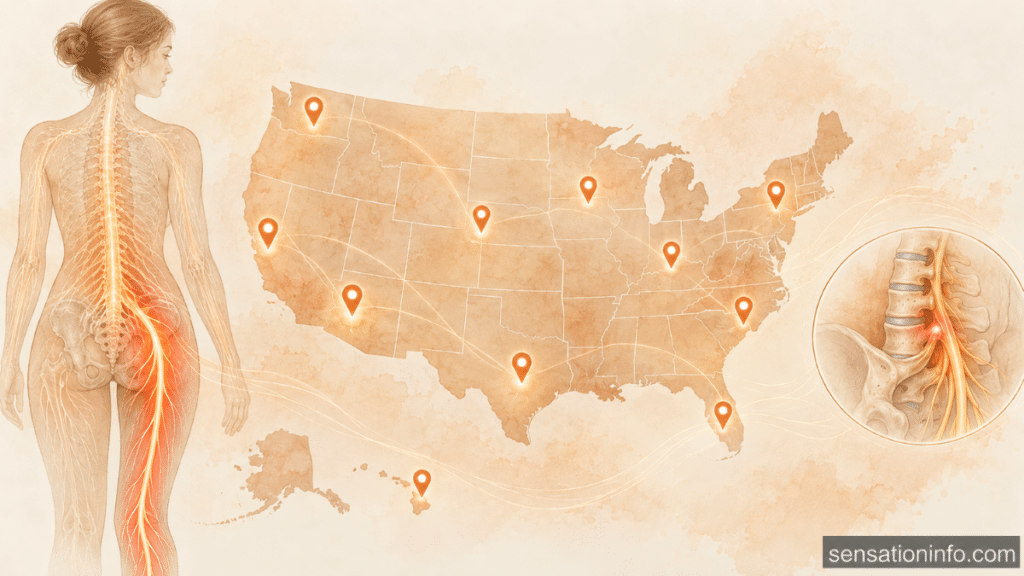
1. Dr. Christopher A. Yeung, MD
Hospital/Clinic: Desert Institute for Spine Care (DISC), Phoenix, Arizona
Specialty Focus: Minimally invasive and endoscopic spine surgery for lumbar disc herniation, sciatica, spinal stenosis, and degenerative disc disease
Why Listed: Castle Connolly Top Doctor for 15 consecutive years (2012 through 2026). Named among Newsweek’s America’s Leading Doctors in Spine Surgery for 2025. Becker’s Spine Leadership Award recipient. Serves as team spine surgeon for the Arizona Diamondbacks, Arizona Cardinals, and multiple MLB teams.
Address: 1635 East Myrtle Avenue, Suite 400, Phoenix, AZ 85020
Contact: (602) 944-2900
Profile: Desert Institute for Spine Care
What Sets Him Apart: Dr. Yeung is a principal investigator for multiple FDA studies on artificial disc replacement and dynamic stabilization, giving his patients access to advanced treatment options not available at most spine centers.
2. Dr. Todd J. Albert, MD
Hospital/Clinic: Hospital for Special Surgery (HSS), New York, New York
Specialty Focus: Orthopedic spine surgery with focus on cervical and lumbar spine disorders, minimally invasive techniques, and image guided spinal management
Why Listed: Surgeon-in-Chief Emeritus at HSS, the number one ranked orthopedic hospital in the United States by U.S. News and World Report for 2025 through 2027. Castle Connolly Top Doctor for 15 years. Recipient of the Nicholas Andry Award (2019) and Sir John Charnley Award of Excellence. Past President of the Cervical Spine Research Society and the Scoliosis Research Society.
Address: The Pavilion, 541 East 71st Street, New York, NY 10021
Contact: (212) 606-1004
Profile: Hospital for Special Surgery
What Sets Him Apart: As former Surgeon-in-Chief at the nation’s top orthopedic hospital, Dr. Albert brings decades of leadership in spinal innovation, including performing HSS’s first augmented reality spine surgery.
3. Dr. Sheeraz Qureshi, MD, MBA
Hospital/Clinic: Hospital for Special Surgery (HSS), New York, New York
Specialty Focus: Minimally invasive and motion preserving spine surgery, including TLIF, LLIF, and disc replacement for lumbar radiculopathy and sciatica
Why Listed: Co-Chief of HSS Spine and holder of the Patty and Jay Baker Chair in Minimally Invasive Spine Surgery. Professor of Orthopedic Surgery at Weill Cornell Medical College. Castle Connolly Top Doctor for 10 years. New York Times Super Doctor (2014 through 2020).
Address: The Pavilion, 541 East 71st Street, New York, NY 10021
Contact: (212) 606-1585
Profile: Hospital for Special Surgery
What Sets Him Apart: Dr. Qureshi’s dual training in medicine and health administration (MBA earned during medical school) gives him a patient centered approach that combines clinical precision with healthcare systems thinking, ensuring streamlined care pathways for sciatica patients.
4. Dr. Andrew C. Hecht, MD
Hospital/Clinic: The Spine Hospital at Mount Sinai, New York, New York
Specialty Focus: Cervical and lumbar spine surgery, including herniated discs, spinal stenosis, minimally invasive spine surgery, microsurgery, spine trauma, and tumors
Why Listed: System Chief of Spine Surgery for the Mount Sinai Health System. Professor of Orthopaedic Surgery and Neurologic Surgery at Icahn School of Medicine at Mount Sinai. Castle Connolly Top Doctor in America for Orthopaedic Spine Surgery. Harvard Medical School graduate with spine fellowship from Emory University. Director of the NFL Spine Care Program for retired players.
Address: 5 East 98th Street, 4th Floor, New York, NY 10029
Contact: (212) 241-0735
Profile: Mount Sinai Health System
What Sets Him Apart: As Director of the NFL Spine Care Program, Dr. Hecht manages spinal conditions in former professional athletes, demonstrating a level of expertise in complex lumbar cases that directly benefits civilian patients with persistent sciatica.
5. Dr. Ali Bydon, MD
Hospital/Clinic: Johns Hopkins Hospital, Baltimore, Maryland
Specialty Focus: Degenerative spine disorders, lumbar disc herniation, spinal stenosis, spinal tumors, spinal trauma, and complex spinal reconstruction
Why Listed: Director of the Division of Spine Neurosurgery at Johns Hopkins. Professor of Neurological Surgery holding the Ziya L. Gokaslan Professorship. Over 5,000 surgeries performed and more than 265 peer reviewed publications. Has trained more than 75 practicing neurosurgeons. Best Scientific Paper Award from SPINE journal (2013).
Address: 401 North Broadway Street, Weinberg Building, Floor L2, Baltimore, MD 21287
Contact: Appointments through Johns Hopkins Medicine website
Profile: Johns Hopkins Medicine
What Sets Him Apart: With over 5,000 surgeries and 265 published papers, Dr. Bydon combines one of the highest surgical volumes in the field with an active research program that shapes how sciatica and lumbar spine disorders are treated nationally.
6. Dr. Michael P. Steinmetz, MD
Hospital/Clinic: Cleveland Clinic, Cleveland, Ohio
Specialty Focus: Complex spine surgery, minimally invasive spinal procedures, spine trauma, and spinal cord injury management
Why Listed: Chairman of the Department of Neurosurgery at Cleveland Clinic. Professor and Chairman of Neurological Surgery at Cleveland Clinic Lerner College of Medicine. Author of over 145 peer reviewed publications. Co-editor of Benzel’s Spine Surgery textbook and Section Editor for World Neurosurgery.
Address: 9500 Euclid Avenue, Cleveland, OH 44195
Contact: (216) 636-5860
Profile: Cleveland Clinic
What Sets Him Apart: As Chairman of Neurosurgery at one of the world’s leading health systems, Dr. Steinmetz oversees a spine care team that treats some of the most complex cases in the country, with patient satisfaction ratings of 4.9 out of 5 stars.
7. Dr. Kern Singh, MD
Hospital/Clinic: Rush University Medical Center, Chicago, Illinois
Specialty Focus: Minimally invasive and endoscopic spine surgery for cervical, thoracic, and lumbar spine disorders, spinal disc replacement, motion preserving technology, and complex degenerative spine conditions
Why Listed: Vice Chair of Clinical Affairs, Department of Orthopaedic Surgery at Rush. Professor and Director, Division of Spine Surgery. Co-Director of the Minimally Invasive Spine Institute. Named to Becker’s Top 100 Spine Surgeons. Crain’s 2026 Notable Leaders in Healthcare. Best Paper honors at North American Spine Society (2013). Most Compassionate Doctor Award from Vitals.com.
Address: 1611 West Harrison Street, Chicago, IL 60612
Contact: (877) 632-6637
Profile: Midwest Orthopaedics at Rush
What Sets Him Apart: Dr. Singh’s combination of high volume minimally invasive spine surgery and his role leading suture-less endoscopic procedures positions him at the forefront of outpatient sciatica treatment, getting patients back to normal activity faster.
8. Dr. John M. Rhee, MD
Hospital/Clinic: Emory Orthopaedics and Spine Center, Atlanta, Georgia
Specialty Focus: Cervical and lumbar spine surgery, complex spinal deformity correction including scoliosis and kyphosis, and spinal tumor surgery
Why Listed: Named among Newsweek’s America’s Leading Doctors in Spine Surgery for 2025. Listed among the top 28 spine surgeons in North America by Orthopaedics This Week. Past President of the Cervical Spine Research Society (2020 through 2021). First Place Award for Outstanding Clinical Research from the Cervical Spine Research Society. Author of multiple spine surgery textbooks.
Address: 21 Ortho Lane, Atlanta, GA 30329
Contact: (404) 778-3350
Profile: Emory Healthcare
What Sets Him Apart: Dr. Rhee’s tenure as President of the Cervical Spine Research Society and his textbook authorship reflect a depth of knowledge in spinal biomechanics that directly informs his surgical decision making for patients with lumbar nerve compression and sciatica.
9. Dr. Ehsan Saadat, MD
Hospital/Clinic: Cedars-Sinai Medical Center, Los Angeles, California
Specialty Focus: Disc replacement and motion preserving surgery, minimally invasive microscopic decompression of the lumbar spine, minimally invasive spinal fusions (XLIF and ALIF), and complex revision spine surgery
Why Listed: Named among Newsweek’s America’s Leading Spine Surgeons for 2025. Assistant Professor of Orthopaedic Surgery at Cedars-Sinai. Harvard trained (residency) and Emory fellowship trained. Practices at a facility ranked number two nationally for orthopedic surgery by U.S. News and World Report.
Address: 444 South San Vicente Boulevard, Suite 901, Los Angeles, CA 90048
Contact: (310) 961-9820
Profile: Saadat Spine at Cedars-Sinai
What Sets Him Apart: Dr. Saadat’s focus on motion preserving disc replacement and robotic spine surgery at Cedars-Sinai means patients with sciatica from lumbar disc herniation may avoid traditional fusion, maintaining natural spinal movement while eliminating nerve compression.
10. Dr. James M. Mok, MD, MBA
Hospital/Clinic: Stanford Health Care, Stanford University, California
Specialty Focus: Minimally invasive spine surgery, including microdiscectomy, laminectomy, spinal fusion, and artificial disc replacement for degenerative disc conditions, disc herniations, stenosis, and spondylolisthesis
Why Listed: Clinical Associate Professor, Department of Orthopaedic Surgery at Stanford University School of Medicine. Chief of Spinal Endoscopy, Division of Spine Surgery (2026). Fellowship trained at The Spine Institute, California, and residency at UCSF. Member of the North American Spine Society, Scoliosis Research Society, and Society for Minimally Invasive Spine Surgery. Patient rating of 4.9 out of 5 from over 420 reviews.
Address: 420 Broadway, Pavilion D, Floor 2, Redwood City, CA 94063
Contact: (650) 725-1125
Profile: Stanford Health Care
What Sets Him Apart: Dr. Mok’s appointment as Stanford’s Chief of Spinal Endoscopy in 2026 positions him at the leading edge of ultra-minimally invasive techniques, offering sciatica patients smaller incisions, less tissue disruption, and faster recovery times.
Specialist Comparison

| Specialist | Location | Specialty Focus | Key Recognition |
|---|---|---|---|
| Dr. Christopher A. Yeung, MD | Phoenix, AZ | Endoscopic and minimally invasive spine surgery | Castle Connolly Top Doctor 15 years; Newsweek Leading Doctor |
| Dr. Todd J. Albert, MD | New York, NY | Cervical and lumbar spine disorders | Surgeon-in-Chief Emeritus, HSS; Castle Connolly 15 years |
| Dr. Sheeraz Qureshi, MD, MBA | New York, NY | Minimally invasive and motion preserving spine surgery | Co-Chief HSS Spine; Castle Connolly 10 years |
| Dr. Andrew C. Hecht, MD | New York, NY | Lumbar surgery, herniated discs, spinal stenosis | Chief of Spine Surgery, Mount Sinai; NFL Spine Care Director |
| Dr. Ali Bydon, MD | Baltimore, MD | Degenerative spine, lumbar disc herniation | Division Director, Johns Hopkins; 5,000+ surgeries |
| Dr. Michael P. Steinmetz, MD | Cleveland, OH | Complex spine, minimally invasive procedures | Chairman of Neurosurgery, Cleveland Clinic |
| Dr. Kern Singh, MD | Chicago, IL | Minimally invasive and endoscopic spine surgery | Becker’s Top 100; Crain’s 2026 Notable Healthcare Leader |
| Dr. John M. Rhee, MD | Atlanta, GA | Cervical and lumbar spine, spinal deformity | Past President, CSRS; Newsweek Leading Doctor |
| Dr. Ehsan Saadat, MD | Los Angeles, CA | Disc replacement, motion preserving surgery | Newsweek Leading Surgeon; Harvard and Emory trained |
| Dr. James M. Mok, MD, MBA | Stanford, CA | Minimally invasive and endoscopic spine surgery | Chief of Spinal Endoscopy, Stanford; UCSF residency |
How to Choose the Right Sciatica Specialist
Choosing the right doctor starts with understanding the type of specialist who matches your condition. For most sciatica patients, an orthopedic spine surgeon or a neurosurgeon with fellowship training in spine surgery is the appropriate specialist. Both are trained to diagnose and treat nerve compression in the lumbar spine.
Look for board certification from the American Board of Orthopaedic Surgery or the American Board of Neurological Surgery. Fellowship training in spine surgery is the strongest indicator of subspecialty competence for sciatica treatment. A surgeon who treats a high volume of lumbar disc herniations and spinal stenosis cases will generally have better outcomes than one who performs spine surgery occasionally.
Consider whether the specialist practices at an academic medical center or a dedicated spine center, as these institutions typically offer multidisciplinary care teams that include physiatrists, pain management physicians, physical therapists, and neurologists. This team approach is particularly valuable for sciatica, where nonsurgical options such as epidural steroid injections, physical therapy, and nerve blocks should be explored before surgery.
If you are dealing with persistent tingling or numbness in your legs, a specialist who offers both conservative and surgical options ensures all treatment pathways are evaluated before a decision is made.
When distance is a factor, many of these specialists now offer virtual consultations for initial evaluations and second opinions, making specialized spine care accessible regardless of geographic location.
Questions to Ask at Your First Appointment
Preparing specific questions before your appointment helps you evaluate the specialist and understand your treatment options. These seven questions cover the essentials every sciatica patient should ask.
- What is the specific cause of my sciatica, and how was it diagnosed?
- Have all nonsurgical treatment options been explored for my case?
- What is your experience with minimally invasive surgery for my specific condition?
- How many procedures like the one you are recommending have you performed in the past year?
- What are the realistic outcomes, and how long is the typical recovery?
- Will I need physical therapy after treatment, and for how long?
- Does my insurance plan cover the recommended procedure at this facility?
What to Expect During Your First Visit
A first appointment with a sciatica specialist typically lasts 30 to 60 minutes. The doctor will review your medical history, ask about the location and severity of your pain, and perform a physical examination that includes tests for nerve function, reflexes, and range of motion in the lower back and legs. You should bring any existing imaging (MRI or CT scans) and a list of treatments you have already tried.
If imaging has not been done, the specialist may order an MRI of the lumbar spine to visualize the nerve roots and identify the source of compression, whether it is a herniated disc, spinal stenosis, or another structural issue. In some cases, electrodiagnostic studies (EMG/NCV) are ordered to assess nerve damage.
Most specialists will discuss a treatment plan during the first visit. Surgery for sciatica is rarely the first step. For many patients, treatment starts with physical therapy, anti-inflammatory medications, and possibly epidural steroid injections. Surgery is generally recommended only after conservative treatment has failed for six to twelve weeks, or sooner if there is significant muscle weakness, loss of bowel or bladder function, or progressive neurological decline.
Regarding insurance, most major plans cover sciatica evaluation and treatment at these academic medical centers. Contact the facility’s patient financial services department before your visit to confirm coverage and understand any out of pocket costs. If your sciatica is accompanied by burning sensations in the lower back, mention this to your specialist, as it may indicate additional nerve involvement that affects the treatment approach.
Frequently Asked Questions
An orthopedic spine surgeon or a neurosurgeon with fellowship training in spine surgery is the most qualified specialist for sciatica. Both types of surgeon are trained to diagnose and treat the structural causes of sciatic nerve compression, including lumbar disc herniations, spinal stenosis, and spondylolisthesis. For nonsurgical management, a physiatrist (physical medicine and rehabilitation physician) or a pain management specialist may be the appropriate first step.
See a specialist if your sciatica has not improved after four to six weeks of conservative treatment, if you have progressive weakness in your leg or foot, if you experience numbness in the groin or saddle area, or if you lose bladder or bowel control. These symptoms may indicate serious nerve compression that requires urgent evaluation.
No. Approximately 80 to 90 percent of sciatica cases resolve with nonsurgical treatment, including physical therapy, medications, and injections. Surgery is typically reserved for cases where conservative measures have failed after six to twelve weeks, or when imaging reveals significant nerve compression causing progressive neurological deficits.
A microdiscectomy is the most commonly performed surgery for sciatica caused by a herniated lumbar disc. This minimally invasive procedure removes the portion of the disc that is compressing the sciatic nerve root. The procedure typically takes less than an hour, and most patients go home the same day with significant pain relief.
Yes. Many of the specialists listed here offer virtual consultations for initial evaluations and second opinions. Virtual visits are particularly useful if you are considering traveling for treatment and want to discuss your case before committing to an in person appointment. Contact the specialist’s office directly to ask about telehealth availability.
Key Takeaways
- The ten specialists listed here practice at some of the highest ranked spine centers in the United States, including HSS, Cleveland Clinic, Johns Hopkins, Mount Sinai, Stanford, Rush, Cedars-Sinai, and Emory.
- Every doctor on this list holds board certification and completed fellowship training specifically in spine surgery.
- Most sciatica cases resolve without surgery, and a qualified specialist will exhaust conservative options before recommending an operation.
- Minimally invasive and endoscopic spine surgery techniques have significantly reduced recovery times for patients who do require surgical intervention.
- Virtual consultations are now widely available, making it possible to access these specialists regardless of where you live in the country.
- When choosing a sciatica specialist, prioritize board certification, spine fellowship training, surgical volume, and whether the physician practices at a multidisciplinary spine center.
Doctor’s Recommendation
If you are experiencing sciatica related tingling that extends into your legs or feet, understanding the underlying nerve involvement can help you have a more productive conversation with your specialist. Our medical guide on relieving sciatica tingling covers the mechanisms of sciatic nerve compression and practical steps you can take while waiting for your appointment.