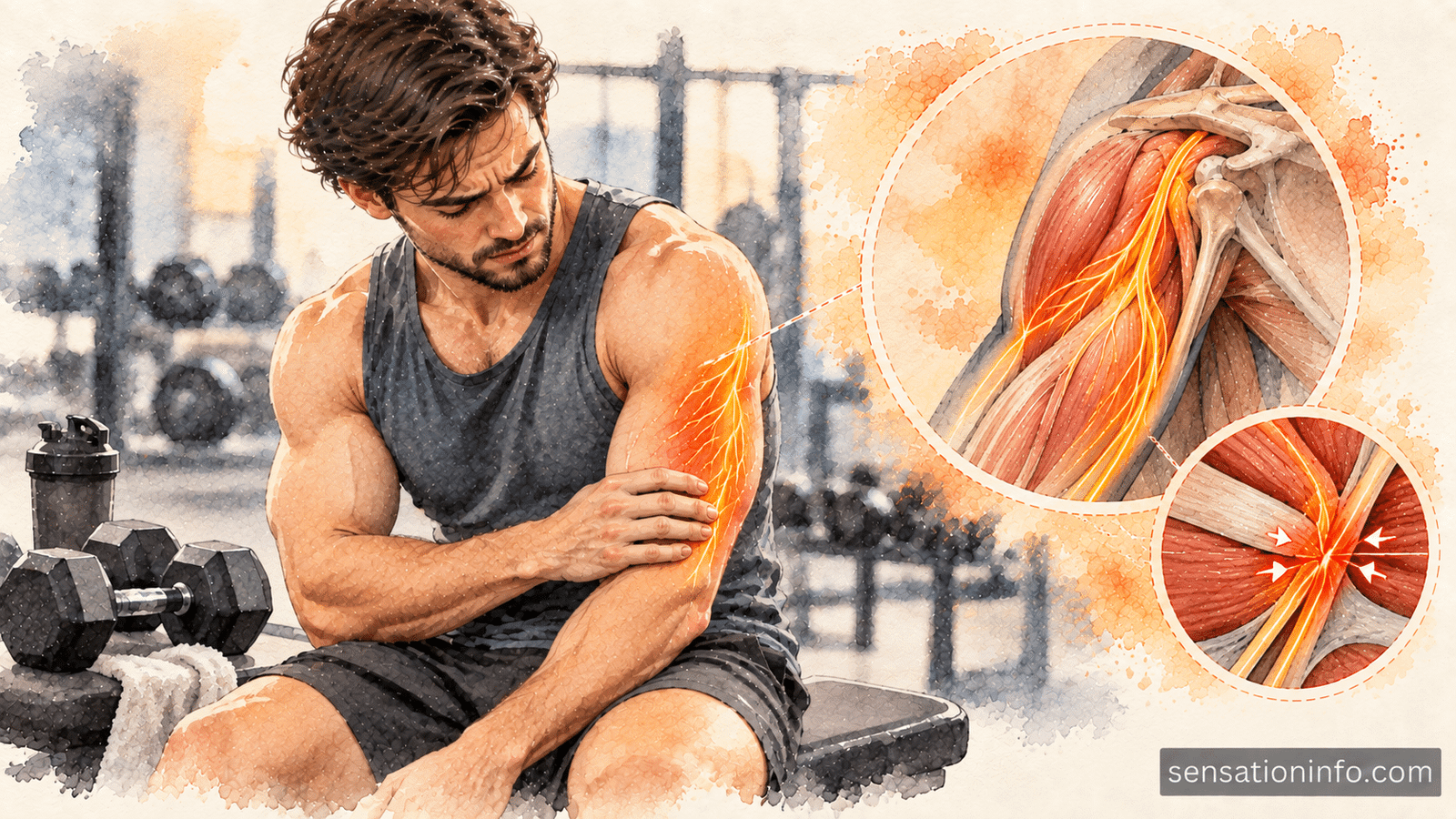

Experiencing numbness over the outside of your bicep after a heavy lifting session usually happens when intense muscle contractions or repetitive curling motions compress the delicate nerves in your upper arm. During strenuous resistance training, your muscles naturally swell with blood, which can temporarily pinch the musculocutaneous nerve and its sensory branches as they weave through tight anatomical tunnels.
While experiencing this kind of unusual tingling and numbness after exercise is highly common and typically resolves with proper rest and mobility work, you should pay close attention to how long the sensation lasts. If the sensory loss persists for days, or is accompanied by neck pain and a sudden drop in arm strength, you need a prompt medical evaluation to rule out a pinched nerve in your cervical spine.
When to Seek Immediate Medical Attention
Most cases of numbness after training are benign and temporary. However, certain symptoms indicate serious neurological compromise or acute musculoskeletal trauma that warrants prompt clinical care.
Seek immediate emergency medical evaluation if you develop any of the following red flag symptoms:
- Sudden loss of motor strength when bending your elbow, raising your arm, or turning your palm upward
- A visible muscle deformity or sudden ball like bulge near your shoulder or elbow crease, which indicates a biceps tendon tear
- Sharp, electric pain , tingling or burning sensation that starts in your neck and radiates down through your shoulder into your fingers
- Persistent, complete numbness across your entire arm or hand that does not improve after resting
- Progressive muscle wasting or visible shrinkage in your shoulder or arm muscles
- Unexplained loss of bowel or bladder control, which is a critical medical emergency related to severe spinal cord compression
- Coldness, skin discoloration, or a weakened pulse in your forearm and hand
If your symptoms are confined to localized, mild sensory blunting or tingling on the outer bicep without weakness, you can safely explore conservative self care while monitoring your recovery.
Anatomy of the Lateral Bicep: How Nerves Travel Through Your Arm
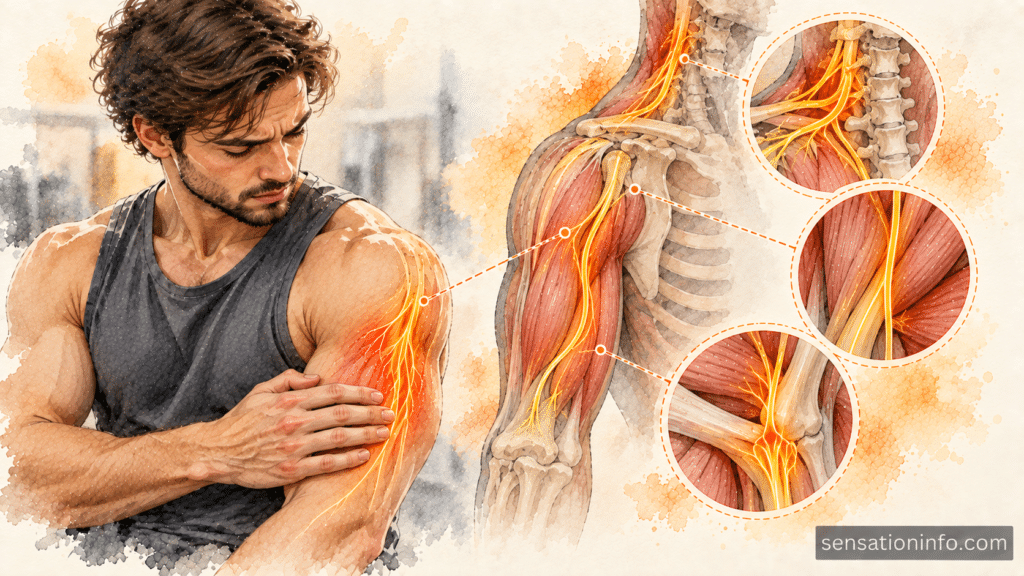
Understanding why heavy resistance training triggers numbness over the lateral bicep requires a clear look at how upper extremity nerves travel from your neck to your hand.
Musculocutaneous Nerve Entrapment
The musculocutaneous nerve originates from the lateral cord of the brachial plexus, carrying motor and sensory nerve fibers from the C5, C6, and C7 spinal levels. It travels downward through your upper arm, piercing the coracobrachialis muscle before running between the biceps brachii and the brachialis muscles.
This nerve provides motor control to your primary elbow flexor muscles and delivers sensory innervation to the skin along the lateral aspect of your arm and forearm. During heavy barbell curls, preacher curls, and weighted chin ups, forceful contraction of the biceps and brachialis muscles generates high mechanical tension. According to clinical data published by the National Library of Medicine, repetitive contraction of hypertrophied arm musculature can entrap the musculocutaneous nerve within its fascial tunnel, causing localized numbness, tingling, and dull aching along the outer bicep.
Lateral Antebrachial Cutaneous Nerve Irritation
Near the elbow crease, the musculocutaneous nerve emerges from beneath the biceps tendon to continue as the lateral antebrachial cutaneous nerve. This purely sensory nerve pierces the deep fascia just lateral to the distal biceps tendon and passes beneath the bicipital aponeurosis, a dense band of fibrous connective tissue.
Exercises that combine heavy loading with forearm pronation and elbow extension, such as heavy deadlifts, farmers walks, and barbell rows, pull the bicipital aponeurosis taut. This anatomical tension can compress the lateral antebrachial cutaneous nerve against surrounding tendon fibers, generating sharp prickling or persistent numbness over the distal outer bicep and radial forearm.
Intramuscular Swelling and External Gear Pressure
Strenuous lifting produces microtrauma in muscle fibers, triggering acute cellular swelling, localized inflammation, and increased compartment pressure. In muscular athletes, this swelling leaves little room for adjacent peripheral nerves. When athletes wear tight arm wraps, heavy compression cuffs, or blood flow restriction bands placed too high on the arm, external pressure restricts microvascular circulation to the nerve sheath, producing acute paresthesia.
Differentiating Lateral Bicep Numbness from Other Conditions
Because multiple spinal and peripheral conditions can cause arm numbness, comparing your specific symptoms against key clinical patterns helps clarify the source of the problem.
| Condition | Primary Location of Numbness | Aggravating Movements | Key Accompanying Symptoms |
|---|---|---|---|
| Musculocutaneous Nerve Entrapment | Lateral bicep and anterolateral forearm | Heavy curls, resisted elbow flexion | Deep muscular ache, fatigue during forearm supination |
| Lateral Antebrachial Cutaneous Neuropathy | Distal outer bicep and radial forearm | Heavy carries, full elbow extension | Burning near elbow crease, hypersensitivity to touch |
| Cervical Radiculopathy (C5 or C6) | Neck, shoulder top, outer bicep, thumb | Neck extension, rotation, overhead lifts | Radiating shooting pain, neck stiffness, reduced biceps reflex |
| Distal Biceps Tendinopathy | Anterior elbow with radiating upper arm ache | Heavy pulling, eccentric lowering | Localized tendon tenderness, pain during resisted supination |
| Radial Nerve Compression | Posterior arm, dorsal forearm, thumb web | Triceps extensions, direct rear arm pressure | Weakness extending wrist and fingers, wrist drop |
| Thoracic Outlet Syndrome | Medial arm, forearm, ring and little finger | Overhead carrying, prolonged elevated arms | Swelling in hand, cold fingers, vascular color changes |
Cervical Radiculopathy vs Local Arm Nerve Entrapment
One of the most important clinical distinctions is whether your numbness originates in your neck or your arm. The National Institute of Neurological Disorders and Stroke notes that cervical radiculopathy occurs when a spinal nerve root becomes pinched by a herniated disc, bone spur, or spinal stenosis.
When the C5 or C6 nerve root is compressed, it sends sensory disturbances down the exact same lateral arm dermatome supplied by the musculocutaneous nerve. However, spinal nerve compression is typically aggravated by neck motion rather than isolated arm contractions. If tilting your head backward and turning toward the symptomatic side reproduces your arm numbness, a positive Spurling sign, your condition likely stems from a cervical spine issue. If neck movements cause no discomfort and numbness changes only during direct arm exercises, localized peripheral nerve entrapment is far more probable
Distal Biceps Tendon Irritation
The distal biceps tendon connects your biceps muscle to the radius bone near the elbow. Repetitive strain from heavy lifting can inflame this tendon sheath, producing fluid accumulation and localized swelling. Because the lateral antebrachial cutaneous nerve runs directly adjacent to the tendon, inflammatory swelling from tendon overuse can produce secondary nerve compression, leading to distal biceps tendon irritation and elbow strain alongside outer arm numbness.
Clinical Diagnosis: What to Expect During an Examination

If your arm numbness persists beyond a couple of weeks, a sports medicine physician, orthopedist, or physical therapist can perform a thorough examination to determine the precise site of compression.
- Physical Inspection and Palpation: Your clinician examines both arms for muscle symmetry, localized swelling, or tendon defects. They will palpate the coracobrachialis muscle, the anterior bicep belly, and the lateral elbow crease to identify tender spots and reproduce tingling.
- Neurological and Motor Testing: Sensory testing with light touch and pinprick mapping outlines the exact borders of sensory impairment. Motor testing evaluates the strength of elbow flexion and forearm supination, isolating individual muscle groups.
- Cervical Provocative Maneuvers: Clinical maneuvers such as the Spurling test, cervical distraction, and upper limb tension tests evaluate whether spinal nerve roots contribute to your symptoms.
- Electrodiagnostic Testing: Electromyography and nerve conduction studies measure the electrical conduction speed and amplitude along the musculocutaneous nerve, pinpointing the exact location where nerve signals are delayed.
- Diagnostic Imaging: Magnetic resonance imaging of your cervical spine or arm evaluates disc pathology, soft tissue masses, and tendon tears. High resolution diagnostic ultrasound provides dynamic visualization of the nerve sliding beneath the bicipital aponeurosis during active elbow motion.
Phased Recovery and Rehabilitation Protocol
Treating workout related lateral bicep numbness requires a structured approach that removes mechanical compression, restores neural mobility, and safely rebuilds lifting tolerance.
Phase 1: Acute Load Modification (Days 1 to 7)
The primary goal during the first week is eliminating the repetitive friction irritating the nerve.
- Pause heavy straight barbell curls, weighted pull ups, preacher curls, and heavy deadlifts.
- Avoid training to muscular failure, which causes extreme intramuscular swelling and compromises joint mechanics.
- Shift upper body training toward neutral grip dumbbell exercises and chest supported rows that reduce strain on the biceps tendon.
- If swelling or aching is present, an over the counter anti inflammatory medication such as ibuprofen (Advil) or naproxen (Aleve) can help reduce tissue inflammation, provided your doctor confirms it is safe for you.
- Apply cold packs wrapped in a thin cloth to the anterior arm for ten to fifteen minutes after workouts to manage exercise induced tissue warmth and edema.
Phase 2: Restoring Nerve Mobility and Tissue Flexibility (Weeks 2 to 4)
Once acute irritation calms down, gentle neural mobilization helps the nerve glide smoothly through muscular corridors without adhering to surrounding tissues.
- Musculocutaneous Nerve Gliding Drill: Stand upright with your arm at your side. Extend your shoulder slightly backward, straighten your elbow completely, internally rotate your arm so your palm faces backward, and gently tilt your head toward the opposite shoulder. Hold this gentle position for two seconds, then return to the starting position. Perform six to eight slow, painless repetitions twice daily.
- Targeted Myofascial Release: Perform gentle self massage along the pectoralis minor, anterior deltoid, and coracobrachialis muscles using light palm pressure. Avoid digging aggressively into spots with active numbness or tingling, as direct mechanical pressure can aggravate nerve inflammation.
- Submaximal Isometric Loading: Perform light isometric elbow flexion holds at ninety degrees using thirty to fifty percent of your maximum effort to maintain neuromuscular connection without stressing the nerve.
Phase 3: Gradual Return to Progressive Resistance (Weeks 4 to 8)
When resting sensation has normalized and basic mobility drills cause no tingling, you can safely reintroduce progressive resistance training.
- Begin with moderate loads and higher repetition ranges (twelve to fifteen repetitions), focusing on controlled eccentric lowering.
- Use training tools that allow natural wrist rotation, such as an EZ curl bar, dumbbells, or cable ropes, rather than fixed straight bars.
- Monitor your arm for twenty four hours after each workout. If tingling or numbness returns, reduce your training volume and intensity by twenty to thirty percent.
Practical Strategies to Prevent Bicep Nerve Compression
Preventing recurrent nerve compression involves refining your exercise selection, managing total training volume, and maintaining proper lifting mechanics.
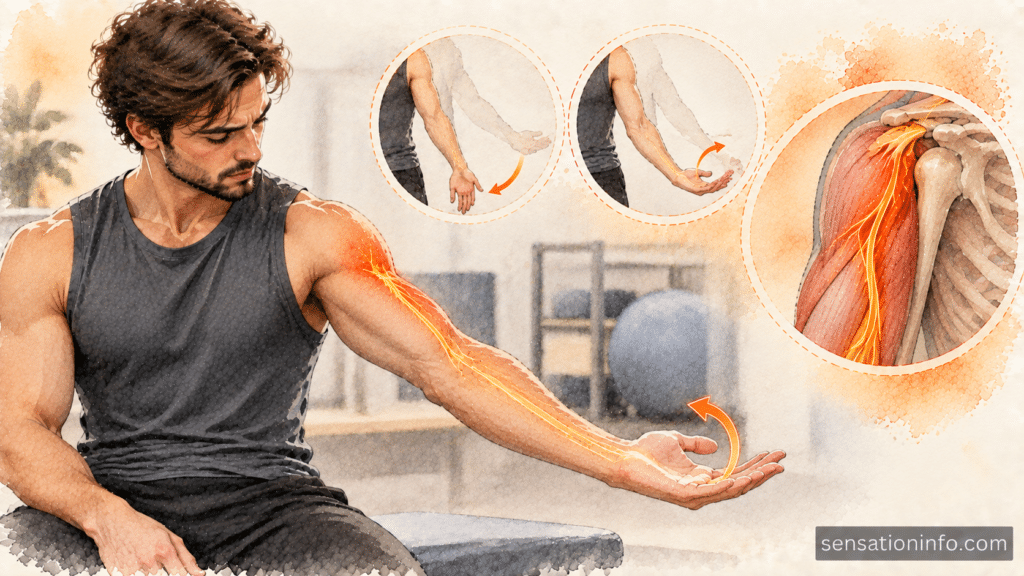
- Avoid Rigid Straight Barbell Curls: Straight barbells force your forearms into maximum supination, increasing pressure on the bicipital aponeurosis and compressing the lateral antebrachial cutaneous nerve. Switching to an EZ curl bar or dumbbells allows your wrists to stay in a comfortable, joint friendly position.
- Warm Up Upper Body Neural Pathways: Spend five to ten minutes before lifting performing dynamic arm circles, light band pull aparts, and gentle nerve glides to increase blood flow and tissue elasticity.
- Avoid Overly Restrictive Supportive Gear: Remove tight compression sleeves, elbow wraps, or supportive cuffs between sets. Never wrap blood flow restriction bands so tightly that your skin becomes pale, cold, or numb.
- Progress Volume Gradually: Increase your total weekly training volume or weight by no more than five to ten percent per week. Gradual progression gives tendons, fascia, and nerves adequate time to adapt to mechanical demands.
- Maintain Neutral Spine and Neck Posture: Keep your cervical spine in neutral alignment during heavy squats, deadlifts, and overhead presses to prevent compressing nerve roots in your neck.
Common Myths About Lifting and Arm Numbness
Widespread misconceptions in the gym can lead lifters to ignore genuine nerve compression or pursue harmful treatments.
- Myth: Numbness is caused by lactic acid buildup. Lactic acid contributes to temporary muscle burning during high repetition sets and clears rapidly following exercise. It does not cause cutaneous numbness or prolonged sensory loss.
- Myth: You should dig into the numb spot with a hard lacrosse ball. Rolling aggressively over a superficial, inflamed nerve damages the delicate neural sheath and worsens swelling. Soft tissue work should target surrounding muscle tissue while avoiding direct focal pressure on sensitive nerves.
- Myth: If there is no sharp pain, you can ignore the numbness and keep lifting heavy. Painless numbness indicates that sensory nerve fibers are experiencing reduced blood supply or physical compression. Continuing to lift heavy weights through numbness can convert mild, reversible neuropraxia into chronic nerve dysfunction.
Expected Recovery Timeline
The duration of recovery depends on the underlying cause and severity of nerve irritation.
- Mild Exercise Induced Neuropraxia: Sensory symptoms resulting from transient muscle swelling or tight sleeves typically resolve within one to three weeks with load reduction, hydration, and gentle mobility.
- Moderate Entrapment with Fascial Tightness: Nerve irritation involving the bicipital aponeurosis or coracobrachialis generally resolves over four to six weeks of structured physical therapy, nerve gliding, and technique modification.
- Cervical Radiculopathy or Structural Nerve Injury: When numbness originates from a cervical disc herniation or chronic nerve entrapment, full recovery may take three to six months and requires ongoing clinical oversight.
Key Takeaways
- Numbness over the lateral bicep after heavy lifting is most frequently caused by localized compression of the musculocutaneous nerve or the lateral antebrachial cutaneous nerve.
- Forceful elbow flexion and heavy forearm rotation create muscular swelling and fascial tension that temporarily reduce nerve blood supply.
- Distinguishing localized arm nerve entrapment from cervical spine radiculopathy is essential for choosing the correct rehabilitation plan.
- Immediate recovery focuses on load modification, avoiding rigid straight barbell exercises, and performing gentle nerve gliding drills.
- Persistent sensory loss, sudden muscle deformity, or noticeable arm weakness warrants prompt medical evaluation by an orthopedic or sports medicine physician.
Frequently Asked Questions
Numbness on the outer bicep after curls occurs when swollen arm muscles or tight connective tissue press against the musculocutaneous nerve or lateral antebrachial cutaneous nerve during heavy elbow bending.
Mild nerve compression from lifting typically resolves within one to three weeks when you reduce training weight, avoid straight barbells, and perform gentle nerve gliding drills.
You should pause heavy bicep curls and pulling movements that worsen the numbness, but you can continue training other muscle groups with neutral grip exercises that cause no arm symptoms.
Doctor’s Recommendation
If your lateral bicep numbness is accompanied by neck stiffness, shoulder aching, or tingling that extends past your elbow into your fingers, reviewing clinical guidance on cervical nerve root compression and radicular arm symptoms can provide valuable insight into spinal nerve pathways. Understanding the connection between cervical spine alignment and peripheral nerve function will help you have a productive discussion with your physician regarding diagnostic imaging and physical therapy.
References
- American Academy of Orthopaedic Surgeons. Cervical Radiculopathy (Pinched Nerve). OrthoInfo. 2022.
- National Institute of Neurological Disorders and Stroke. Pinched Nerve Information Page. National Institutes of Health. 2023.
- National Library of Medicine. Musculocutaneous Nerve Entrapment. StatPearls Publishing. 2023.
- Cleveland Clinic. Peripheral Neuropathy: Causes, Symptoms, and Treatment. Cleveland Clinic Health Library. 2024.
- Mayo Clinic. Pinched Nerve: Symptoms and Causes. Mayo Foundation for Medical Education and Research. 2023.