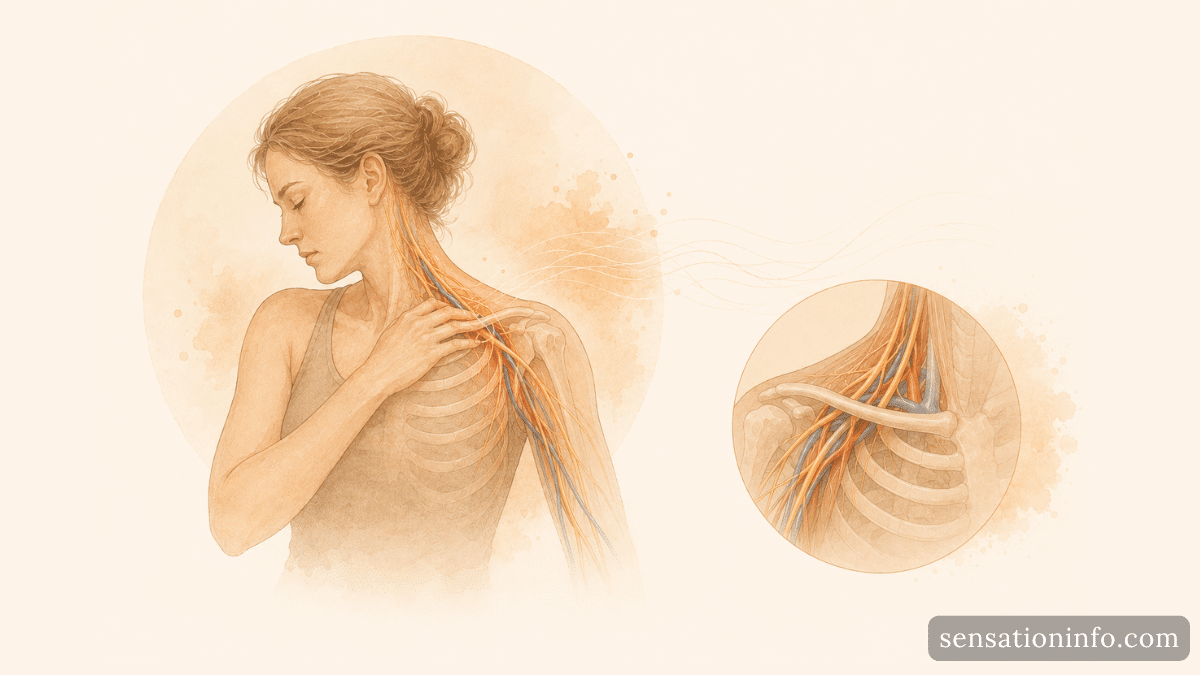

Thoracic outlet syndrome is a group of conditions caused by compression or irritation of nerves or blood vessels in the narrow space between the neck and shoulder. The affected structures may include the brachial plexus, subclavian vein, or subclavian artery.
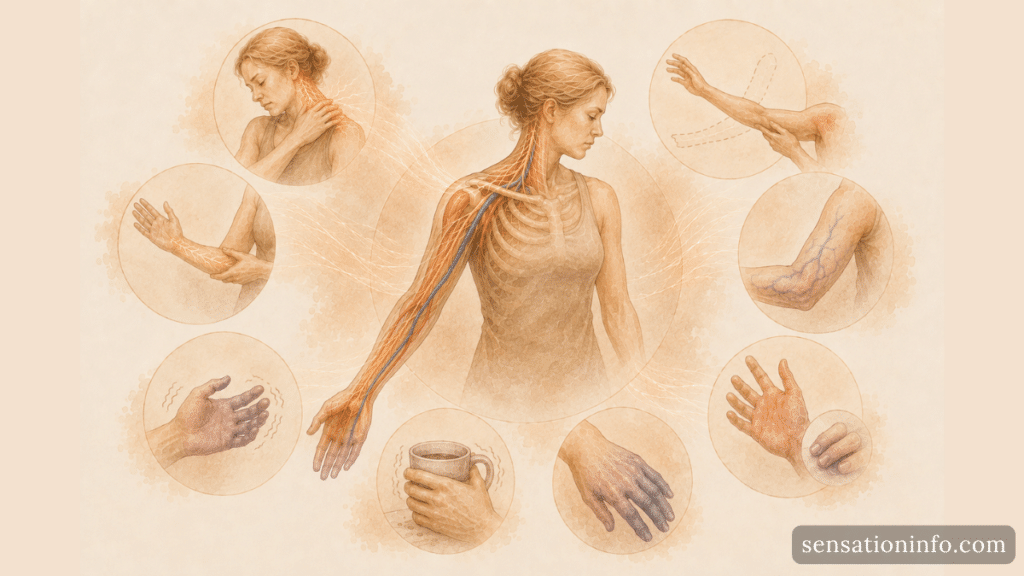
Depending on the structure involved, symptoms may include pain, numbness, tingling, weakness, arm fatigue, swelling, prominent veins, or changes in hand color and temperature.
What is thoracic outlet syndrome?
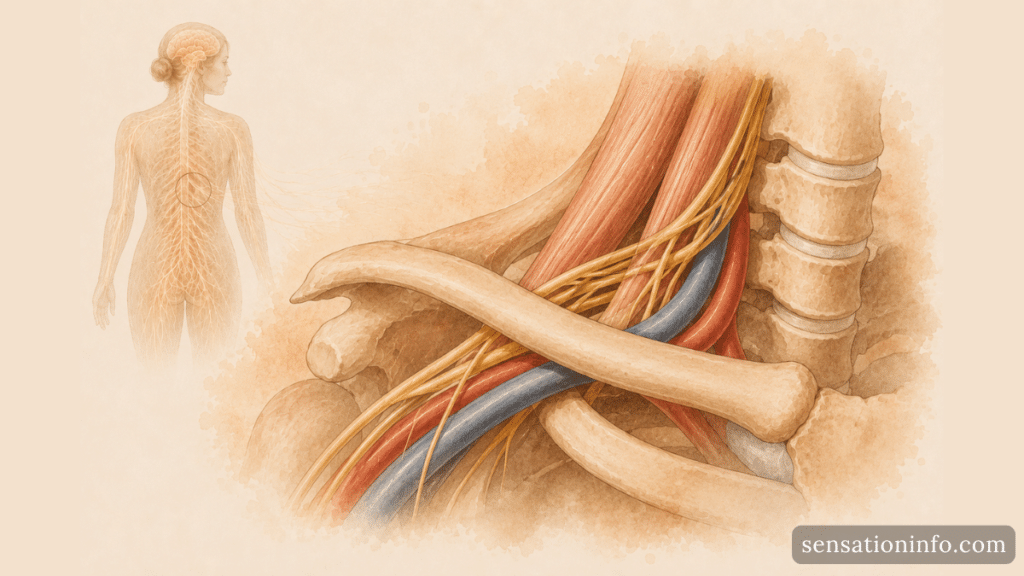
The thoracic outlet is the passage between the base of the neck and upper chest, near the collarbone and first rib. Important nerves and blood vessels travel through this area from the chest toward the arm and hand.
Three major structures pass through or near the thoracic outlet:
- The brachial plexus is a network of nerves that carries movement and sensation signals between the spinal cord and the arm and hand.
- The subclavian vein carries blood from the arm back toward the heart.
- The subclavian artery carries oxygen rich blood from the heart toward the arm.
The first rib, collarbone, scalene muscles, and connective tissue help form this passage. Symptoms develop when pressure or irritation affects the nerves or blood vessels. The pattern depends on which structure is involved.
When should you seek emergency care?
Sudden arm swelling, major skin color changes, a cold hand, a weak or absent pulse, or rapidly worsening weakness may indicate impaired blood flow or another serious condition.
Seek emergency care for:
- Sudden swelling of one arm, hand, or shoulder, especially with blue, gray, or purple skin.
- Severe arm or hand pain with sudden swelling or major color changes.
- A cold, very pale, or unusually discolored hand with a weak or absent pulse.
- Purple or black fingertips, new sores, or rapidly worsening fingertip pain.
- New or worsening hand weakness, visible muscle wasting, or loss of function.
- Chest pain, shortness of breath, fainting, or coughing blood together with sudden arm swelling.
These symptoms do not prove that thoracic outlet syndrome is the cause. They can also occur with blood clots or other serious circulation problems. Do not wait for a routine appointment when these warning signs appear.
Do not forcefully stretch your neck or arm, perform provocative self tests, or use massage instead of urgent medical assessment when vascular warning signs are present.
Three types of thoracic outlet
Thoracic outlet syndrome is classified according to whether nerves, veins, or arteries are primarily affected.
| Type | Structure affected | Typical symptoms | Main concern |
| Neurogenic | Brachial plexus nerves | Neck, shoulder, arm, or hand pain, numbness, tingling, weakness, and arm fatigue | Ongoing nerve compression or damage |
| Venous | Subclavian vein | Arm or hand swelling, heaviness, aching, discoloration, and prominent veins | Impaired venous drainage or blood clot |
| Arterial | Subclavian artery | Cold or pale hand, weak pulse, color changes, fingertip sores, or tissue injury | Reduced arterial blood flow or vessel damage |
Neurogenic thoracic outlet syndrome is the most common form. Venous and arterial forms are less common but may affect circulation and require faster medical evaluation.
What does thoracic outlet syndrome feel like?
Symptoms vary depending on the affected structure. They may become more noticeable when the arm is raised, used repeatedly, or held in a position that increases pressure around the thoracic outlet.
Nerve related symptoms
- Neck or shoulder pain
- Arm or hand pain
- Numbness
- Tingling or pins and needles
- Burning sensations
- Arm weakness
- Hand weakness
- Clumsiness
- Arm fatigue
Symptoms may travel from the neck or shoulder into the arm or hand. Some people notice symptoms near the ring and little fingers, but symptom location alone cannot confirm the diagnosis.
Long lasting nerve compression may cause visible muscle wasting in the hand. Progressive weakness or muscle loss requires prompt clinical evaluation.
For related information, see our guide to tingling in the arms.
Symptoms of venous thoracic outlet syndrome
Venous thoracic outlet syndrome may cause:
- Swelling in the arm or hand
- Heaviness
- Aching
- Tightness
- Blue, gray, or purple discoloration
- Prominent veins around the shoulder, neck, or upper chest
Sudden or marked swelling should not be monitored at home without medical advice. Compression of the subclavian vein can interfere with blood drainage and may be associated with a blood clot.
Arterial thoracic outlet syndrome
Arterial thoracic outlet syndrome may cause:
- A cold hand
- Pale or changed skin color
- Pain during arm use
- A weak or absent pulse
- Numbness or tingling
- Arm or hand weakness
- Fingertip sores
- Darkening of fingertip tissue
A cold, pale hand with a weak or absent pulse is an urgent warning sign.
What makes symptoms worse?
Symptoms may worsen with:
- Overhead activity
- Prolonged arm elevation
- Repetitive reaching
- Heavy lifting
- Sustained neck or shoulder positions
- Poor workstation positioning
- Activities that repeatedly strain the neck and shoulder
These patterns can help guide a clinical evaluation, but they do not identify the cause by themselves.
Main causes of thoracic outlet
Thoracic outlet symptoms can develop when the space around the nerves and blood vessels becomes crowded or when changes in the bones, muscles, connective tissue, or surrounding structures increase pressure.
Possible contributors include:
- Anatomical differences
- A cervical rib
- Neck, shoulder, or collarbone injuries
- Repetitive overhead activity
- Repetitive lifting
- Prolonged poor posture
- Muscle tension or structural changes
Can an extra rib cause symptoms?
An extra rib, known as a cervical rib, can change the space available for nearby nerves and blood vessels.
Having a cervical rib does not automatically mean that a person has thoracic outlet syndrome. Some people have this anatomical variation without developing symptoms.
What are the scalene muscles?
The scalene muscles are located on the sides of the neck. The anterior and middle scalene muscles form part of the muscular anatomy surrounding the thoracic outlet.
Changes in muscle size, tension, or positioning may contribute to pressure around the nerves or blood vessels. However, tight scalene muscles alone do not establish a diagnosis.
Can an injury cause thoracic outlet syndrome?
An injury involving the neck, shoulder, or collarbone can alter the muscles, bones, or connective tissue around the thoracic outlet.
Swelling or structural changes after an injury may reduce the available space around the nerves and blood vessels.
Can repetitive activity cause thoracic outlet syndrome?
Repeated overhead movements, lifting, sports, or work activities can place ongoing strain on the neck and shoulder region.
Repetitive activity does not automatically cause thoracic outlet syndrome. It is one possible contributor in people who are susceptible to compression.
Can poor posture cause or worsen symptoms?
Posture can affect pressure around the thoracic outlet. Forward head positioning, rounded shoulders, or a downward pulled shoulder position may increase strain around the nerves and blood vessels.
Poor posture alone does not prove that thoracic outlet syndrome is present.
Can stress cause symptoms?
Stress can increase muscle tension and change how a person holds the neck and shoulders. This may make existing symptoms feel worse.
Persistent numbness, weakness, swelling, color changes, or temperature changes should not be dismissed as stress. These symptoms require appropriate medical evaluation.
Who is more likely to develop symptoms?
Thoracic outlet symptoms can occur in people with or without an obvious risk factor.
Factors that may increase the likelihood include:
| Situation | Why it may matter |
| Repetitive overhead work or sport | Repeated positioning may increase pressure around the outlet |
| Previous trauma | Injury can alter muscles, bones, or connective tissue |
| Cervical rib or other anatomical difference | A changed passage may leave less room for nerves or blood vessels |
| Prolonged poor posture | Neck and shoulder position may affect pressure around the outlet |
| Repetitive lifting | Repeated strain may aggravate susceptible tissues |
People with previous neck, shoulder, or collarbone injuries and those involved in repetitive overhead work or sports may need particular attention to persistent symptoms.
Is it thoracic outlet syndrome or another condition?
Arm numbness, tingling, weakness, pain, and swelling can have many possible causes. A clinician should consider other conditions rather than relying on one symptom or one physical maneuver.
| Possible alternative | Features that may overlap | Why clinical evaluation matters |
| Cervical radiculopathy | Neck pain, arm pain, tingling, or weakness | A nerve root in the neck may be affected |
| Carpal tunnel syndrome | Hand tingling or numbness | The median nerve may be compressed at the wrist |
| Cubital tunnel syndrome | Tingling involving the ring and little fingers | The ulnar nerve may be compressed around the elbow |
| Shoulder disorders | Shoulder pain and weakness | The problem may involve the joint or tendons |
| Deep vein thrombosis | Arm swelling, pain, and discoloration | A blood clot requires prompt medical evaluation |
| Raynaud phenomenon or another circulation disorder | Finger color and temperature changes | The cause may involve blood vessel spasm or another vascular condition |
Thoracic outlet syndrome can overlap with nerve, muscle, joint, and vascular disorders. Symptom location, triggers, strength, sensation, pulses, skin findings, and test results need to be interpreted together.
For broader information about hand symptoms, see our guide to numbness in the fingers.
How is thoracic outlet syndrome treated?
Treatment depends on whether nerves, veins, arteries, or more than one structure is affected. Neurogenic symptoms often begin with nonsurgical care, while vascular symptoms may require faster specialist management.
What is the first treatment for neurogenic thoracic outlet syndrome?
Physical therapy is commonly used as an initial treatment for neurogenic thoracic outlet syndrome.
A physical therapist may address:
- Posture
- Shoulder and upper back strength
- Gentle flexibility
- Breathing mechanics
- Range of motion
- Activity modification
- Gradual return to normal activities
The program should be individualized. Exercises should not sharply increase numbness, weakness, swelling, color changes, or circulation symptoms.
What activity changes can help?
Depending on the symptoms, a healthcare professional may recommend:
- Taking regular breaks during desk work
- Reducing prolonged overhead positioning
- Adjusting workstation height
- Avoiding heavy loads that worsen symptoms
- Improving shoulder support and posture
- Modifying repetitive activities
- Returning gradually to activities that trigger symptoms
A single posture correction is not a guaranteed cure.
Are medicines or injections used?
Depending on the diagnosis, clinicians may consider pain medicines, anti inflammatory medicines, or muscle relaxants.
If a blood clot is present, treatment may include blood thinning medicines or clot dissolving treatment under specialist care.
In selected cases, injections containing a local anesthetic, steroid, or botulinum toxin may be considered. Treatment depends on the type and cause of the condition.
Do not start, stop, combine, or change medicines without guidance from your healthcare professional.
When does surgery become necessary?
Surgery may be considered when appropriate nonsurgical treatment does not provide sufficient relief, symptoms remain disabling, progressive nerve damage occurs, or vascular compression creates a significant risk.
Thoracic outlet decompression may involve removing part of the first rib or releasing a muscle that contributes to compression. Vascular cases may also require treatment of a blood clot or repair of a damaged blood vessel.
Surgery has potential risks, including nerve injury, bleeding, incomplete symptom relief, and recurrence. The decision should be made with an appropriately experienced specialist team.
What can you do at home while waiting for an evaluation?
Gentle, low risk measures may reduce aggravation while you arrange an evaluation. Home care should not delay urgent assessment when vascular or progressive neurological warning signs are present.
You can:
- Keep your neck and shoulders in a comfortable position.
- Take regular breaks from desk work, driving, lifting, or overhead activity.
- Avoid movements that reliably increase symptoms until you have been evaluated.
- Record when symptoms occur and which positions or activities trigger them.
- Note whether swelling, color changes, temperature changes, or weakness appear.
- Bring a list of medicines, supplements, previous injuries, work demands, and sports activities to your appointment.
- Use only exercises recommended by an appropriate healthcare professional or physical therapist.
Be especially cautious about stretching, massage, or heat when you have swelling, suspected clotting, severe pain, major color changes, or reduced circulation.
How long does recovery take?
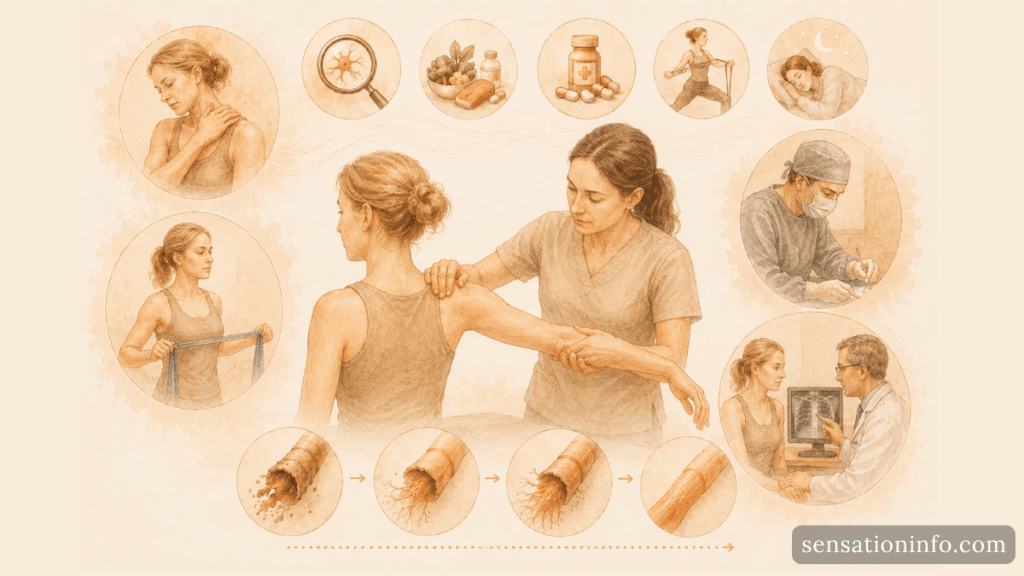
There is no single recovery timeline. Recovery depends on the type of condition, its cause, symptom duration, severity, treatment, and whether nerve or blood vessel damage has occurred.
| Stage | What to understand |
| First evaluation | The clinician identifies the symptom pattern and checks for urgent vascular or neurological findings |
| Early nonsurgical care | A structured therapy and activity plan may be used for appropriate neurogenic symptoms |
| Reassessment | Symptoms, strength, function, swelling, color, and test results guide the next treatment decision |
| Specialist treatment | Persistent disabling symptoms or vascular complications may require specialist care |
| Long term follow up | Activity progression, posture, and strength work may help reduce recurrence, but outcomes vary |
Persistent or worsening symptoms should be reassessed rather than managed indefinitely at home.
Can thoracic outlet syndrome be prevented?
Not every case can be prevented, particularly when anatomy contributes to compression.
Practical measures that may reduce strain include:
- Maintaining a comfortable neck and shoulder position
- Taking breaks from repetitive overhead activity
- Using safe lifting techniques
- Avoiding heavy shoulder bags when they worsen symptoms
- Improving workplace ergonomics
- Building strength and flexibility under appropriate guidance
- Addressing activities that repeatedly trigger symptoms
These measures may reduce aggravation but cannot guarantee prevention.
Key takeaways
- Thoracic outlet syndrome involves compression or irritation of nerves or blood vessels between the neck and shoulder.
- Neurogenic, venous, and arterial forms produce different symptom patterns.
- Sudden arm swelling, blue or purple discoloration, a cold pale hand with a weak pulse, severe fingertip changes, or progressive weakness require urgent medical attention.
- Diagnosis usually combines the medical history, physical examination, targeted imaging, and nerve or blood flow studies when appropriate.
- Physical therapy and activity changes commonly form the starting point for appropriate neurogenic symptoms.
- Vascular forms may require faster specialist assessment because blood flow can be affected.
- Surgery is reserved for selected cases and should be discussed with an experienced specialist team.
- Persistent numbness, tingling, weakness, swelling, or color changes should not be self diagnosed.
Frequently Asked Questions
Neurogenic thoracic outlet syndrome is the most common type. It occurs when nerves in the brachial plexus are compressed or irritated and can cause pain, numbness, tingling, weakness, or arm fatigue.
Poor posture can increase pressure around the thoracic outlet and may worsen symptoms in some people. Forward head positioning and drooping shoulders can affect the space around the nerves and blood vessels, but posture alone does not establish a diagnosis.
Thoracic outlet syndrome is diagnosed using a combination of medical history, physical examination, and targeted testing. Depending on the suspected type, clinicians may use X rays, ultrasound, CT, MRI, vascular studies, electromyography, or nerve conduction studies while evaluating other possible causes.
Thoracic outlet syndrome can recur after treatment in some people. Persistent or returning symptoms may require reassessment to determine whether ongoing compression, structural changes, or another condition is responsible.
Doctor’s Recommendation: Understanding Other Nerve Related Causes
Thoracic outlet syndrome is one possible cause of upper limb nerve symptoms. Numbness, tingling, burning, and weakness can also occur with other nerve disorders. Our guide to neuropathy provides broader information about nerve related symptoms and their possible causes while you arrange appropriate clinical evaluation.