

Numbness after wisdom teeth removal is normal for the first few hours, because the numbing shot usually wears off in about two hours. If your lip, chin, or tongue still feels dead the next day, the nerve that runs next to the lower wisdom teeth may have been bruised or stretched. Most of these nerve injuries heal on their own over weeks to months, but you should tell your surgeon right away so they can track it. Sudden numbness in the face with drooping, weakness, or slurred speech is different and needs a 911 call.
Why Is My Chin Still Numb After Wisdom Teeth Removal?
There are two very different reasons, and the timing tells them apart. Lingering anesthetic lasts hours. Nerve irritation lasts days or longer.
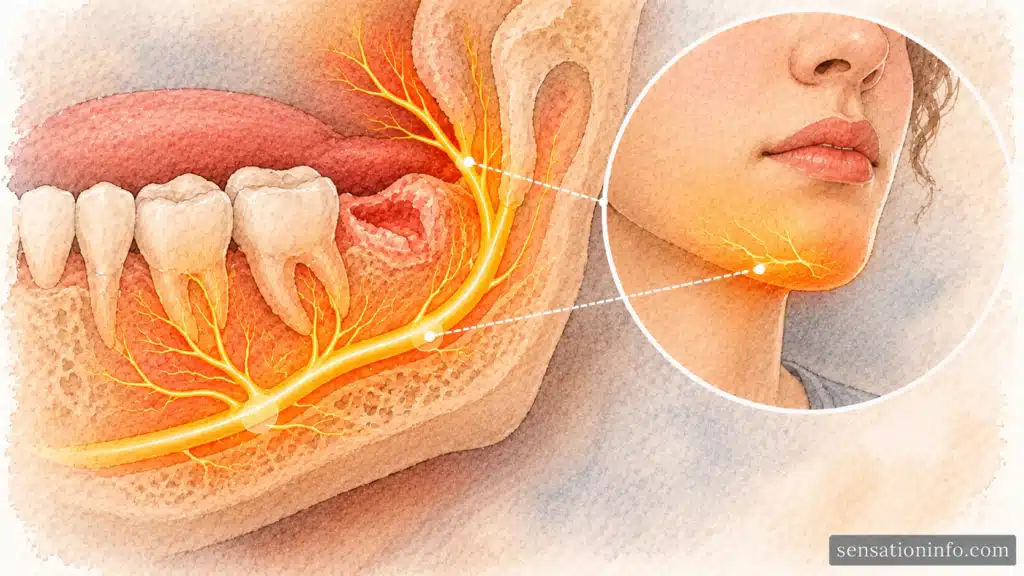
For lower wisdom teeth, the surgeon numbs a large nerve called the inferior alveolar nerve. It runs through a canal inside your jawbone, right under the roots of the lower wisdom teeth, and gives feeling to your lower lip, chin, lower teeth, and gums.
A second nerve, the lingual nerve, runs along the tongue side of the jaw. It carries feeling and taste for the front of your tongue on that side.
Because these nerves sit so close to the teeth, removing a deep or impacted tooth can bruise, squeeze, or stretch them. Rarely, the needle itself irritates the nerve.
Normal Anesthetic Numbness vs Nerve Injury
Patients often ask me, “How do I know if this is just the shot?” The comparison below is the checklist I use, and it helps you decide whether to call.
| Feature | Lingering anesthetic | Possible nerve injury |
|---|---|---|
| How long it lasts | Usually about 2 hours, fading by the evening | Still there the next morning or longer |
| How it changes | Wears off steadily, often with tingling as feeling returns | Stays the same, or comes back patchy |
| Where it is | Whole side of lip, chin, teeth, and tongue | Often one area, such as one side of the lower lip and chin |
| Other feelings | None | Pins and needles, burning, electric twinges, or altered taste |
That tingly, “fizzy” phase as the shot wears off is a good sign. It means feeling is coming back.
What Does a Numb Chin or Lip Feel Like?
Most people describe a “dead,” rubbery, or swollen feeling, even when nothing looks swollen. Some feel nothing at all on the skin, while others feel tingling, crawling, or burning.
Doctors call an abnormal but painless sensation paresthesia. When the altered feeling hurts, burns, or zaps, it is called dysesthesia.
Daily life is what bothers patients most. You may drool without noticing, bite your lip or cheek, dribble when drinking, or worry that your smile looks crooked even though the muscles work fine.
If the tongue is affected, food may taste dull on one side. Many people also find it hard to speak clearly at first, with the same patchy loss seen in numbness on the side of the tongue.
How Common Is Lasting Numbness, and Will It Go Away?
Short term nerve irritation after lower wisdom tooth removal is not rare. It happens in roughly 0.4% to 13% of extractions for the chin and lip nerve, and in up to 11% for the tongue nerve.
The good news is that most of it heals. Numbness that never fully goes away is uncommon: about 1.6% or less for the lip and chin, and about half a percent for the tongue.
Recovery depends on how badly the nerve was hurt. A bruised or stretched nerve usually recovers fully, while a cut or crushed nerve is much less likely to heal on its own.
Recovery Timeline
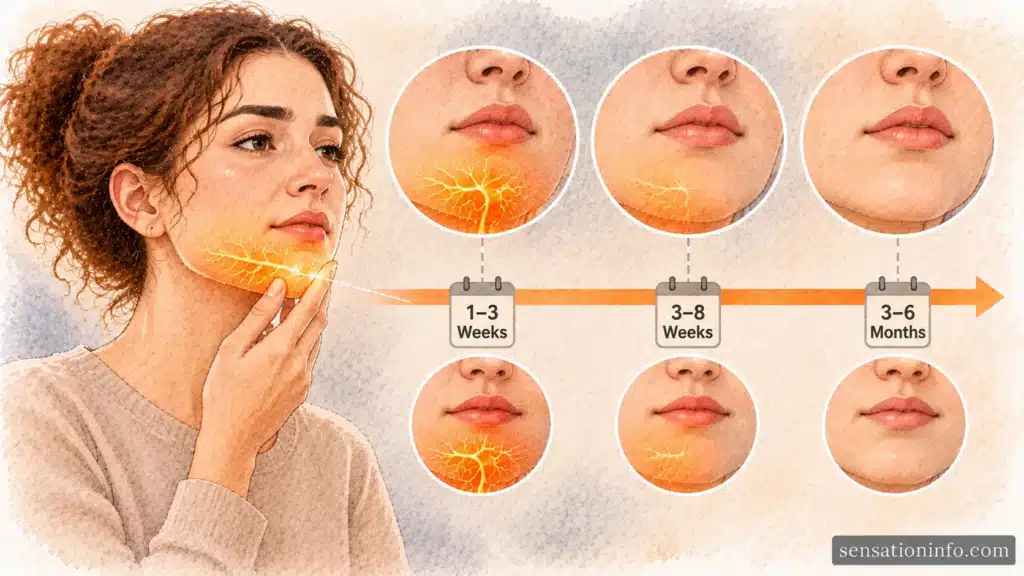
Nerves heal slowly, so the return of feeling is often gradual. Here is the rough pattern I explain to patients, so you know what each stage means.
| Time since surgery | What it usually means | What to do |
|---|---|---|
| First few hours | Normal anesthetic effect | Avoid hot drinks and chewing on that side |
| Next morning | Possible nerve irritation | Call your surgeon and report it |
| First weeks | Mild injuries often start improving, usually with tingling | Keep your follow-up visits |
| 3 months with no improvement | Spontaneous recovery is less likely | Ask for referral to a nerve injury specialist |
| Past 9 months | Repair surgery works less well | Discuss long term options |
What Else Could Make My Chin or Face Feel Numb?
After wisdom tooth surgery, the nerve is by far the most likely cause. Still, I always check for other problems, especially when the timing or pattern does not fit.
The table below sets out the patterns I see and how urgent each one is. It helps you match your own symptoms.
| Where it is | What it feels like | What comes with it | Likely cause | How urgent |
|---|---|---|---|---|
| Lip, chin, teeth on one side | Dead, rubbery | Fades within a few hours | Local anesthetic (lidocaine, articaine) | Normal |
| Lower lip and chin on one side | Numb, tingling, burning | Lasts past the next day | Inferior alveolar nerve injury | Call your surgeon |
| One side of the tongue | Numb, altered taste | Biting the tongue, slurred speech | Lingual nerve injury | Call your surgeon |
| Socket area | Ongoing pain, not numbness | Pain spreading into the face, exposed bone in the socket | Dry socket | Call your surgeon |
| Jaw and cheek | Numbness with swelling | Fever, pus, swelling worse after 3 days | Infection | Call within 24 hours |
| Face, arm, or leg on one side | Sudden numbness | Face drooping, slurred speech | Stroke | Call 911 |
If your numbness started after implant work rather than an extraction, numb chin syndrome after dental implants follows a similar nerve pattern but needs faster action, ideally within 36 hours. And if you want to work out which nerve fits your own symptoms, our nerve symptom checker can help before your follow-up visit.
When Should I Call My Surgeon or Get Emergency Care?
Most numbness is not an emergency. However, some signs need a call or urgent care, and each comes with a clear action.
- Trouble breathing or swallowing: call 911 or go to the emergency room.
- Sudden numbness with face drooping, arm weakness, or slurred speech: call 911.
- Fever above 102°F, pus, or swelling that gets worse after 3 days: call your surgeon the same day.
- Bleeding that will not stop or severe pain that pain medicine does not touch: call your surgeon the same day.
- Lip, chin, or tongue still numb the morning after surgery: call your surgeon within a day or two.
- No improvement in numbness after 3 months: ask for a referral to a nerve injury specialist.
Pain that burns or shoots through the numb area also deserves a call, because nerve pain can be treated.
What Will My Surgeon Ask, and Which Tests Will I Have?
Your description guides everything. I ask patients to bring a few details, because they show whether the nerve is healing.
Note the points below before your visit. Tracking them every week makes changes much easier to spot:
- Exactly where you feel numb, ideally marked on a photo of your face
- Whether the area is shrinking, staying the same, or spreading
- Any tingling, burning, or electric feelings
- Any change in taste on one side of the tongue
- Accidental lip or tongue biting
Your surgeon will test feeling in the area with simple tools: a light brush stroke, a gentle pinprick, a two point touch test, and warm or cold contact. Repeating these tests over time shows whether the nerve is recovering.
Good questions to ask include: “Which nerve do you think is involved?” “When will we know if it is healing?” and “At what point should I see a nerve injury specialist?”
Treatment Options
For most people, treatment is watchful waiting with regular checks. That said, some cases need more.
Early on, your surgeon may prescribe a short course of a corticosteroid to calm swelling around the nerve, although the evidence for this is weak. If the area burns or zaps, nerve pain medicines such as certain antidepressants or anti-seizure drugs, or numbing creams, can help.

If feeling has not improved after about three months, ask for a referral. Nerve repair surgery works best when done within three to six months, and results are poorer after nine months.
Meanwhile, a few habits protect you while the area is numb. These are the ones I give every patient:
- Cut food into small pieces and chew on the other side.
- Let hot drinks cool, because you cannot feel a burn.
- Check your lip in a mirror after eating for bites or crumbs.
- Use lip balm, since a numb lip dries and cracks easily.
Key Takeaways
These points sum up what matters most about numbness after wisdom teeth removal. Each one stands on its own as a quick reminder.
- Numbness after wisdom teeth removal is normal for a few hours, while the anesthetic wears off.
- Numbness that lasts into the next day suggests nerve irritation and should be reported to your surgeon.
- Most nerve related numbness improves on its own, and permanent numbness is uncommon.
- If there is no improvement after 3 months, see a nerve injury specialist, because repair works best within 3 to 6 months.
- Sudden numbness with face drooping, weakness, or slurred speech needs a 911 call.
Frequently Asked Questions
Rarely, the needle used for the numbing shot can irritate the nerve and cause numbness that lasts beyond the usual few hours. Most people with this kind of injection related numbness recover on their own, and between 85% and 94% regain normal feeling.
Tingling or a fizzy feeling in the chin or lip as numbness fades is usually a good sign that feeling is returning. Tingling that lasts for days or comes with burning or electric twinges should be reported to the surgeon who removed the tooth.
Nerve injury after wisdom teeth removal is more likely when the anatomy around the tooth is complicated, such as roots lying close to the nerve, or when the area has had surgery before. A surgeon can assess this risk on imaging before surgery and discuss ways to lower it.
Doctor’s Recommendation
Your oral surgeon or dentist is the first person to call about numbness that lasts past the day of surgery. If feeling has not improved by about three months, ask for a referral to an oral and maxillofacial surgeon who treats nerve injuries, and see your primary care doctor for any numbness outside the mouth area. If the numb area turns painful or burning, our list of pain management doctors for nerve pain can help you find a specialist for long lasting nerve pain.
References
- Cleveland Clinic. How Long Does Novocaine Last? Cleveland Clinic Health Essentials. 2023.
- Cleveland Clinic. Wisdom Teeth Removal. Cleveland Clinic. Accessed 2026.
- Cleveland Clinic. Impacted Wisdom Teeth: Symptoms, Signs, Removal and Recovery. Cleveland Clinic. Accessed 2026.
- StatPearls. Inferior Alveolar Nerve and Lingual Nerve Injury. StatPearls Publishing. 2023.
- Nguyen JD, Duong H. Anatomy, Head and Neck: Alveolar Nerve. StatPearls, NCBI Bookshelf, National Library of Medicine. 2023.