

I’ve been helping people understand weird body sensations for years, and let me tell me—nothing gets my attention quite like someone describing a burning feeling in their leg. It’s one of those symptoms that sounds simple but can actually point to a range of issues, from something minor you can shake off to something that needs real medical attention. In this article, I’m going to walk you through everything you need to know about that burning sensation running from your knee to your ankle, what might be causing it, and what you can actually do about it.
What Does a Burning Sensation in Your Leg Actually Mean
When people describe a burning sensation in their legs, they’re usually talking about a feeling that ranges from mild warmth to an intense heat that makes them want to dunk their leg in ice water. The sensation can be constant, come and go, or flare up specifically after certain activities like walking or sitting for long periods.
Here’s the thing your legs contain an impressive network of nerves, blood vessels, and muscles, all packed into a relatively small space. When any of these components get irritated, compressed, or damaged, you might feel that distinctive burning. The location matters too: burning above the knee often points to different causes than burning below it, and feeling it specifically around the ankle suggests yet another set of possibilities.
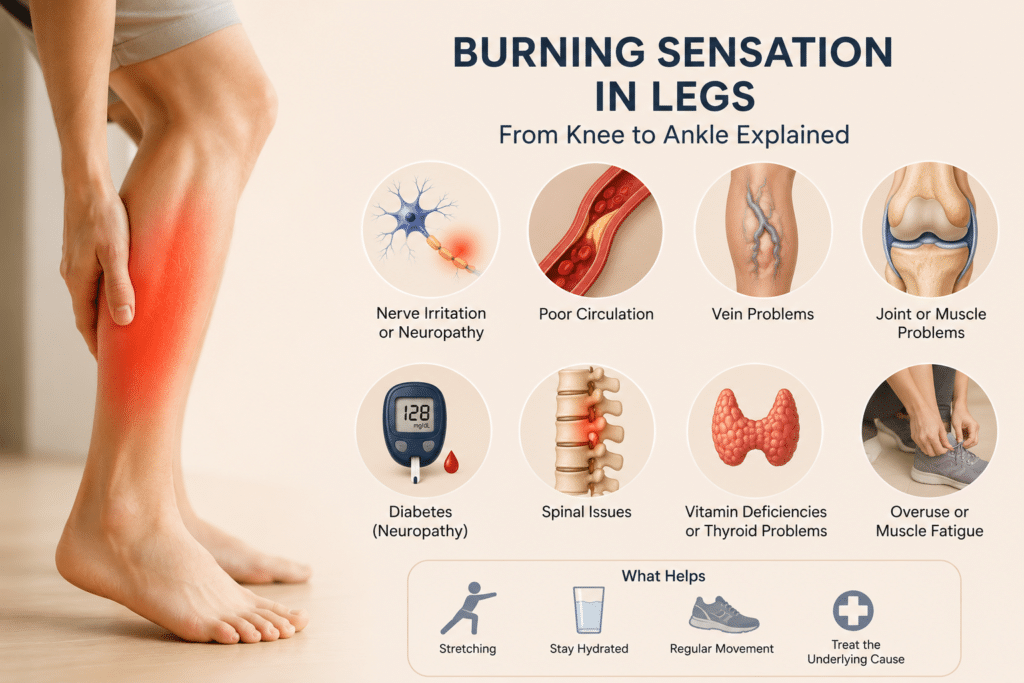
Common Causes of Burning Leg Sensation
After years of researching this and talking to patients, I’ve found that burning legs typically stem from a handful of common causes. Let me break them down in a way that actually makes sense.
Nerve Compression and Neuropathy
Nerve problems are probably the biggest culprit I see. Your sciatic nerve runs from your lower back down through your leg, and when it gets compressed—often from a herniated disc or muscle tightness—you can feel burning that radiates down the back of your leg. Peripheral neuropathy, where the nerves in your extremities get damaged, also commonly causes burning sensations, especially in people with diabetes. In diabetic neuropathy, that burning typically starts in the feet and can work its way up toward the knee.
Carbuncular tunnels in your leg can also compress nerves. The tarsal tunnel, for instance, runs near your ankle, and when the tibial nerve gets squeezed there, you might feel burning in your foot and lower leg. Think of it like a garden hose getting pinched—the pressure interrupts normal flow, and something’s going to complain.
Circulation Issues
Your blood vessels matter just as much as your nerves when it comes to feeling things. Peripheral artery disease, where plaque builds up in the arteries of your legs, can cause burning pain that typically gets worse when you’re walking and better when you rest. This happens because your muscles aren’t getting enough oxygen-rich blood, and the buildup of metabolic waste creates that burning sensation.
Varicose veins and chronic venous insufficiency can also cause a burning feeling, usually around the ankles and calves. The veins aren’t efficiently returning blood to your heart, which leads to pooling and pressure that your nerves interpret as heat or burning.
Musculoskeletal Causes
Muscle strain and overuse commonly produce burning sensations. If you’ve ever done an intense workout and felt your calves or thighs burning afterward, that’s lactic acid and metabolic byproducts irritating your muscles. The difference is this usually goes away with rest.
Iliotibial band syndrome causes a distinctive burning on the outside of the knee and thigh, especially in runners and cyclists. The IT band gets tight and rubs against the bone, creating inflammation and that characteristic hot, stinging feeling.
Other Medical Conditions
Restless leg syndrome sometimes includes burning or crawling sensations that are worse at rest. Vitamin deficiencies, particularly B12 and B6, can cause nerve-related burning. Some autoimmune conditions and even certain medications can trigger similar symptoms.
Specific Areas: Knee to Ankle
Let me be more specific about where you’re feeling this, because location tells us a lot.
Burning right at the knee often involves the patellar tendon or surrounding structures. Runners and jumpers frequently deal with this. Just above the knee might involve your quadriceps muscle or issues with your femur. Burning behind the knee usually connects to hamstring issues or popliteal artery problems.
For the lower leg, burning in your calf frequently ties to circulation or muscle issues. Shin splints cause burning along the front of your shin bone. Burning around your ankle could be Achilles tendon problems, tarsal tunnel syndrome, or ankle sprain aftermath.
When to Take This Seriously
I’m not trying to scare anyone, but there are times when burning legs need prompt attention. If your burning is severe and sudden, especially if it comes with weakness or numbness, that could indicate something urgent. If the burning is accompanied by swelling, redness, or skin changes, get it checked out. Any open wounds or sores that won’t heal need immediate care.
If you’ve tried basic rest and ice for a week or two and nothing’s improved, that’s your signal to see a healthcare provider. Also, if you have existing conditions like diabetes, heart disease, or a history of blood clots, don’t mess around with leg symptoms get evaluated.
Treatment Options That Actually Work
Here’s where it gets practical. Treatment depends entirely on what’s causing your burning, but I’ve seen good results across several approaches.
For nerve-related burning, medications like gabapentin, pregabalin, or certain antidepressants often help. These don’t fix the underlying problem but can quiet down the overactive nerves. Physical therapy works wonders for many people, especially when nerve compression involves muscle tightness or posture issues.
Circulation problems respond well to regular exercise—walking is literally one of the best things you can do. Compression socks help with venous issues. For more severe peripheral artery disease, medications or procedures to open blood vessels might be necessary.
If it’s a musculoskeletal cause, rest, ice, and over-the-counter anti-inflammatories usually do the trick. Proper footwear and gradual activity progression prevent recurrence. Sometimes a podiatrist or sports medicine specialist can help with custom orthotics.
Lifestyle matters too. Managing your blood sugar if you’re diabetic, maintaining healthy vitamin levels, staying hydrated, and avoiding prolonged sitting all contribute to healthier legs.

What You Can Do Right Now
Before you even see a doctor, there are things that help. Stretch regularly, especially your hamstrings, calves, and hip flexors. Elevate your legs when you’ve been standing or sitting for a while. Switch up your position frequently if you’re desk-bound.
Check your shoes—bad footwear creates problems all the way up your legs. Make sure you’re getting enough B vitamins through food or supplements. Stay hydrated; muscle cramping and nerve irritability increase when you’re dehydrated.
If it’s mild and occasional, these self-care measures might be all you need. But track your symptoms—if they’re getting worse or changing, write that down to share with your doctor.
Wrapping It Up
Burning sensation in your legs from knee to ankle is one of those symptoms that definitely deserves attention. It might be something simple that’s easy to fix, or it might be your body’s way of flagging something that needs proper treatment. I’ve watched plenty of people ignore this kind of thing only to deal with bigger problems later.
Pay attention to what makes it better or worse, note when it happens, and don’t hesitate to get professional help if it’s persistent or affecting your daily life. Your legs carry you through everything—taking care of them is just good sense.
Frequently Asked Questions
Common causes include peripheral neuropathy, poor circulation, sciatica, diabetes, venous insufficiency, and muscle overuse.
Yes. Peripheral artery disease and venous insufficiency commonly trigger burning sensations, especially during walking or prolonged standing.
Burning that worsens at night often points toward nerve-related conditions like neuropathy or restless leg syndrome.
Yes. Sciatica commonly sends burning, tingling, or electric sensations down the leg into the calf and foot.
Seek medical attention if symptoms become persistent, severe, one-sided, associated with weakness, swelling, skin discoloration, or walking difficulty.
Final Thoughts
A burning sensation in the lower legs can feel confusing because it sits right between muscle discomfort, nerve irritation, and circulation problems.
Sometimes the explanation is simple, like overworked muscles or poor posture. Other times, your nerves or blood vessels are trying to warn you about something deeper.
The key is paying attention to patterns instead of brushing symptoms aside for months.
And honestly, if your calves consistently feel like they secretly swallowed heating elements, your body is probably asking for a closer look.